
Over 70% of TikTok users decide whether to stay or scroll within the first 3 seconds of a video. That is the entire window you get.
The bar keeps rising. The often-cited 8-second average attention span has been debunked by the BBC, Fast Company, and multiple researchers who traced it to fabricated data, but the direction is clear 68% of users aged 13 to 25 say social media has shortened their ability to focus. On TikTok specifically, the completion rate threshold for viral distribution has climbed to roughly 70%, up from around 50% in 2024. Your hooks need to work harder than they did a year ago.
This guide covers why hooks work (the psychology), how to write them (a repeatable process), the channels they operate through, platform-specific tactics, and ready-to-use templates you can adapt today. The concept tying it all together is pattern interrupt, the mechanism that forces your audience to stop scrolling.
What is a social media hook?
A social media hook is the first element of your content, whether that is text, visual, or audio, designed to interrupt the scroll and give viewers a reason to keep watching or reading. TikTok’s Creative Center recommends treating the first two seconds as the make-or-break moment for ad recall and awareness.
Every hook works through the same underlying mechanism, called pattern interrupt. Your brain runs on autopilot while scrolling. It filters out anything that matches the expected pattern of content it has already seen. A hook forces the brain to break that autopilot loop and shift to conscious attention. This is the neuroscience-level explanation for why hooks work at all, and every specific hook type in this guide is a variation of it.
A good hook shares three qualities. First, immediacy: it has to land in under 3 seconds. Second, truthfulness, because a hook that promises something the content never delivers burns trust and tanks your retention on future posts. And third, specificity, because generic hooks get ignored while specific ones stop thumbs.
Hooks also operate through distinct modalities, and most guides only cover one of them. Text, visual, and audio each work differently, fire at different speeds, and matter more or less depending on the platform you are posting to.
Modality | What it is | Example |
Text | Captions, first lines, text overlays | "Nobody talks about this..." |
Visual | Movement, transitions, unexpected imagery | Jump cut, zoom-in on product |
Audio | Trending sounds, voiceover tone, sound effects | Whisper opening, viral sound |
The psychology behind social media hooks
According to a TTS Vibes analysis, 84.3% of viral TikTok videos used psychological hook triggers within their first 3 seconds. Understanding the mechanisms behind that number lets you build hooks with intention instead of guessing.
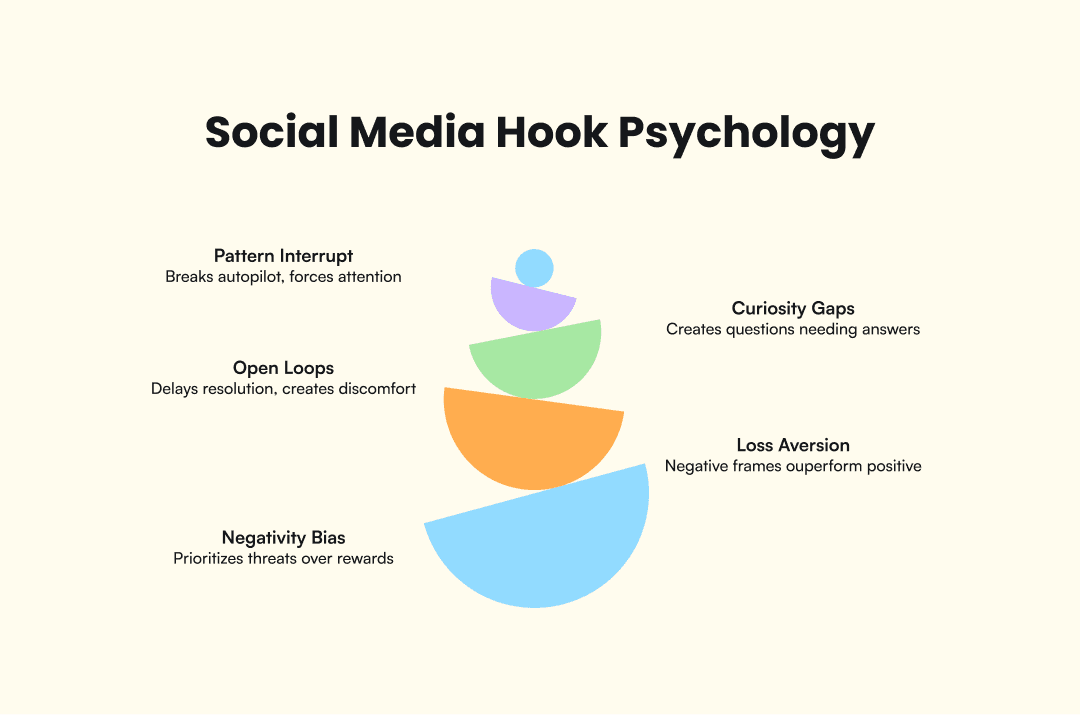
Pattern interrupt
Your brain processes the social media feed on autopilot, skipping anything that matches the expected rhythm of content it has seen dozens of times. A pattern interrupt breaks this autopilot loop and forces conscious attention.
Every hook type in this guide, from curiosity to controversy, is a form of pattern interrupt. "Stop reading if you already know this" works because it challenges the brain’s prediction of what comes next. A jump cut in the first frame works for the same reason. Pattern interrupt is the umbrella concept; everything else sits under it.
Curiosity gaps and open loops
A curiosity gap creates a question your brain needs answered. "The one mistake killing your engagement" works because you cannot help wondering what the mistake is.
An open loop does something related but different. It starts a story and delays the resolution. "I lost 10K followers before I figured this out…" leaves the narrative incomplete, and your brain cannot let that go. Psychologists call this the Zeigarnik effect. Both mechanisms exploit your brain’s discomfort with incomplete information, and they pair well together.
Loss aversion and negativity bias
People feel losses roughly twice as strongly as equivalent gains. That is loss aversion, and it explains why negative-frame hooks consistently outperform positive ones. Negativity bias compounds the effect because your brain gives priority to threats over rewards.
Positive frame | Negative frame |
"5 ways to grow your following" | "5 mistakes killing your follower growth" |
The negative version pulls harder because it activates both mechanisms at once, which is why "what to avoid" beats "what to do" in most A/B tests.
Social proof and the bandwagon effect
When a hook signals "everyone is doing this," it triggers the bandwagon effect. Social proof adds credibility on top of that. "Why 50K creators switched to this method" works because the number validates the claim before the viewer even hears the method. Platform algorithms feed the cycle: high-engagement content gets more distribution, which generates more social proof, which drives more engagement.
The 3 hook modalities: text, visual, and audio
Most hook advice focuses on text, meaning captions and first lines. But on TikTok, Reels, and Shorts, the visual and audio hooks fire before the viewer reads any text at all. Understanding all three modalities means you can pick the right tool for the right platform.
Text hooks
Text hooks are the most universal format. They include first-line formulas like "Nobody talks about…", "Here’s why…", and "The truth about…" as well as text overlays on video (keep them under 8 words, high contrast, center frame) and caption hooks on static posts, where a question opener or bold statement pulls readers past the fold. Text overlays on video pull double duty because they work as both text hooks and visual hooks at the same time.
Visual hooks
Jump cuts or snap zooms in the opening frame grab the eye before anything else registers. Before/after reveals work because the viewer wants to see the full transformation. Starting face-to-camera mid-action, without any lead-in or setup, breaks the scroll pattern by skipping the predictable intro sequence the brain has already learned to tune out. Unexpected props or settings that contrast with the visual norm of the feed accomplish the same thing. Visual hooks matter most on TikTok, where a significant share of users browse with sound off.
Audio hooks
Trending sounds ride algorithm momentum because the audio itself is already getting distribution. Voiceover contrast, like starting with a whisper or a shout or dropping in mid-sentence, interrupts the expected audio pattern of the feed. Sound effects such as a snap, a ding, or a record scratch work as raw attention triggers. Music shifts or beat drops timed to the opening visual combine two modalities at once. Audio hooks dominate on TikTok and Instagram Reels but are less relevant on LinkedIn and Facebook, where text leads.
Modality | Best for | Key techniques | Platform priority |
Text | LinkedIn, Facebook, captions | First-line hooks, text overlays, question openers | LinkedIn #1, all platforms for captions |
Visual | TikTok, Reels, Shorts | Jump cuts, zoom-ins, unexpected visuals | TikTok #1, Instagram Reels |
Audio | TikTok, Reels | Trending sounds, whisper/shout contrast, voiceover shifts | TikTok #1, Instagram Reels |
7 types of social media hooks (with examples)
Each hook type below maps to a psychological mechanism from the previous section. The table shows how they connect, with examples across modality and platform.
Hook type | Psychology behind it | Text example | Best modality | Best platform |
Curiosity | Curiosity gap | "Nobody talks about this..." | Text, Visual | All |
Story | Open loop | "I was about to give up when..." | Text, Audio | TikTok, LinkedIn |
Problem/Pain | Loss aversion | "Stop wasting money on..." | Text | All |
Controversial | Pattern interrupt | "Unpopular opinion: hashtags are dead" | Text | LinkedIn, X |
List/Number | Specificity bias | "5 things I wish I knew..." | Text | All |
Value/Benefit | Reward anticipation | "The free tool that replaced my..." | Text, Visual | All |
Question | Curiosity gap | "Why does nobody talk about this?" | Text, Audio | All |
Curiosity hooks work across every platform because the curiosity gap is universal. Pair them with an open loop for stronger pull. Story hooks perform best when the open loop is personal and specific, because "I lost $10K on ads before I learned this" hits much harder than a generic "Here’s my story."
Problem and pain point hooks tap directly into loss aversion and tend to outperform benefit hooks in A/B tests because negative framing gets priority attention from the brain. Controversial hooks are pattern interrupts in their purest form. They thrive on LinkedIn and X but backfire if the take is not genuinely held.
List and number hooks lower the commitment barrier by telling the brain exactly what to expect. "5 things" signals a defined scope, which reduces the perceived effort of watching. Value and benefit hooks promise a concrete reward upfront and work best when that reward is specific ("saved me 4 hours a week" rather than "changed my life"). Question hooks are a variant of curiosity hooks, phrased as a direct question to pull the reader into answering it mentally before they scroll past.
How to write a social media hook (step by step)
You do not need to guess at hooks. Follow this five-step process to build them with intention.
Start by identifying your content’s core value. What will the viewer gain? If you cannot state it in one sentence, the content is not focused enough to hook anyone.
Next, choose the hook type that matches what you are doing. A curiosity or list hook fits when you are teaching something, a story hook when you are sharing an experience, and a problem hook when you are calling out a common mistake.
Then pick the modality that fits the platform. LinkedIn needs text hooks. TikTok and Reels need visual and audio hooks working together. The best-performing videos on short-form platforms tend to combine all three modalities at once.
Adapt everything for the platform, because a hook that works on TikTok may fall flat on LinkedIn. Tone, length, and format norms differ by platform, and the same message often needs a different entry point depending on where you are posting it.
Finally, test and iterate, because hooks are hypotheses, not certainties. Run the same content with different hooks and let retention data tell you which one wins.
Hook-Value-Action
A hook alone is not enough. If the hook grabs attention but the content falls flat, you lose the viewer anyway. Structure every piece of social content in three parts.
The Hook stops the scroll in the first 1 to 3 seconds. Value delivers on whatever the hook promised, because a bait-and-switch kills retention faster than a weak hook does. The Action tells the viewer what to do next (the CTA). Skip any of these and the post underperforms.
Platform | Dominant modality | Hook culture | Hook length | Key stat |
TikTok | Visual + Audio | Bold, fast, clickbait-tolerant | 1-3 seconds | 70%+ decide in first 3 sec |
Visual + Text | Polished, aspirational | 1-3 sec (Reels), first line (captions) | Carousels: 3x engagement | |
Text | Professional, no clickbait | First 2 lines (before fold) | — | |
YouTube | Visual + Audio | Thumbnail + title = hook | First 5-10 seconds | — |
Text | Community, longer narrative | First 2-3 lines | — |
Worked example for a post on writing better Instagram captions. Hook (curiosity + text): "The first line of your caption is the only line that matters." Value: Explain why Instagram truncates after one line, share three first-line formulas. Action: "Save this post and try one tomorrow."
Social media hooks by platform
Each platform has different audience behavior, dominant modalities, and algorithm signals. Here is what matters on each.
TikTok hooks
Over 70% of TikTok users decide to stay or scroll within 3 seconds, and the completion rate threshold for viral distribution sits at roughly 70%. Visual and audio hooks dominate here, with text overlays playing a supporting role rather than leading. Face-to-camera snaps and mid-sentence starts create instant pattern interrupts, and the combination of a trending sound with a text overlay remains one of the most reliable hook pairings on the platform.
Instagram hooks
Instagram runs multiple formats, each with different hook dynamics. Reels follow the same rules as TikTok, with visual and audio hooks coming first. Carousels are a different game entirely because the first slide IS the hook, and carousels get 3.1x more engagement on average, making that first slide one of the highest-leverage design decisions on the platform. Stories use polls, questions, and stickers as interactive hooks that pull participation rather than passive viewing. For static posts, the first caption line before the "...more" fold is your only shot.
LinkedIn hooks
LinkedIn is text-first with zero clickbait tolerance. The "see more" fold after the first two lines is the hook boundary, so everything has to land in that space. Credibility hooks work best here: data points, authority signals, and contrarian professional takes. Story hooks with business context also land well. "I fired our agency and here’s what happened" is a strong opener because it combines a story hook with a controversial take. No visual pattern interrupts needed because the hook is pure text.
YouTube hooks
YouTube has a dual hook system. The thumbnail and title work together as the pre-click hook, and then the first 5 to 10 seconds of the video serve as the retention hook. Shorts follow TikTok rules: fast, visual, front-loaded. Long-form content needs a verbal hook, a visual hook, and a value promise all within the first 10 seconds.
Facebook hooks
Facebook’s audience tolerates longer, narrative-style hooks than any other platform. Two- to three-sentence hooks work here, and emotional storytelling consistently outperforms clickbait. Community and relatability drive engagement more than novelty does. In Facebook Groups, trust is pre-established, so hooks can be more direct and skip the credibility-building that other platforms require.
Social media hook templates
Below are hook templates organized by type. Each one is fill-in-the-blank, tagged with platform fit and modality. Pick one, fill in your topic, and test it.
Curiosity hook templates
Template | Best platforms | Modality |
"Nobody talks about [topic] and it's costing you [outcome]" | All | Text |
"I found [discovery] and it changed how I [action]" | TikTok, LinkedIn | Text, Audio |
"The real reason [common belief] doesn't work" | All | Text |
"What happens when you [unexpected action] for [time period]" | TikTok, Reels | Text, Visual |
Story hook templates
Template | Best platforms | Modality |
"I [failed/lost/struggled] before I figured out [lesson]" | TikTok, LinkedIn | Text, Audio |
"A year ago I was [old situation]. Now I [new result]" | All | Text |
"I almost [mistake] until [turning point]" | TikTok, Reels | Text, Audio |
"Here's what [time period] of [activity] taught me" | All | Text |
Problem/Pain hook templates
Template | Best platforms | Modality |
"Stop [common mistake] if you want [desired outcome]" | All | Text |
"You're losing [something valuable] because of [cause]" | All | Text |
"The #1 mistake [audience] make with [topic]" | All | Text |
"[Common practice] is killing your [desired result]" | TikTok, All | Text, Audio |
Controversial hook templates
Template | Best platforms | Modality |
"Unpopular opinion: [bold claim]" | LinkedIn, X | Text |
"[Common advice] is bad advice. Here's why" | All | Text |
"I stopped [popular practice] and my [metric] improved" | LinkedIn, TikTok | Text |
"[Trending tactic] doesn't work anymore" | All | Text, Audio |
List/Number hook templates
Template | Best platforms | Modality |
"[Number] things I wish I knew about [topic] sooner" | All | Text |
"[Number] [topic] mistakes costing you [outcome]" | All | Text |
"I tested [number] [things] and only [number] worked" | TikTok, LinkedIn | Text, Audio |
"[Number] [timeframe] tips from [number] years of [activity]" | All | Text |
Value/Benefit hook templates
Template | Best platforms | Modality |
"The free [tool/method] that replaced my [expensive alternative]" | All | Text, Visual |
"How to [desired result] without [common pain point]" | All | Text |
"This [approach] got me [specific result] in [timeframe]" | TikTok, LinkedIn | Text, Audio |
Question hook templates
Template | Best platforms | Modality |
"Why does nobody talk about [overlooked topic]?" | All | Text, Audio |
"What would you do if [scenario]?" | Instagram, TikTok | Text |
"Is [common belief] actually true?" | All | Text |
"What's the one [topic] hack you swear by?" | Instagram, TikTok | Text |
Putting it together
Every metric you care about on social media, whether that is retention, shares, conversions, or follower growth, sits behind one gate: whether the viewer stops scrolling in the first place.
The mistake most people make is treating hooks as decoration. They write the content first and slap a catchy line on top afterward. Reverse the order and start with the hook, because the hook is not separate from the content. It is the content’s promise, and everything after it either delivers or breaks that promise.
Pick one hook type from this guide, test it across two or three platforms, and track retention data to see what lands. Then try another type, stack what works, drop what does not, and you will build an instinct for what stops a thumb in your specific niche faster than any formula can teach you.