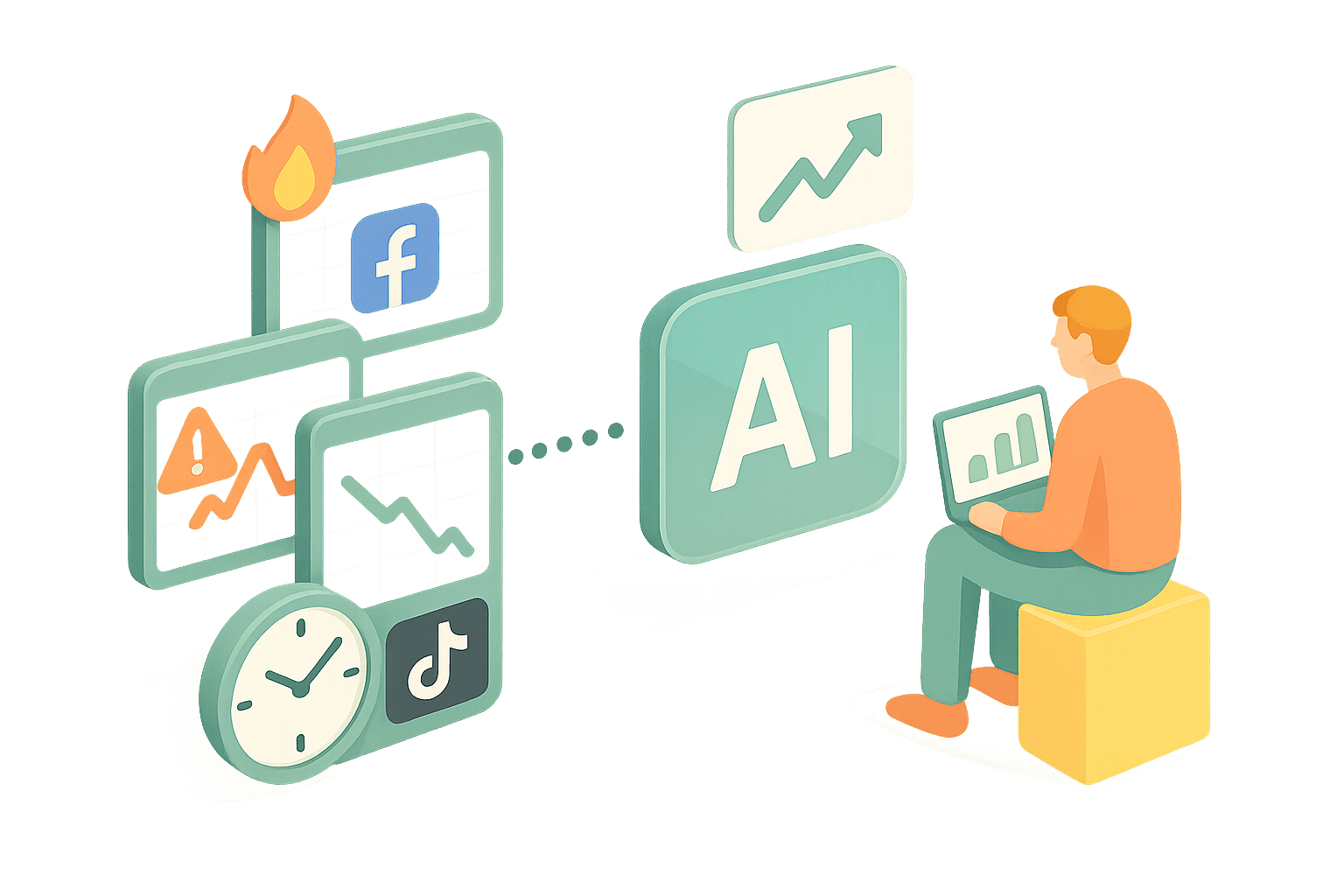
Every ad platform, SaaS product, and marketing tool now claims to have an AI agent built in. The word appears on pricing pages, in product changelogs, and across keynote slides at every conference this year. But ask five marketers what an AI agent does, and you will get five different answers, most of them wrong.
The confusion is not surprising. "AI agent" has become a catch-all label applied to everything from auto-responders to fully autonomous campaign management systems. For people managing ad spend and creative production, the difference between those two extremes is the difference between a chatbot that answers questions and a system that monitors your campaigns, identifies problems, and fixes them while you sleep.
This article breaks down what AI agents are, how they work under the hood, and when they make sense for practitioners who run campaigns. It also covers what agents cannot do yet and when simpler tools are the better choice. PwC found that 79% of organizations have adopted AI agents in some form, but McKinsey's data from a separate survey of nearly 2,000 respondents puts the number scaling agents in production at just 23%.
Key Takeaways
An AI agent is an autonomous, goal-oriented software system that uses a large language model to perceive its environment, reason through options, take actions with external tools, and learn from results. Five traits separate agents from other AI software: autonomy, goal-orientation, tool use, memory, and learning.
Every AI agent runs on the same core loop: perceive (gather data from the environment), reason (evaluate options against a goal), act (execute decisions through external tools), and learn (refine the approach based on what happened).
Chatbots respond to single prompts and wait for the next question. AI assistants add tool access but still wait for instructions. AI agents pursue goals across multiple steps, act on their own initiative, and adapt based on outcomes.
The standard taxonomy (Russell and Norvig) breaks agents into five types ordered by sophistication: simple reflex, model-based, goal-based, utility-based, and learning. Each type adds a layer, from fixed rules with no memory to feedback-driven self-improvement.
The LLM in an agent functions as a brain; tool integrations function as hands. Most AI products today are just the brain answering questions in a chat window. An agent thinks and then acts on what it found.
Agent washing is the practice of labeling a product as an AI agent when it is a chatbot with a new wrapper or rules-based automation with an LLM attached. The basic test: does the product handle autonomous, multi-step execution?
Agents still fall short on ambiguous judgment calls, original creative taste, compliance-heavy processes, and emotional intelligence. Human-in-the-loop deployment is the industry standard, not a limitation of the technology.
If a workflow is predictable, repeatable, and rarely changes, rules-based automation handles it faster, cheaper, and with fewer failure points than an agent. Agents fit when the task requires multi-step execution across tools, adaptation to changing inputs, and improvement over time.
What is an AI agent?
An AI agent is an autonomous, goal-oriented software system that uses a large language model to perceive its environment, reason through options, take actions using external tools, and learn from the results of those actions.
That single definition carries the five characteristics that separate agents from every other kind of AI software: autonomy, goal-orientation, tool use, memory, and learning.
Autonomy means the agent operates without a human instruction at every step. You give it a goal, and it figures out the path. Goal-orientation means it works toward a defined outcome across multiple interactions, not just one prompt at a time. Tool use means it connects to APIs, databases, ad platforms, and other external systems to do real work, not just generate text in a chat window. Memory means the agent retains context across interactions rather than starting from scratch each time. Learning means it adjusts its approach based on feedback, improving with each cycle rather than repeating the same process regardless of results.
A chatbot waits for your question about ad performance and gives you a summary. An agent monitoring your ad account notices that a creative’s click-through rate dropped 40% over three days, identifies the pattern as creative fatigue, and begins generating replacement variants before you open the dashboard. You did not ask it to. It identified the problem and acted.
Traditional software follows fixed rules: if condition X, then action Y, and when conditions change, it either breaks or ignores the shift. An agent reads the new conditions, re-evaluates its options, and picks a different path. That proactive behavior, where the system anticipates needs rather than waiting for prompts, is what gives agents their name.
One terminology note: “agentic AI” and “AI agent” overlap but mean different things. MIT Sloan draws a useful distinction. An AI agent is a single system. Agentic AI refers to the broader approach of building autonomous AI systems, which can include multiple agents collaborating as a team.
How AI agents work
Every AI agent follows the same core loop, regardless of what it is built to do. The industry uses several names for this process (perceive-reason-act, observe-think-act, sense-plan-act-reflect), but the steps are consistent.
Perceive. The agent gathers information from its environment. For a marketing agent, that might mean pulling real-time performance data from Meta Ads, reading product reviews from a Shopify store, or scanning competitor ad libraries. It builds a context-aware picture of what is happening right now, drawing on both current inputs and past interactions.
Reason. Using a foundation model (typically a large language model like GPT, Claude, or Gemini) as its reasoning engine, the agent evaluates inputs against its goal. What options are available, what has worked before, what is most likely to produce the desired outcome. Some agents use a formal reasoning framework called ReAct, which alternates between reasoning steps and action steps to keep the agent grounded in observable results rather than running on assumptions.
Act. The agent executes a decision by calling external tools. It might pause an underperforming ad set through the Meta API, generate three new video ad variants, adjust a daily budget cap, or send a Slack notification to a media buyer. Without tool access, an LLM can only talk. With tool access, it can do.
Learn. After acting, the agent observes what happened. Did the new creative outperform the old one? Did the budget shift improve ROAS? The results feed back into the next cycle, and the agent refines its internal model of what works. Each loop adds context that makes the next decision better informed. That iterative refinement is what separates agents from static software.
A useful analogy: the LLM is a brain, and the tool integrations are hands. Most AI products you interact with today are just the brain, answering questions in a chat window. An agent is a brain with hands. It thinks and then does something about it.
The speed of this loop varies. Some agents complete a full cycle in seconds, pausing an ad and checking results within a minute. Others run on longer timescales, analyzing weekly campaign data and proposing strategic shifts every Monday morning.
Types of AI agents
The most widely cited taxonomy comes from AI research (Russell and Norvig) and breaks agents into five categories, ordered from simplest to most sophisticated. You might see references to “7 types” in search results; those typically add sub-variants, but the five-type model is the standard framework.
Simple reflex agents
Simple reflex agents follow pre-set rules with no memory of past interactions. If a customer asks “where’s my order?” the agent checks the tracking system and responds with a status update. It handles one input, produces one output, and moves on. Most automated email responders and basic customer support bots fall into this category.
Model-based agents
Model-based agents maintain an internal representation of how their environment works. An ad delivery system that tracks historical performance patterns across time of day, device type, and audience segment uses an internal model to predict where impressions will be most valuable. Unlike simple reflex agents, model-based agents remember context from previous interactions, which lets them spot trends rather than reacting to individual data points in isolation.
Goal-based agents
Goal-based agents plan sequences of actions to reach a specific target. A campaign management agent told to hit a 4x ROAS across a product line does not just optimize one variable. It evaluates creative performance, reallocates budget between audiences, pauses underperformers, and launches new test variants, all in service of that single goal.
Utility-based agents
Utility-based agents handle competing objectives. When you need to maximize conversions while staying under a cost-per-acquisition ceiling and keeping creative frequency below fatigue thresholds, a utility-based agent weighs all three constraints simultaneously and finds the best available trade-off. Budget allocation across multiple advertising channels is a classic utility-based problem.
Learning agents
Learning agents improve their own performance over time through feedback loops. A creative testing agent that tracks which ad hooks, formats, and visual styles produce the strongest engagement data across hundreds of campaigns gets better at predicting winners with each testing cycle. Reinforcement learning is the underlying mechanism: the agent receives positive or negative signals based on outcomes and adjusts its future decisions based on what worked. This adaptive quality is what separates learning agents from every other type in the taxonomy.
AI agents vs. chatbots, assistants, and automation
Chatbots respond to prompts. AI agents pursue goals. That is the core distinction, and it is the one most product marketing blurs.
A chatbot takes a single input (your question), generates a single output (an answer), and waits for the next question. It has no agenda, no memory of what it did five minutes ago, and no ability to go do something in the real world. ChatGPT in its default mode is a chatbot. You type a question, it sends back an answer.
An AI assistant sits one level above. Assistants like Siri, Google Assistant, or Microsoft Copilot can access external tools (checking your calendar, sending an email, running a search) but they still wait for you to ask. They are reactive with tool access, not autonomous.
An AI agent adds autonomy and goal pursuit on top of tool access. It decides what actions to take, executes them across multiple steps, and adapts based on results. The attributes that separate an agent from everything below it: multi-step execution, self-initiated action, and the ability to operate without constant human direction.
Rules-based automation (Zapier workflows, platform-native rules, if/then logic) rounds out the comparison. Automation follows fixed rules without any reasoning. It is fast and reliable for predictable tasks but cannot adapt when conditions change.
Chatbot | AI Assistant | AI Agent | Rules-Based Automation | |
Initiative | Reactive | Reactive | Proactive | Triggered |
Scope | Single exchange | Single task | Multi-step workflow | Fixed workflow |
Learning | None | Minimal | Adapts over time | None |
Human oversight | Always present | Always present | HITL or autonomous | Set-and-forget |
How AI agents are used in business
In marketing and advertising, agents handle work that would otherwise require dedicated staff doing repetitive, data-heavy tasks every day. The clearest applications:
Creative testing at scale. An agent can generate dozens of ad variations from a single product URL, launch them across platforms, monitor performance data, and rotate out fatigued creatives without a human reviewing every thumbnail.
Audience segmentation, bid optimization, and performance-based budget reallocation. These are high-volume tasks where agents outperform manual workflows because the inputs change constantly and the decisions are data-dependent.
Customer service. This remains the most widely deployed use case across all industries. In a December 2025 Zapier survey of 500+ enterprise leaders, 49% of customer support teams had already deployed AI agents. Any function that handles high volumes of repeatable interactions with enough data to learn from is a strong fit.
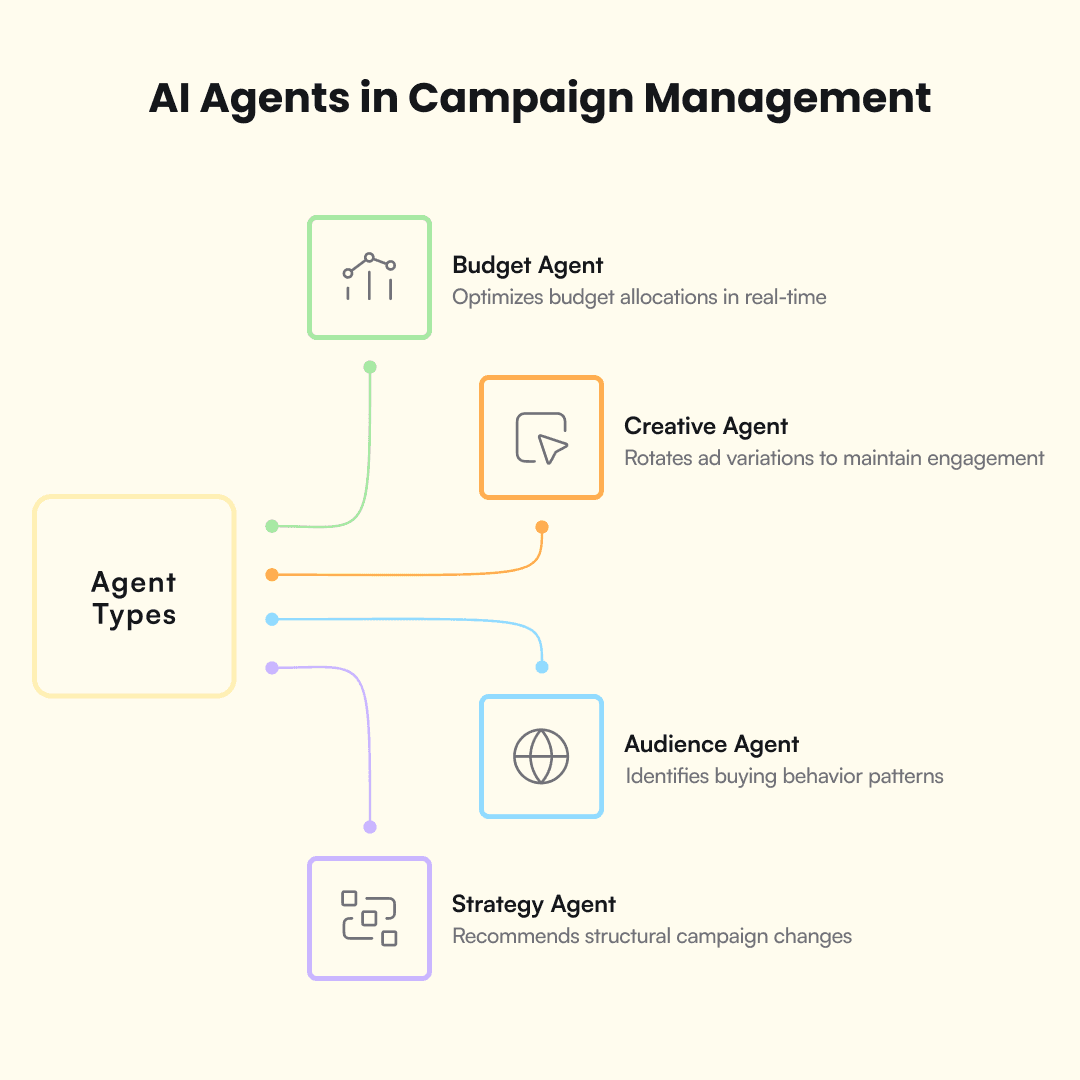
Multi-agent systems. Instead of one agent handling everything, specialized agents collaborate on different parts of a workflow. One handles creative generation, another monitors campaign performance, a third manages budget allocation across channels, and an orchestrator coordinates the team. Databricks reported that multi-agent workflows on its platform grew 327% in just four months between June and October 2025.
For e-commerce brands, the workflow is concrete: an agent pulls product data from your store, researches competitor positioning, writes ad scripts targeting specific buyer personas, generates video and image creatives, and publishes finished ads to Meta or TikTok. The media buyer reviews and approves while the agent handles production. Agents do not replace the strategist. They replace the hours spent on production tasks that eat up the time a strategist should spend on strategy.
Supply chain optimization, fraud detection in financial services, and personalized shopping recommendations in e-commerce are additional high-adoption areas, though these sit outside the marketing workflow.
AI agent adoption: where the market stands
PwC's 79% adoption figure comes with important context: of those adopters, 66% reported measurable productivity gains, and 88% planned to increase AI-related budgets in the next 12 months. The experimentation-to-production gap shows up across every dataset. OutSystems surveyed 1,900 IT leaders in 2025 and found that while 96% were running AI agents in some capacity, only 1 in 9 had reached production at scale. The market is large and growing: Grand View Research projects the global AI agents market will exceed $10.9 billion in 2026, up from $7.6 billion in 2025.
Infrastructure catching up
Two interoperability protocols are gaining traction. MCP (Model Context Protocol), created by Anthropic, standardizes how agents connect to external tools and has passed 97 million monthly SDK downloads. A2A (Agent-to-Agent Protocol), developed by Google, defines how agents communicate with each other and has attracted more than 150 organizational supporters. A2A moved under Linux Foundation governance in June 2025, and MCP followed in December 2025 when the Agentic AI Foundation (AAIF) launched with both protocols under its umbrella. The move signaled that the industry is treating agent interoperability as shared infrastructure rather than a proprietary advantage.
What AI agents can’t do (yet)
Most AI projects never reach production. A frequently referenced RAND figure puts the stall rate at 80 to 90% during the pilot phase, though that number traces back to secondary reporting rather than a single primary study. Gartner's own data tells a similar story: high cancellation rates across enterprise AI projects, with most failures tied to integration and data readiness rather than the models themselves.
Then there is agent washing: labeling a product as an "AI agent" when it is a chatbot with a new wrapper or rules-based automation with a language model bolted on. No competitor ranking for this topic addresses agent washing directly. The term keeps showing up in practitioner discussions because too many tools marketed as agents do not pass the basic test of autonomous, multi-step execution.
Where agents still fall short:
Ambiguous judgment calls. Situations where context is unclear and training data is thin. An agent can optimize a bid, but it cannot tell whether a campaign's messaging will land wrong with a specific cultural audience.
Creative taste beyond pattern matching. Agents can remix winning formats, but they cannot originate a brand voice or decide that an ad should break every rule in the playbook to stand out.
Compliance-heavy processes. Anything where an error carries legal consequences, such as regulated industries, financial disclosures, or healthcare claims, stays with humans.
Emotional intelligence. Reading tone, managing sensitive customer interactions, or navigating internal politics. These require context that no model can reliably infer from data alone.
Human-in-the-loop deployment is the industry standard, not the exception. That is not a failure of the technology. It reflects how experienced teams deploy AI: agents handle volume and speed, humans handle judgment and accountability.
When AI agents aren’t the right tool
If your workflow is predictable, repeatable, and rarely changes, you do not need an AI agent. Rules-based automation handles fixed processes faster, cheaper, and with fewer failure points. A workflow that moves new Shopify orders into a Google Sheet and sends a Slack notification will outperform an agent for that task every time, because there is nothing to reason about.
Chatbots and AI assistants are sufficient when you need one-shot answers without ongoing execution. If the task starts and ends with a single question and a single response, the overhead of an agent’s perception-reasoning-action loop adds complexity without adding value.
Use an agent when the task involves multi-step execution across tools, requires adaptation to changing inputs, and benefits from learning over time. If those three conditions are not present, simpler technology is the better choice.
How to get started with AI agents
Pick one workflow. Start with the most repetitive, data-rich task in your current process, whether that is creative iteration, performance reporting, or audience research. Trying to automate everything at once is how pilot projects stall.
Evaluate tools based on what the workflow requires. Does it need multi-step execution? Tool integrations with your existing platforms? The ability to learn and improve over time? Match the agent’s capabilities to the specific job rather than buying the broadest feature set. Many platforms now offer no-code or low-code options, so technical depth is not a prerequisite.
Expect to start with human oversight and gradually increase autonomy as trust builds. Most teams keep a human approving key decisions for the first several months. Tools like AdMove let you generate video ads from a product URL through an agent-driven workflow, where you review briefs and approve output while the agent handles research, scripting, and production.