
Every social media tool released in 2026 calls itself an "AI agent," whether it is a scheduling app, a chatbot builder, a caption generator, or an analytics dashboard. They all use the label now, but most of them are doing the same things they did two years ago with a rebrand on top.
The money backing this space is real. The AI in social media market is projected to hit $10.33 billion by 2029, and Meta is rebuilding its entire advertising infrastructure around AI-generated creative. But most of that investment is buying automation with a fresh coat of branding, not genuine agent behavior. The word "agent" implies software that can perceive context, reason about options, and act autonomously across platforms without step-by-step human instructions. Very few tools currently on the market meet that bar.
If you’re a media buyer evaluating new platforms, a DTC brand owner deciding where to invest, or an agency owner trying to figure out which tools reduce headcount pressure versus which ones just add another dashboard, the label problem affects your budget directly. You are being asked to pay agent prices for automation-level capability, and the difference between the two can be thousands of dollars per month. Most guides on this topic are written by the companies selling the tools. This one isn’t.
Key Takeaways
A social media AI agent perceives data from social platforms, reasons about what action to take, and executes without step-by-step human direction. Bots and chatbots follow scripts; agents adapt across workflows.
Three autonomy levels separate current tools: AI-assisted (human drives every decision), autonomous with guardrails (agent acts within set boundaries), and fully autonomous (agent runs end-to-end). Most tools marketed as "agents" operate at level one or two.
Production-ready social media agents in 2026 cover four capability areas: content creation and brand voice, scheduling and distribution, engagement and community management, and analytics and performance prediction.
Content repurposing delivers the clearest time savings. A single long-form piece becomes platform-specific content for LinkedIn, TikTok, Instagram, and X without manual reformatting.
The gap between organic and paid social workflows is where AI agents add the most underused value. Content that performs well organically carries audience signals that can inform ad creative testing and targeting.
Meta is targeting fully automated ad generation by end of 2026, which makes the convergence between organic content tools and advertising agents more urgent for media buyers and DTC brands.
Hallucination, brand safety incidents, and low consumer trust in AI-generated content are the three documented failure modes. All three call for review gates, approval workflows, and escalation paths rather than avoidance of the technology.
"AI agent" has become a marketing label applied to tools at every capability level. Testing whether a tool perceives data, reasons about actions, and executes across workflows is a more reliable filter than vendor positioning.
Three adoption paths exist: enterprise platforms with built-in agent features, specialized agentic tools, and custom builds using LLM APIs or workflow builders. The right choice depends on technical resources, data requirements, and how much customization your workflow needs.
What is an AI agent for social media?
A social media AI agent is software that can perceive data from social platforms, reason about what action to take based on that data, and execute the action without requiring step-by-step human direction. That definition, adapted from Stanford’s Human-Centered Artificial Intelligence (HAI) research on autonomous agents, draws a clear line between genuine agents and the automation tools that currently dominate the market.
The practical difference plays out across three levels of autonomy. At the first level, AI-assisted tools, a human drives every decision and the AI helps with execution: generating caption options, suggesting hashtags, recommending post times. At the second level, autonomous with guardrails, the agent drives the workflow and the human approves key outputs: the agent drafts content matched to your brand voice training data, selects posting windows based on audience behavior patterns, and queues everything for review. At the third level, fully autonomous, the agent handles the entire cycle from content creation through distribution and optimization with no human intervention. Level three does not exist in production today for social media management.
Knowing where a tool sits on this spectrum is the single most useful filter when evaluating vendors. A tool at level one with strong AI-assisted features can be worth the investment. A tool at level one marketed as level two is overcharging you.
How AI agents differ from bots and chatbots
Bots follow scripts. They execute predefined if-then rules: if someone comments with a keyword, reply with a template. Chatbots handle conversations within structured flows, often using natural language processing to interpret inputs, but they operate within boundaries set during configuration.
Agents perceive context across multiple data sources, reason about what the data means, and take action across workflows. Stanford HAI’s criteria for agent behavior include the ability to learn from outcomes and adapt future actions based on performance data, not just follow a pre-built decision tree. A scheduling bot posts at the time you set. An agent analyzes when your audience is active, tests different windows, and adjusts the schedule based on what performs.
The distinction matters for purchasing decisions. The “AI agent” label is applied to tools at every level of this spectrum, and the pricing often reflects the label rather than the actual capability.
What social media AI agents can do today
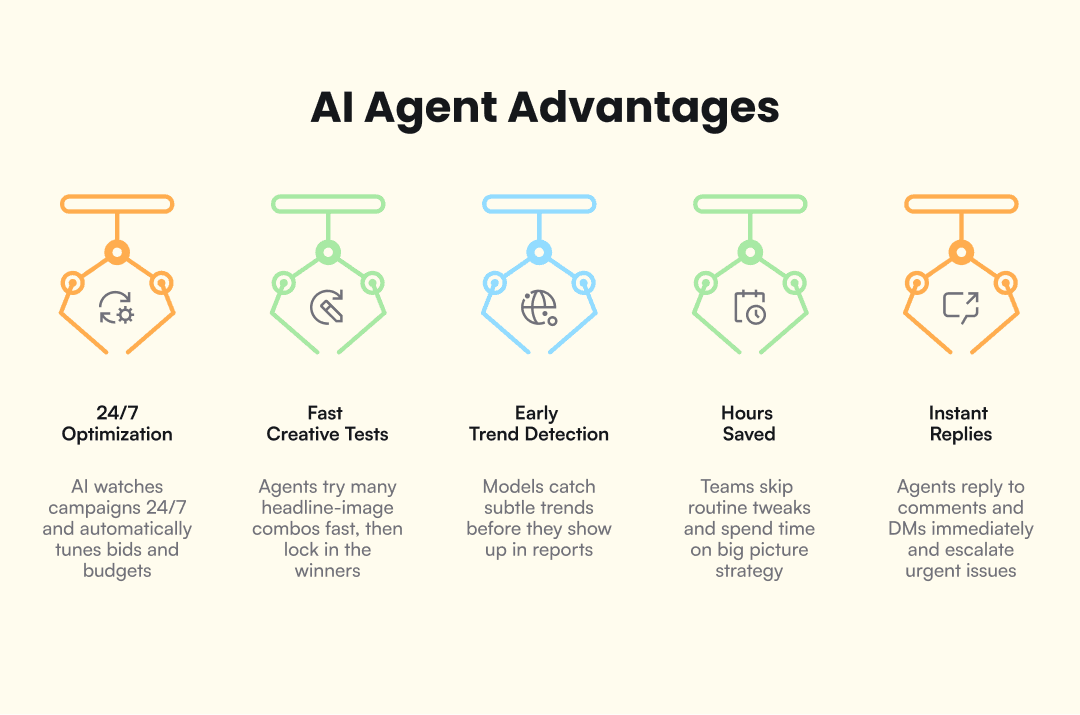
Production-ready social media agents in 2026 operate across four capability areas. Content creation and brand voice management, scheduling and distribution with trend detection, engagement and community management, and analytics with performance optimization. These are not aspirational roadmap items. They are functions that working tools deliver right now, with varying degrees of autonomy.
Social media managers spend an average of 20 hours per week on content creation and scheduling alone. Agents that handle even part of that load free up time for the strategic work that automation cannot replace.
Content creation and brand voice
The strongest agents generate text, image concepts, and video scripts from a combination of brand assets and product data. Multimodal output from a single input is what separates current-generation agents from the caption generators of two years ago. The differentiator between a capable agent and a generic generator is brand voice training. That means the agent learns your tone, vocabulary, and style rules, then applies them consistently across outputs. An agent trained on your brand voice produces LinkedIn posts that sound like your team wrote them, not like a template filled in blanks.
Content repurposing is where social media AI agents deliver the clearest time savings. A single long-form blog post or video becomes a LinkedIn article, a TikTok script, an Instagram carousel, and an X thread, each adapted to that platform’s format and audience expectations. The 78% of marketers using AI for content who report equal or higher engagement compared to human-only content are largely seeing those results from platform-specific adaptation, not from raw generation quality alone.
Scheduling, distribution, and trend detection
Agents analyze audience behavior data to determine posting windows specific to your followers, not generic “best time to post on Instagram” tables pulled from industry benchmarks. They distribute content across multiple platforms from a single input. Format, copy length, and media ratios adjust per channel. A video created for Instagram Reels gets cropped and re-captioned for TikTok, condensed to a text summary for X, and expanded into a longer narrative for LinkedIn, all from one production cycle.
The more valuable function is trend detection. Agents that monitor real-time signals across platforms can identify emerging topics relevant to your niche and draft reactive content while the trend still has momentum. Trend-related content gets 2-3x the reach of evergreen posts within the first 24-48 hours, which means speed of response matters more than production polish.
Engagement and community management
Comment response and DM handling are the most visible agent functions for community management. The better implementations go beyond keyword-triggered replies to context-aware responses that consider the commenter’s history, sentiment, and the thread they are responding to. An agent that knows a commenter has complained twice before handles that interaction differently than it handles a first-time question.
Sentiment analysis has matured past simple positive/negative classification. Current tools detect 40 or more emotion categories, including sarcasm, frustration, and urgency, and weight them by volume and velocity. Crisis detection sits at the more advanced end: agents that flag unusual spikes in negative sentiment, brand mentions in complaint contexts, or emerging conversation threads that signal a potential PR incident before it trends. The defensive use case is the one most buying guides skip entirely, but for brands running at scale across Meta, TikTok, and X, early warning before escalation is worth more than any content generation feature.
Analytics and performance optimization
Pattern recognition across platforms is where agents add value that is genuinely difficult for humans to replicate at scale. An agent monitoring performance data across Instagram, LinkedIn, TikTok, and X simultaneously spots correlations that a human reviewing platform dashboards individually would miss: which content formats drive engagement on which platforms, which posting cadences correlate with follower growth, which creative elements appear consistently in top-performing posts across channels. A human analyst can do this work, but not at the speed or frequency that an agent can maintain across four or five platforms simultaneously.
Predictive analytics takes this a step further. Agents that score draft content against historical performance data before publication give teams a way to prioritize what to post and what to rework. The output is not a guarantee, but a probability estimate that reduces the number of low-performing posts in your content calendar. Automated reporting pulls these patterns into structured summaries without requiring manual data aggregation across each platform’s native dashboard.
AI agents for social media advertising
Every guide on social media AI agents treats organic and paid as separate worlds. The content-focused articles cover scheduling, posting, and community management. The advertising articles cover campaign optimization, audience targeting, and bid management. Almost none connect the two. That separation is becoming a costly blind spot for media buyers and DTC brand owners running both organic and paid.
Advertising-specific AI agents handle a different set of tasks than their organic counterparts. At the core, they manage creative testing at scale: generating multiple ad variations, deploying them across audience segments, measuring performance, and reallocating budget toward winning combinations. They also handle audience targeting refinement. Lookalike and interest-based audiences shift based on conversion data rather than static demographic assumptions. Bid optimization and budget reallocation across campaigns round out the standard feature set. The teams that benefit most are the ones currently running manual A/B tests with two or three creative variants per cycle, because agents can test dozens simultaneously.
Where this gets interesting is the convergence between organic and paid workflows. Content that performs well organically carries signals about what resonates with an audience, signals that can inform paid creative strategy. Engagement patterns on organic posts, comment sentiment, share velocity, and save rates all feed data that ad-optimizing agents can use to prioritize which creative angles get ad spend behind them. An agent that bridges both sides of this workflow connects content performance to ad performance in a single system rather than forcing teams to manually translate insights between platforms.
Meta’s trajectory makes this convergence more urgent by the month. The company is targeting fully automated ad generation using AI by end of 2026. The goal is a model where advertisers provide product data and objectives while Meta’s systems handle creative production, audience selection, and optimization. Whether or not Meta hits that timeline, the direction is clear. The line between content creation and ad creation is collapsing.
For media buyers, the workflow-first question is whether your current tools treat content and ads as connected pipelines or as separate workflows that require manual bridging. For DTC brand owners, the question is whether the creative velocity that agents enable on the organic side can translate to fresher ad creative on the paid side. The 60% of US ad buyers who have used or plan to use AI-based buying products are largely operating in a world where these two sides still do not talk to each other. That is the gap worth closing.
Risks and limitations of social media AI agents
Social media AI agents fail in specific, measurable ways. Understanding those failure modes is more useful than either dismissing the technology or assuming it works as advertised.
What AI agents get wrong
Hallucination is the most documented risk. AI models generate content that sounds plausible but contains fabricated facts, invented statistics, or misattributed quotes. Hallucination rates range from 15% to 27% depending on the model and task complexity. For social media content, that means roughly one in five to one in four outputs may contain something factually wrong if published without review.
Brand safety incidents track closely behind. Over 70% of marketers have encountered at least one AI-related incident, including hallucinated claims, biased content, or material that violates brand guidelines. These are not edge cases. They are the current baseline for teams deploying AI content generation at scale.
The consumer trust numbers compound the problem. Only 40% of consumers trust generative AI output. Publishing AI-generated social content without disclosure risks both audience trust and, in some jurisdictions, regulatory compliance.
None of these failure modes are reasons to avoid the technology. They are reasons to deploy it with review gates, approval workflows, and clear escalation paths. The agents that acknowledge these limitations in their product design are generally more trustworthy than the ones that do not mention them.
The "AI agent" label problem
“AI agent” has turned into a marketing label. Basic scheduling tools call themselves agents, and so do chatbots that match keywords to canned replies and caption generators with a tone slider. When every vendor in the category uses the same word, the word stops helping buyers figure out what they are paying for.
A practical evaluation filter starts with three questions. Does the tool generate content autonomously based on learned brand parameters? Does it make scheduling and distribution decisions based on performance data? Does it adapt its behavior over time based on outcomes, or does it repeat the same process regardless of results? The criteria for agentic behavior include perception, reasoning, and autonomous action. Most tools currently on the market satisfy one of these, sometimes two, rarely all three.
Fully autonomous social media management at the level vendors imply in their marketing does not yet exist. Recognizing that gap between label and capability is the most important filter a buyer can apply.
Building custom agents vs. using platform tools
Three paths exist for adopting social media AI agents, and the right choice depends on your technical resources, data requirements, and how much customization your workflow actually needs.
Enterprise platforms with built-in agent features offer the lowest setup friction. Specialized agentic tools built specifically for social media offer deeper functionality in a narrower scope. Custom builds using LLM APIs and integration frameworks offer maximum flexibility at the highest development cost.
The DIY path: LLM APIs, workflow builders, and MCP
Custom agent building starts with connecting a large language model API to your social media accounts through an orchestration layer. The developer-oriented version involves wiring an LLM API to scheduling tools and platform APIs directly, then adding Model Context Protocol (MCP) integrations to give the agent access to your data sources, CRM, product catalog, or analytics platforms.
For teams without dedicated developers, workflow builders like Zapier, n8n, or Make.com serve as a middle ground. They provide visual interfaces for connecting AI models to social media platforms and handle the integration plumbing without custom code. The trade-off is less fine-grained control over agent behavior.
Custom building makes sense when you have workflow requirements that no off-the-shelf tool covers: unique data sovereignty needs, multi-system orchestration across proprietary internal tools, or highly specialized content generation that requires fine-tuned models. If your needs amount to scheduling plus basic content generation, a platform tool gets you there faster and cheaper.
When off-the-shelf is enough
HubSpot Breeze adds AI agent capabilities that connect directly to CRM data. Teams already in HubSpot skip most of the onboarding curve because Breeze pulls from the same contacts, deals, and properties they already work with. The AI generation quality is comparable to other tools; the CRM integration is the reason to pick this one.
The evaluation question is not which tool has the most features. It is which tool fits the workflow you actually run, at the autonomy level you actually need.
How to get started with social media AI agents
Start by auditing your current social media workflow for the task that consumes the most time relative to the value it produces. For most teams, that is content creation and scheduling. For agency teams managing multiple clients, it is cross-account reporting and content adaptation.
Once you have identified the highest-impact automation opportunity, evaluate tools against the autonomy criteria from the definition section: does the tool actually perceive your data, reason about actions, and act with some independence? Or does it require you to drive every decision? A tool that saves you 10 hours a week at autonomy level one can be more valuable than a tool that promises level two but delivers level one with extra configuration overhead.
McKinsey estimates that agentic AI will power as much as two-thirds of current marketing activities. That number describes what is technically possible, and most teams are nowhere near it yet. Start a pilot on a single platform with one content type and one workflow. Run the agent alongside your current process for two to four weeks before replacing anything. Track time saved, output quality, and error rate against your current baseline, then expand only after the pilot proves the agent adds real value at the quality threshold you set.
For media buyers, prioritize agents that connect to your ad platforms, specifically Meta, LinkedIn, and any channels where you are actively spending. The organic-to-paid pipeline discussed earlier represents the highest-leverage workflow for your role. DTC brand owners should start with content generation and scheduling, the two tasks where agents deliver the most immediate time savings. Agency owners should evaluate multi-client scalability first, because an agent that works for one brand but breaks at ten clients creates more problems than it solves.
When evaluating any tool, check these criteria: what autonomy level does it actually operate at, which platform integrations does it support, how does brand voice training work, what analytics does it surface, what human-in-the-loop controls are available, and what does the pricing model look like at your scale.
Governance and human-in-the-loop deployment
If you are deploying AI agents for social media at any organizational scale, governance is not optional. Regulated industries like financial services and healthcare require approval workflows before AI-generated content goes live, and brand consistency demands review gates that catch off-brand output before it reaches your audience. Legal compliance in multiple jurisdictions, including the EU’s AI Act and emerging US state-level requirements, increasingly requires disclosure when content is AI-generated.
Human review is not a workaround for weak AI. Without it, one bad output eventually hits your audience and undoes months of trust. Good agents account for this by handling routine generation and execution on their own while routing high-stakes decisions through approval checkpoints before anything goes live.
The practical question is where to set the threshold between auto-publish and human review. Low-risk content like reshared articles, standard product announcements, and templated responses can often flow through with automated quality checks. High-risk content like responses to complaints, crisis communications, and anything involving pricing claims or legal language should require human approval regardless of agent confidence.
Gartner projects that AI agents will handle at least 80% of customer service interactions by 2029. At that scale, governance structures built today determine whether your deployment is a competitive advantage or a liability.
A governance baseline for teams deploying social media agents starts with disclosure: define when and how you tell your audience that AI was involved in creating content. The 77% of consumers who want to know when AI creates content will eventually become a regulatory expectation. Beyond disclosure, set escalation triggers that automatically route content to a human reviewer when it touches sensitive topics, flagged keywords, or high-negative-sentiment threads.
Review agent output quality on a regular schedule, even when nothing has gone wrong. A weekly spot-check of a random sample catches drift before it becomes a pattern. Access controls matter too: limit who can change agent parameters or approve content. You also need a documented incident response process for when the agent publishes something wrong, because at some point it will.
Where social media AI agents go from here
Over the next 12-18 months, the trend is toward deeper platform integration. Meta, LinkedIn, and TikTok are all building native AI capabilities directly into their advertising and content creation workflows. The expectation that Meta will have fully automated ad generation by end of 2026 sets the pace for the broader market, even if the timeline slips. Third-party agents that keep adding value will be the ones that orchestrate across platforms, because competing with built-in features on any single platform is a losing position. Smaller point solutions will either get acquired or lose relevance as the major platforms absorb their core features.
Social media AI agents work, and they are getting better. The best current tools save teams 10-15 hours per week on content creation, scheduling, and community management tasks that were previously manual. Sentiment shifts get caught faster than human monitoring can manage, and content variation output runs at a speed that makes consistent creative testing possible for teams that could not afford it before.
They also hallucinate, produce off-brand content, and operate at lower autonomy levels than their marketing suggests. The “AI agent” label covers everything from basic schedulers to genuine multi-step reasoning systems, and the pricing rarely reflects the distinction. Buyers who test what a tool can do in a trial before trusting the sales pitch will spend less on tools that underdeliver.
Media buyers running paid social should start with agents that connect organic content performance to ad creative strategy. The organic-to-paid pipeline is the most valuable workflow most teams have not automated yet.
DTC and ecommerce brand owners get the fastest return from content generation and scheduling. Those are the tasks where current agents deliver the most reliable results with the least supervision required.
Agency owners have a different priority: multi-client scalability. An agent that works for three clients but requires workarounds at fifteen is a tool you will replace within a year.
The technology is worth adopting, but the marketing around it deserves skepticism. Before signing up, figure out what the tool does without human input, what it learns from over time, and where its outputs still need your review before going live. Those answers matter more than anything on the feature comparison page.