Your media buyer needs 15 fresh creatives by Friday. Your designer is already behind on last week’s batch. And the ads you launched ten days ago? Performance is tanking because creative fatigue has set in with your audience. Top advertisers now produce 50 to 70 ads per week. That kind of volume used to require a full creative department. For most ecommerce teams, it still feels that way.
The cost of trying to keep pace without a system is brutal. A 2025 Billion Dollar Boy global study found that 52% of creators report burnout, with 37% considering leaving their roles entirely. And the stakes are high: creative quality drives 56% of purchase intent impact. You can’t afford to burn people out, and you can’t afford to let quality slip.
Volume and burnout don’t have to go together. The teams producing the most ads run modular creative systems paired with batch production sprints and smart rotation, not longer hours. What follows is a three-pillar approach: a production method that turns a handful of components into 100+ variations, a rotation strategy that extends ad lifespan so you need fewer new ones, and operational practices that protect the people doing the work.
The Real Cost of the Creative Treadmill
Two different problems get lumped together under “creative fatigue,” and conflating them leads teams to apply the wrong fixes.
The first is ad fatigue on the audience side: your target sees the same creative too many times and stops responding. The numbers are stark. CTR can decline by 40% or more once ad frequency exceeds 3 to 4 exposures, with performance continuing to deteriorate as repetition increases. Once frequency climbs past 3.0, expect declining returns across the board. When refreshes are delayed, rising CPCs and falling conversion rates follow within one to two weeks, a pattern documented in multiple ad fatigue studies. Translate that to your bottom line: rising CPAs and falling ROAS on ads you’re still paying to run. We estimate that 15 to 25% of total ad spend gets wasted on fatigued creatives. That’s money burning while your team scrambles to produce replacements.
Ad Fatigue (Audience Side) | Creative Burnout (Team Side) | |
What it is | Audience sees the same ad too often, stops responding | The people making ads are running on empty |
Key signal | CTR drops, CPC rises, frequency above 3.0 | Declining output quality, missed deadlines, turnover risk |
Impact | Rising CPA, falling ROAS on still-running ads | Weaker creatives → faster audience fatigue → more replacements needed |
Fix | Rotate and refresh creatives systematically | Role specialization, batch workflows, protected creative time |
The second problem is creative burnout on the team side: the people making the ads are running on empty. Adobe Express surveyed 1,000 business owners in 2025 and the picture is grim. 46% compromise work-life balance to meet content goals. 36% sacrifice creativity just to keep up with output demands. Nearly half the work doesn’t move the needle, which means all that overtime and context switching between tasks is producing diminishing returns.
These two problems feed each other in a vicious cycle. A burned-out team produces weaker creatives. Weaker creatives fatigue faster with audiences. Faster audience fatigue means the team needs to produce even more replacements, and an already thin roster gets stretched further. Effective ad lifespan has been shortening year over year as platforms get faster and audiences scroll quicker, so the treadmill speeds up. And here’s the math that makes this urgent: fewer than 10% of ads become true performers, a figure consistent across advertiser reports and agency benchmarks. You need to produce at volume to find the handful that scale your ROAS, but that volume will break your team unless you build a system around it.
Pillar 1: Build More With Less
Modular creative systems are the reason some teams produce 100+ ads per month while others struggle to ship 10. Instead of building 100 ads from scratch, you build interchangeable components and let combinations do the multiplication. Here’s the formula:
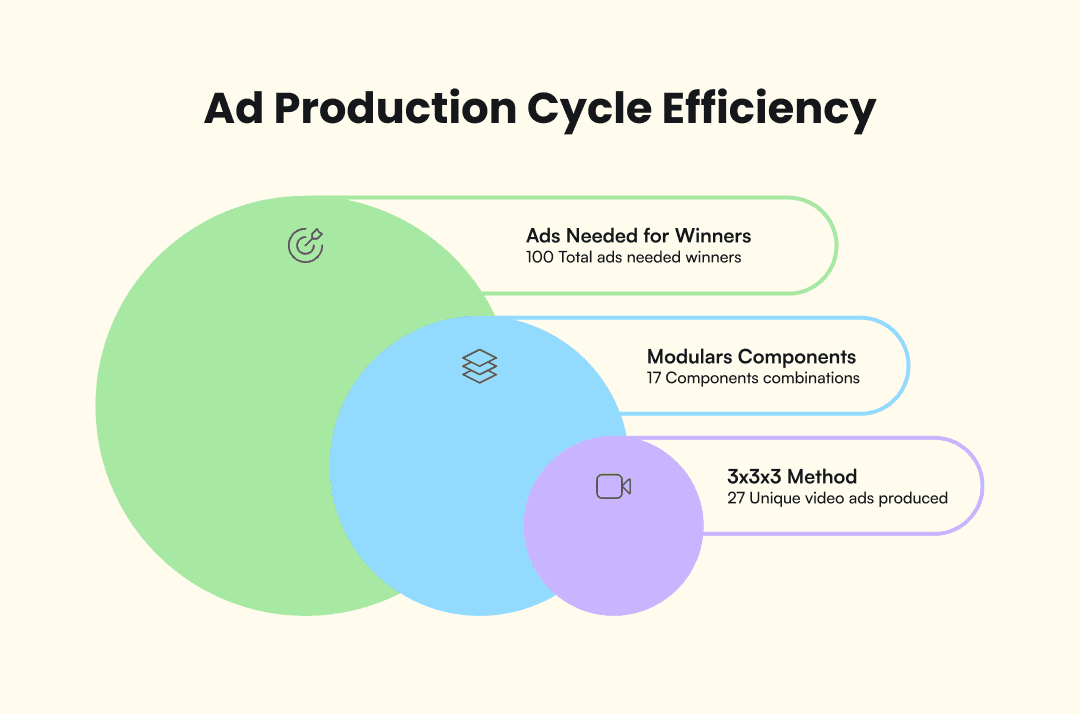
Creative Math: 10 hooks × 5 body scripts × 2 CTAs = 100 unique ad variations
Each component (hook, body, CTA) is a standalone module. The permutations create 100 distinct ads from just 17 individual pieces of copy. One focused creative session’s output covers an entire month of testing.
10 hooks: different opening angles (curiosity, social proof, pain point, etc.)
5 body scripts: different product stories or perspectives
2 CTAs: different closing approaches
= 100 unique combinations from just 17 individual pieces
Batch production sprints make this practical. Instead of scattering ad creation across the week between meetings, Slack threads, and email, you dedicate focused blocks to creative work. Context switching costs 23 or more minutes to recover per interruption, and creative work suffers more from fragmented attention than most tasks. A strategist who writes hooks for two hours straight produces more usable output than one who squeezes the same work across four days of interruptions. The rhythm works best as dedicated sprint days: block Monday for strategy and angle selection, then batch production on Tuesday and Wednesday. Keep production days and admin days completely separate so creative focus stays unbroken.
For video and UGC-style content, the 3x3x3 method applies the same modular thinking to filming. Three hooks, three body scripts, and three CTAs filmed in a single session produce 27 unique video ads. Its strength comes from how little additional effort each permutation requires once the raw footage and creator content exists. One afternoon of shooting becomes a month of video variations.
All of this connects directly to the hit rate problem from above. With sub-10% winner rates, you need around 100 ads to find the handful that scale. Without a modular system, that means 100 separate production cycles. With one, it means 17 components assembled in different combinations, and a team of two or three can hit that number easily. A team of twenty doing it the old way still struggles.
Pillar 2: Keep Ads Working Longer
Producing more creatives solves one problem. But if each ad burns out quickly, you’re still stuck replacing them constantly. Making ads last longer before they fatigue your audience cuts down how many new ones you need in the first place.
A Creative Hierarchy of fatigue speed explains why. Not every element of an ad wears out at the same rate:
Hooks: Fatigue fastest. They’re the first thing people see in their feed and the first element that gets tuned out. Your thumbstop ratio drops before anything else declines.
Body copy: Fatigues next, but holds up longer than the opening.
CTAs: Hold up the longest.
When an ad starts declining, most teams throw out the whole creative and start over. A smarter approach is to swap only the fastest-fatiguing element first. Replace the hook on a declining ad, keep the body and CTA intact, and you’ve created what the algorithm treats as a new ad with a fraction of the effort. This single shift can triple your effective refresh output from the same amount of work.
Building a Hook Bank turns this kind of refresh into a five-minute task. Maintain a running list of tested hooks, sorted by past performance and organized by product angle. When a hook fatigues, pull the next one from the bank and swap it in. You don’t need a brainstorming session, a new production cycle, or a designer’s time. The bank becomes an asset that compounds over time as you add more tested hooks to the rotation.
Platform-specific refresh cadences matter here because fatigue speed varies dramatically across channels.
Platform | Refresh Cadence | Fatigue Speed |
Meta | Every 2–4 weeks | Moderate |
TikTok | Every few days to 1 week | Fast |
Google PMax | Longer cycles | Slow |
The universal signal to watch across all three is ad frequency: once it crosses 3.0, expect declining returns.
Not all ads should be refreshed constantly, though. Refresh your direct-response performance ads on a tight cycle, but let your strongest brand-building assets keep running and compounding.
Pillar 3: Protect the People Behind the Ads
Production systems and rotation strategies solve the output side of the equation. But if the people running those systems burn out, nothing else holds. Superside’s 2025 report found that 77% of creative teams cite speed as their top concern this year. The pressure to produce faster isn’t going away. The only question is whether your team structure absorbs it or breaks under it.
Four operational practices make the difference between sustainable velocity and team collapse:
Role specialization: Split the strategist function (choosing angles, writing hooks, developing creative briefs) from the production function (designing, editing, assembling finals). When one person does both, they stall. The blank-canvas problem happens when someone is asked to simultaneously decide what to say and how to say it visually. Separating these roles removes the paralysis because each person’s decision space gets smaller, and they can move faster within their lane.
AI as force multiplier: First drafts of scripts, hook variations, image resizing, and voiceover generation are all tasks where AI works as the intern who never sleeps, not a replacement for human creative direction. Teams that use AI to generate starting points (briefs, scripts, rough cuts) and then apply human judgment for direction and approval produce more without working more hours. AdMove, for example, generates creative briefs, ad scripts, hooks, and full ad sets directly from a product URL, so teams skip the blank-page stage entirely and jump straight to reviewing and refining output that’s already on-brand.
A/B Weeks: “A weeks” are for client communication, admin, feedback rounds, and reviews. “B weeks” are pure creative production. No mixing. This separation protects deep creative work from the constant interruptions that make a productive week feel impossible. Instead of losing 23 minutes recovering from every Slack ping and email thread during production, your team gets full uninterrupted days to create.
Weekly performance feedback loop: Every Friday, review ad performance across your accounts. Kill the bottom 30% of performers, scale the top 20%, and refresh the middle. This loop means your team never creates blind. Every new batch of creatives is informed by real data on what worked and what didn’t the week before, which improves both the quality and the morale of the work.
Your Weekly Creative Engine
All three pillars come together in a repeatable weekly rhythm that turns creative velocity from an aspiration into a default output.
Day | Focus | Key Activities |
Monday | Strategy | Pull performance data, check frequency scores, swap hooks from the Hook Bank on declining creatives, select new angles based on what’s winning |
Tue–Wed | Batch Production | Produce 20+ variations per session using the modular system, mixing new hook-body-CTA combinations with refreshed versions of existing winners |
Thursday | Review & Refresh | Check fatigue signals on running ads, apply hook swaps where needed, finalize and queue finished creatives for launch |
Friday | Performance Loop | Kill bottom 30%, scale top 20%, refresh middle. Log learnings to feed next Monday’s strategy session |
Even at a conservative pace of 20 variations per production day, that’s 40 or more per week and 160 or more per month. The 100-ad target stops being ambitious and starts being the baseline your system delivers by default.
AdMove fits into this weekly engine at every step where speed matters and human judgment doesn’t. Ideation, first-draft scripting, variation generation, and performance flagging all benefit. AI agents like AdMove compress the production sprint further by generating full ad sets (briefs, scripts, video ads, static creatives) from a product URL, and what used to take two days of hands-on production becomes a few hours of review and approval. The creative velocity increases without anyone on the team working longer hours.
Producing 100 or more ad creatives a month comes down to process, not headcount. Modular production math, fatigue-aware rotation, and team protection practices break the false link between volume and effort. A two-person team running this system will outproduce a ten-person team without one.
Admove can compress this further for teams that want to skip the manual setup. Feed it a product URL and it generates finished ad sets with scripts, video, statics, and briefs, all on-brand and ready to test. But the system works with or without AI tools. What separates high-output teams from burned-out ones is the process they built before they started producing.