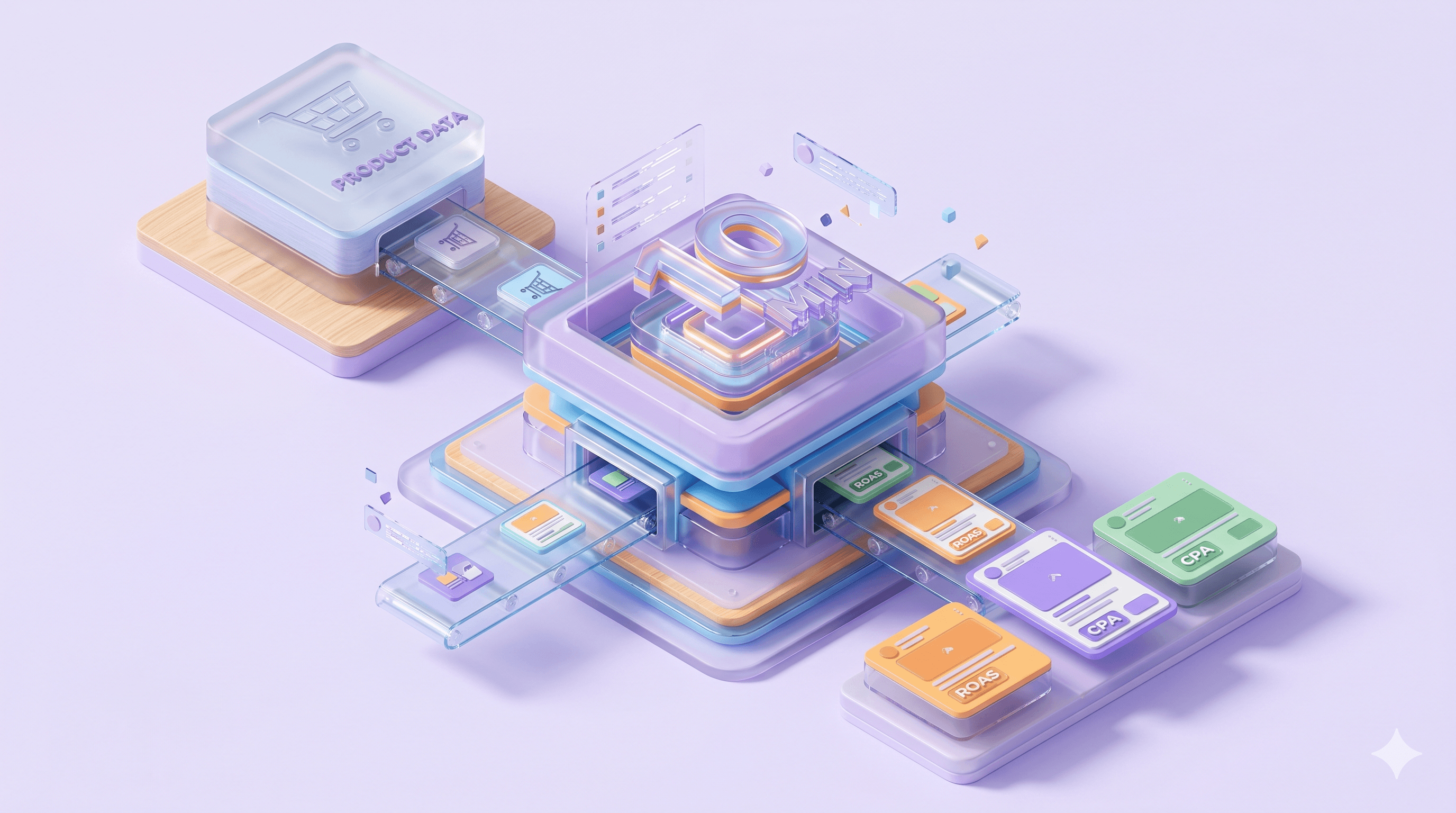
For a Shopify store, launching ads in 2026 takes about 15 minutes of clicks: connect Meta, install the Pixel, pick a budget, publish. Most of the setup is automated. With 77.4% of top Shopify stores already running Meta Ads and Tier 1 ad costs up 12% year over year, the work that used to live in Ads Manager has moved into the creative pipeline. The algorithm picks the audience; you have to keep giving it new ads to pick from.
Campaign setup takes minutes. Advantage+ Shopping Campaigns and Performance Max handle most of the targeting work for you. What these platforms can't do is make the ads themselves. That's the bottleneck, and it's the reason most stores either burn budget on stale creative or never scale past their first campaign.
This guide covers the fastest path from "I have a Shopify store" to "my ads are running," with a realistic breakdown of what it takes to scale once you're live. While focused on Shopify, the strategy works for any ecommerce store.
Key Takeaways
77.4% of top Shopify stores already run Meta Ads, and Tier 1 ad costs are up 12% year over year. The work that used to live in Ads Manager has moved into creative production, where 10+ video variations per product feed algorithm-driven campaigns.
Advantage+ Shopping Campaigns (Meta) and Performance Max (Google) handle audience targeting automatically and require at least 50 weekly purchase events to optimize, so creative variety drives results more than audience selection.
Meta Pixel plus Conversions API (CAPI) is the required tracking setup for Shopify ads in 2026 because iOS 26 strips click identifiers like fbclid and gclid by default in Safari, so server-side attribution is the only reliable signal.
Starting budgets of $20-$50 per day give algorithm-driven campaigns enough conversion data to find buyers. Stores should scale only after hitting a consistent 3-4x ROAS benchmark.
Only 2-4% of first-time Shopify visitors convert on their first visit, which makes retargeting the highest-ROI ad spend because the cost of the initial click is already paid.
Meta Ads costs $1.72 per click versus Google's $5.26. Meta works as a cost-efficient platform for creative testing at volume, while Google captures higher-intent shoppers searching by product category.
Creative production is the bottleneck
Setting up a campaign on Meta or Google takes less than 15 minutes. Producing a set of video creatives that the algorithm can test and learn from? That takes days, sometimes weeks.
In 2026, broad, algorithm-fed campaigns like Advantage+ Shopping Campaigns and Performance Max find buyers through creative variations, not audience micro-targeting. The trade-off is volume: ASC needs at least 50 weekly purchase events to optimize effectively , and generating those events requires fresh creative the algorithm can rotate through.
The algorithm handles audience selection automatically. What it needs from you is 10+ ad variations per product so it can test which message connects with which buyer at which moment. One polished hero video won't cut it.
The brands and agencies winning right now treat creative production as a repeatable pipeline rather than a one-off project. Each week brings new variations for the algorithm to test, instead of starting every campaign cycle from zero.
The 10-minute path: store to live ads
Here's what that system looks like in practice, broken into three steps using AdMove and your Shopify store.
Step 1: Connect your store and let Product Intelligence do the research (2 minutes)
Connect your Shopify store to AdMove with a single click. The integration pulls your entire product catalog: titles, descriptions, pricing, images, and customer reviews.
From there, Product Intelligence takes over. It analyzes your product data alongside competitor positioning, identifies buyer personas, and surfaces marketing angles you'd normally spend hours researching by hand. The brief-writing and research phase finishes in a two-minute automated pass.
By the time you review the output, AdMove has already mapped out who your buyers are, what problems they're trying to solve, and which product benefits to lead with in your ads. That research would typically take a strategist half a day. Here, it's done before your coffee cools.
Step 2: Generate campaign-ready creatives (5 minutes)
With your product data and research in place, AdMove's creative engine generates video ads complete with scripts, AI voiceovers, captions, and synced visuals. Each product gets 10+ variations with different hooks, calls to action, and messaging angles built for creative testing at scale.
The videos come in UGC-style formats with AI avatars, the kind of raw, authentic creative that outperforms polished studio content on social feeds. And because Brand Hub locks in your brand standards automatically (colors, fonts, tone, logo placement), every variation stays on-brand without manual review.
You can edit anything: swap a hook, adjust the script, regenerate a scene. Or approve the batch and move to launch. The point is volume with quality. Instead of spending a week producing three ads, you have a full creative testing library ready in five minutes.
Step 3: Launch to Meta and TikTok (3 minutes)
Each creative is formatted automatically for the platform it's going to. Reels, Stories, Feed placements, TikTok safe zones, aspect ratios, video lengths, and caption specs are all handled without you touching export settings.
Push your ads live to Meta and TikTok from a single workspace. No switching between platforms, no manual resizing, no re-uploading. The technical formatting that trips up most advertisers is already baked into every video AdMove generates.
What to know before you scale (ad fundamentals that still matter)
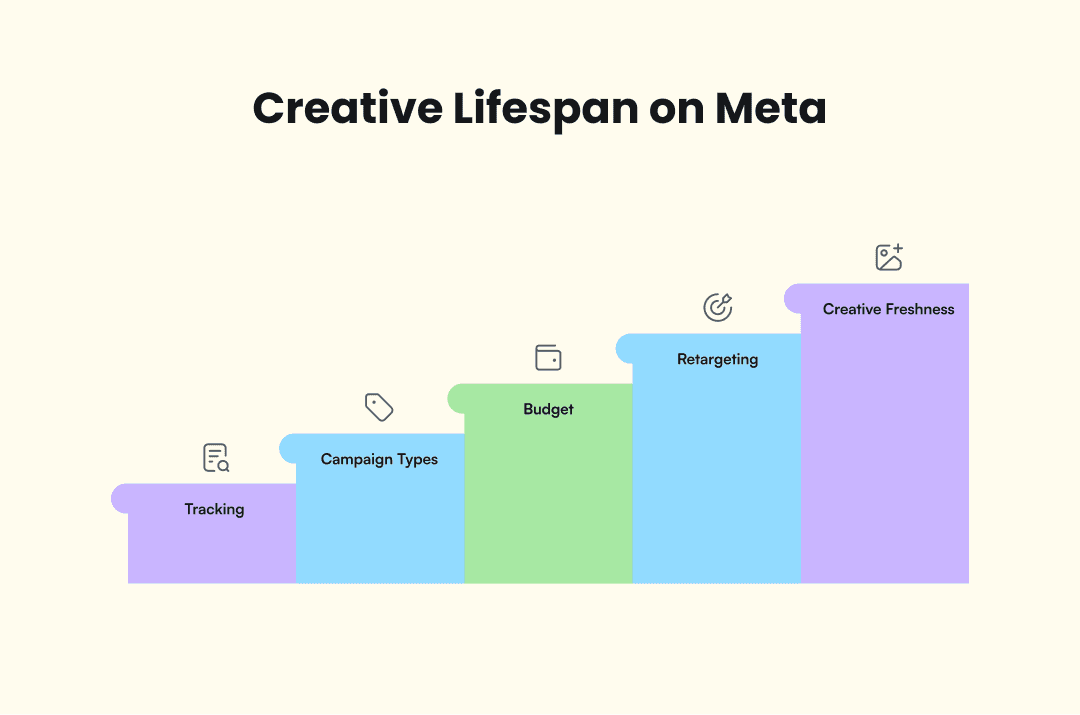
Once your first ads are live, five fundamentals determine whether your Shopify store scales profitably or burns budget.
Tracking. Meta Pixel plus Conversions API (CAPI) is the required tracking setup for Shopify stores running ads in 2026. iOS 26 strips click identifiers like fbclid and gclid by default in Safari, so server-side tracking through CAPI is now the only way to get accurate conversion attribution. Install the Facebook & Instagram Sales Channel from your Shopify admin to connect Pixel and CAPI together. Without both tracking layers, you're feeding algorithm-driven campaigns incomplete conversion data, and incomplete data means wasted ad spend on audiences the algorithm can't properly evaluate.
Campaign types. Advantage+ Shopping Campaigns (ASC) are Meta's default for ecommerce in 2026, using algorithm-driven targeting to find buyers across placements. On Google's side, Performance Max is the equivalent broad-targeting campaign type and requires a connected Google Merchant Center feed through the Google & YouTube Channel on Shopify. Both rely on broad targeting by design, so creative quality and variety matter more than audience selection.
Budget. Start with $20-$50 per day per campaign. Scale only after you hit a consistent 3-4x ROAS benchmark. Going below $20/day starves algorithm-driven campaigns of the data they need to find profitable buyers.
Retargeting. Set it up from day one. Only 2-4% of first-time visitors to a Shopify store convert on their first visit. Retargeting brings the other 96-98% back with specific product reminders, discount nudges, and social proof. This is your highest-ROI spend because the hardest part, getting the initial click, is already done.
Creative freshness. The fastest way to kill a scaling campaign is running the same 2-3 ads for weeks. Algorithms deprioritize stale creative, and your audience stops noticing it. AdMove addresses this with weekly auto-refresh, generating new ad variations based on your product data and performance signals so your campaigns always have fresh creative to test.
Which ad platform fits your store?
The best ad platform for your Shopify store depends on where your buyers are in their purchase journey. Meta Ads is the most cost-efficient click source for Shopify stores at $1.72 CPC versus Google's $5.26, but Google captures higher-intent shoppers already searching for your product category. The right choice isn't one or the other; it's understanding what each platform does best.
Platform | Audience type | Intent level | Best product fit | Starting budget | Default campaign type | Creative format needed |
Meta Ads | Discovery, social browsing | Low to mid | Visual, impulse, lifestyle products | $20-30/day | Advantage+ Shopping | Video (Reels, Stories, Feed) |
Google Ads | Search, high-intent | High | Products people search for by name or category | $30-50/day | Performance Max | Product feed + video |
TikTok Ads | Discovery, younger demographics | Low | Trend-driven, UGC-native products | $20-30/day | Spark Ads, Shopping Ads | Short-form UGC video |
Shop Campaigns | Shopify ecosystem buyers | Mid to high | Any Shopify product (US/Canada only) | Pay-per-conversion | Automated | Product images from catalog |
Meta works best as your starting platform because the lower CPC lets you test more creative variations for less money. Google captures demand that already exists: if people search for your product category, PMax puts your listings in front of them at the right moment. TikTok rewards authentic, native-feeling content, especially for products that skew toward younger demographics.
Shop Campaigns are Shopify's built-in option with a pay-per-conversion model, but they're limited to US and Canada and require Shopify Payments plus Shop Pay.
Mistakes that burn budget fast
Setup errors cost more than platform choice. They silently drain your budget before you have enough data to know what's working.
Choosing the wrong campaign objective. Running a Traffic or Engagement campaign when you want sales means Meta's algorithm optimizes for clicks and likes, not purchases. Always select Sales or Conversions as your objective from the start.
Skipping CAPI in 2026. The most common mistake Shopify store owners make with ads in 2026 is running campaigns without Conversions API installed. iOS 26 strips click identifiers by default in Safari, so without server-side tracking, you're losing the conversion data these algorithm-driven campaigns need to find your buyers. Without CAPI capturing those purchase events, the algorithm flies blind.
Underfunding campaigns. A $5/day budget sounds safe, but it starves the algorithm. You won't generate enough conversion events for ASC or Performance Max to learn who your buyers are. Start at $20-50/day minimum.
Running stale creative. Three ads running for six weeks will fatigue your audience and tank your performance. Creative testing isn't optional with algorithm-driven campaigns. Test 10 variations, not one perfect ad.
Ignoring product feed quality. For Google Shopping and Performance Max, your product feed is your ad. Missing images, vague titles, or incorrect pricing categories mean Google shows your products to the wrong people, or doesn't show them at all.
Perfecting instead of testing. The winning creative is rarely the one you expected. Ship more variations, learn from the data, and iterate faster.
Start running ads today
Creative supply is the variable left to solve. Producing 10+ on-brand variations per product and refreshing them weekly is what keeps a Shopify campaign in the algorithm's rotation long enough to scale.
AdMove is a creative engineering platform built for exactly this shift. Connect your Shopify store, and it handles the research, scripts, video production, brand compliance, and platform formatting from one workspace. Ship ads that win. On autopilot.