Meta rebuilt its advertising infrastructure from the ground up in 2024–2025, and it has officially been rolled out to all accounts in the last couple of months. The new system, called Andromeda, introduces a retrieval stage that determines which ads are allowed to enter the auction.
This single change flips a long-standing assumption in Meta advertising: your ad creative now does most of the targeting work. Audience settings still exist, but they play a much smaller role in deciding who sees what.
Creative diversity carries more weight than micro-optimization. And testing velocity is more important than perfect execution.
Three strategic shifts now require immediate attention:
Minor creative tweaks are no longer viable.
Andromeda groups similar ads together. Changing a headline color, swapping a CTA, or trimming two seconds from a video usually results in the same ad being treated as a duplicate.Volume with variety is mandatory.
Advertisers running 8–20 genuinely different creative concepts inside simplified campaign structures consistently outperform those relying on traditional A/B testing.Refresh cycles are compressed.
Creative fatigue develops more quickly because Andromeda aggressively matches ads to their most responsive audiences. Most brands now need refreshes every 1–3 weeks, not monthly.
What is Meta Andromeda, and How Does it Change Ad Delivery?
Andromeda is Meta’s retrieval layer. Its job is to decide which ads qualify to compete in the auction before bidding and ranking begin.
Before Andromeda, Meta relied primarily on a ranking-first system. Ads entered a massive auction, and the platform evaluated them all at once based on bid, predicted engagement, and relevance.
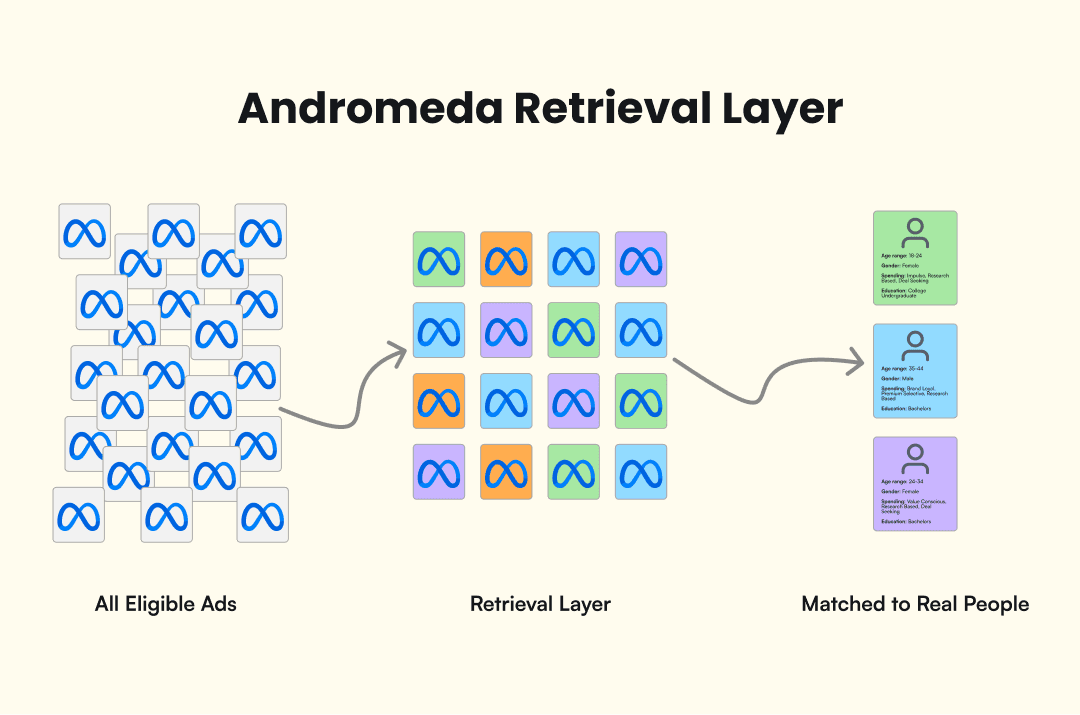
With Andromeda, Meta inserts a retrieval step before ranking. When a user opens Facebook or Instagram, the system first selects a shortlist of ads that appear relevant to that person at that moment. Only those ads move on to the auction.
A useful mental model is a nightclub:
Retrieval is the bouncer deciding who gets inside.
Ranking is what happens once you’re already in the room.
If your ad doesn’t pass retrieval, it never competes, regardless of bid or budget.
Plus, this now has an even more powerful play on serving the right ad to the right people at the right time.
How Does Meta’s Andromeda Retrieval Stage Filter Ads Before The Auction?
Andromeda organizes Meta’s active ads into searchable clusters using signals from creative content itself.
The system analyzes:
Visuals (what’s shown on screen)
Text (captions, overlays, copy)
Audio and pacing (in video)
On-screen actions and context
When a user opens the app, Andromeda compares that user’s behavior and context to these creative clusters and retrieves relevant ads.
Meta built custom infrastructure to support this shift, including dedicated hardware, because retrieval requires scanning massive indexes extremely fast. According to Meta’s engineering disclosures, this architecture improved recall and ad quality at launch, and those gains scale as more inventory flows through retrieval.
Andromeda now “understands” what your creative is about. Not in a human way, but well enough to decide who should see it. That understanding happens before targeting rules, budgets, or bids come into play.
Why Did Meta’s Traditional Ranking-First Ad System Stop Working?
The old system broke under creative volume.
By 2023, creative volume had already exploded. Dynamic Creative, Advantage+ formats, and faster production cycles pushed advertisers to run more variations than ever. Then AI-generated ads arrived, which turned what was already a surge in volume into a flood.
Ranking everything at once became slow and inefficient. Ads that should have matched users never surfaced because the system couldn’t evaluate everything fast enough.
Retrieval-first logic fixes this by shrinking the problem. Instead of ranking millions of ads per impression, Meta retrieves a smaller, more relevant pool and ranks only those.
For advertisers, this means the platform is no longer trying to “figure out” who your audience is based solely on targeting inputs. It’s inferring that from the creative itself.
Why is Creative Content Now The Primary Targeting Signal in Meta Ads?
Andromeda matches ads to users based on the creative's message.
You can run broad targeting and still reach highly specific audiences if your creative signals are clear.
Example:
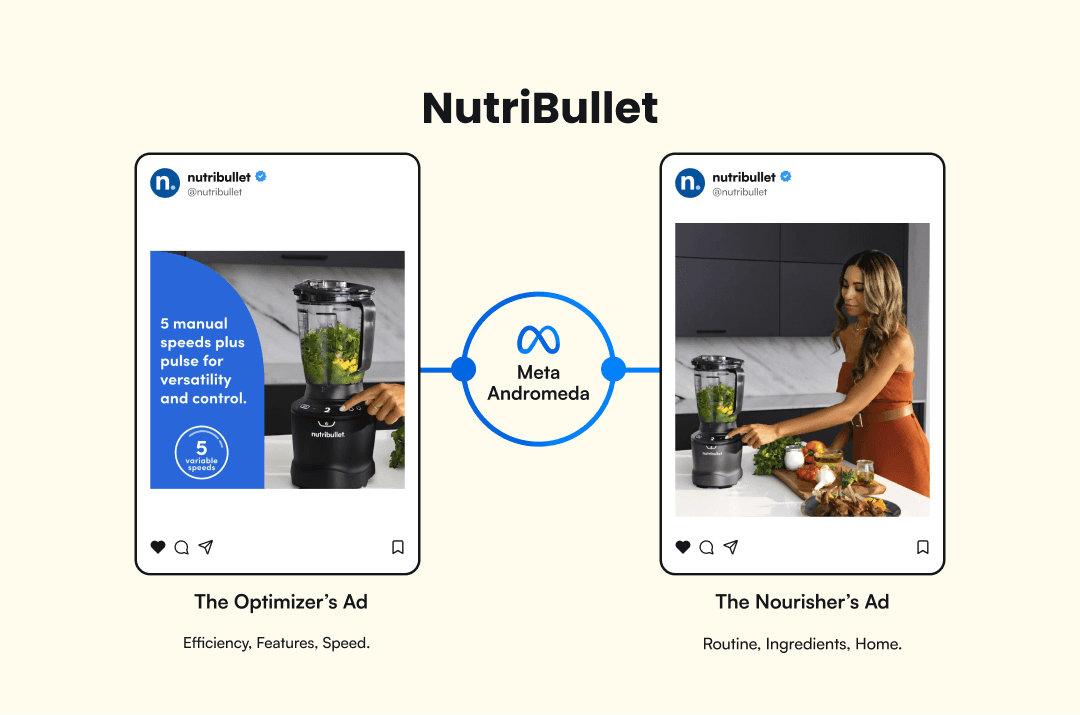
Two ads promote the same Nutribullet SmartSense™ Blender Combo.
Same product. Same brand. Same targeting settings.
Ad A shows the blender in a clean, minimal kitchen with on-screen callouts highlighting cup sizes, auto cycles, and smart features. It emphasizes speed, control, and efficiency. The creative signals a busy individual optimizing their routine.
Ad B shows the blender in use while preparing food in a home setting. Ingredients, motion, and everyday cooking take center stage. It emphasizes nourishment, routine, and shared meals, signaling a household or family-oriented lifestyle.
Targeting is identical.
Andromeda still retrieves these ads for different people because the creative content signals different lifestyles, problems, and desires.
The creative tells the system who the ad is for.
What are Entity IDs and How Does Semantic Similarity Work in Andromeda?
Meta assigns each creative an Entity ID that represents its semantic fingerprint. This ID is generated through semantic analysis of your ad. Creatives with similar Entity IDs are grouped together in the retrieval index.
Each creative is analyzed and assigned a representation based on its meaning, visuals, and messaging. Creatives that look and say roughly the same thing end up grouped together.
This grouping is why minor edits no longer count as real tests.
Changing a button color or rewriting a headline without changing the underlying message does not create a new concept. Andromeda still sees the same idea.
Two ads can have different music, runtimes, or layouts and still be treated as the same if they communicate the same core message in the same way.
What Happens When Creative Similarity Scores Get Too High?
When too many ads cluster tightly around the same concept, Andromeda deprioritizes them.
This isn’t a penalty in the traditional sense, but rather a resource decision. The system avoids retrieving redundant ads when one representative example is sufficient.
For advertisers, the outcome feels the same: ads stop entering auctions.
This is why traditional A/B testing has become less useful. Testing one variable at a time creates variations that Andromeda groups together anyway, leaving you to believe you’re testing different ads when in fact you’re feeding the system duplicates.
How Many Creatives Should I Run Per Ad Set in the Andromeda Era?
Most high-performing accounts now run 8-20 conceptually distinct creatives per ad set.
The keyword is distinct.
Each creative should differ in at least one of the following:
The persona being addressed
The desire being emphasized
The stage of awareness being targeted
If two ads answer the same question in the same way, Andromeda will likely treat them as the same, regardless of surface differences.
Refresh cycles typically range from 1 to 3 weeks, depending on spend and frequency.
But creative volume is not a shortcut. Without distinct concepts that address different pains or desires, more ads simply mean more wasted spend, not more learning.
What is the P.D.A. Framework for Creative Testing?
The P.D.A. framework structures creative diversity across three dimensions:
Persona
Who is this for? A busy parent, a student, a professional, a retiree.
Desire
What outcome does this person care about most? Speed, savings, status, confidence, simplicity.
Awareness
How familiar is the viewer with the problem and solution? Problem-aware, solution-aware, or product-aware.
Each creative should clearly occupy one combination of these dimensions.
Persona ↓ / Awareness → | Problem-Aware | Solution-Aware | Product-Aware |
Busy Parent | “No time to cook after work” | “Meal kits save weeknights” | “Why this brand fits our routine” |
Student | “Food is expensive right now” | “Affordable meal options” | “Student discount + value” |
Young Professional | “Always ordering takeout” | “Faster than cooking” Desire: Efficiency | “Premium, time-saving brand” |
Family Household | “Dinner chaos every night” | “Predictable weekly meals” | “Safe, family-approved choice” |
How Should I Structure My Meta Ad Campaign to Maximize Andromeda Performance
Simplification helps Andromeda learn faster.
Most advertisers benefit from:
Fewer campaigns
Broader ad sets
Consolidated budgets
More creative variation inside each ad set
Fragmented structures dilute signal density. Broad structures allow retrieval to work as designed.
The preferred structure looks like this:
Component | Recommendation |
Campaigns | 1-3 per objective (prospecting, retargeting, retention) |
Ad Sets | Broad targeting with minimal exclusions |
Ads per Ad Set | 8-20 conceptually distinct creatives |
Budget | Consolidated at the campaign level using Advantage Campaign Budget |
Clean conversion signals still matter. Server-side tracking and proper event matching ensure Andromeda receives accurate feedback about which creative–user matches are working.
How Do I Detect Creative Fatigue in a Retrieval-First System?
Creative fatigue shows up at the concept level, not the individual ad level.
Watch for:
rising frequency within matched audiences
declining CTR across a concept
increasing CPM without seasonal explanation
falling thumb-stop rates in video
Solve these performance drops with a new creative concept. Minor visual tweaks cannot fix a strategy that has reached its limit.
What is the Best Framework for Testing Meta Ad Creatives in 2025?
A Creative Matrix mapping angles against personas ensures systematic conceptual diversity that feeds Andromeda’s requirements.
Angle across the top. Persona down the side. Awareness layered in.
Each cell represents a different concept, not a variant.
Rotate through the matrix weekly. Retire concepts that stall. Expand the ones that show traction.
Example:
Angle | Persona A | Persona B | Persona C |
Problem | Video: pain point hook | Static: quiz question | Carousel: |
Solution Aware | UGC: transformation story | Static: benefit stack | Video: how it works |
Product Aware | Video: social proof | Static: comparison chart | Carousel: objection handling |
How Does AdMove Support Creative Production for the Andromeda Era?
Everything above points to one operational reality: producing this level of creative diversity consistently is hard.
The difficulty lies in the execution: doing it every few weeks without burning out your team.
Admove is designed around the same principles outlined in this article.
Instead of starting with assets, it starts with structure: personas, desires, and awareness levels. Those inputs mirror the P.D.A. framework and Creative Matrix already discussed.
From there, the system generates:
strategy briefs that define each concept clearly
scripts and visuals aligned to that positioning
multiple formats per concept, so variation exists at the idea level, not just the execution level
This shifts creative testing from manual iteration to repeatable variation.
Rather than spending time tweaking ads that Andromeda already considers redundant, teams focus on deciding which ideas to test next. Execution scales without increasing complexity.
In a retrieval-first system, that operational shift is what makes sustained testing possible.
Frequently Asked Questions About the Andromeda Era
Does Andromeda affect small-budget accounts differently?
Small-budget accounts face a steeper "learning tax" because Andromeda requires a higher signal density to accurately categorize creative Entity IDs. If your budget is under $100/day, the retrieval engine has fewer data points to "train" on. For these accounts, conceptual diversity is even more vital. Rather than testing 10 ads, test 3 ads that are polar opposites (e.g., a "Rational Stats" static vs. an "Emotional Story" UGC) to help the engine find a match faster.
How does the Creative Similarity Score impact Advantage+ Shopping Campaigns (ASC)?
ASC performance relies almost entirely on Andromeda's ability to "fan out" into different buyer pockets. If your ASC ad set has a high Similarity Score, Meta's Branch-Cutting logic will likely funnel 95% of your budget into a single "hero" ad. This creates an artificial ceiling on your scale. To "break" an ASC plateau, you must introduce a new Entity ID. That means a creative with a similarity score below 60% compared to your current winner.
Can I still use manual interest targeting as a "nudge" for the retrieval engine?
Manual interest targeting now serves as a "soft bias" rather than a hard constraint. While interest layers can help Andromeda narrow its initial retrieval query, the system will quickly override those settings if the creative signals suggest a better match elsewhere. In 2026, manual targeting is best used only for "extreme" niches or strictly regulated products (like alcohol or finance).
What is the Similarity Threshold I should aim for?
Performance data from late 2025 suggests that a Creative Similarity Score above 60% triggers retrieval suppression. When your ads are more than 60% similar, Andromeda views them as redundant "clutter." Aim for a "Diversity Index" in which your active assets share fewer than 40% of the same visual and audio features to ensure maximum auction entry.
Media Buyer Action Items
Audit current creative diversity. Review your active ads and check Creative Similarity scores in your delivery reports. Honestly assess how many represent genuinely different concepts versus minor variations. Most accounts discover they're running 3-4 real concepts disguised as 15-20 ads.
Consolidate campaign structure. Merge fragmented ad sets into broader pools. Let Andromeda find your audience through creative matching instead of manual targeting restrictions.
Implement the P.D.A. framework. Map your next creative batch across distinct personas, desires, and awareness levels. Aim for 8-12 concepts that occupy different clusters in the retrieval index.
Set up fatigue monitoring. Create automated rules or dashboards tracking frequency, CTR trends, and CPM changes at the concept level. Establish thresholds that trigger creative refresh workflows.
Verify signal hygiene. Confirm that the Conversions API is properly configured and has high event match quality scores. Poor signals corrupt Andromeda's learning.
Build a creative pipeline. Establish a sustainable production cadence that delivers fresh concepts every 2-3 weeks. The days of launching a campaign and letting it run for months are over.
Monitor Auction Entry Rates. Track whether your creatives consistently qualify for retrieval or are suppressed by Branch-Cutting logic.
Conclusion
Meta Andromeda has changed how ads reach people. The system now uses your creative as the main way to target customers. This means your results depend on launching fresh ideas every week. Brands that produce new concepts quickly will lead the auction in 2026.
AdMove solves the production problem. Our system builds your strategy and creates your ads for you every week. You get the variety you need to keep performance stable without the manual work.