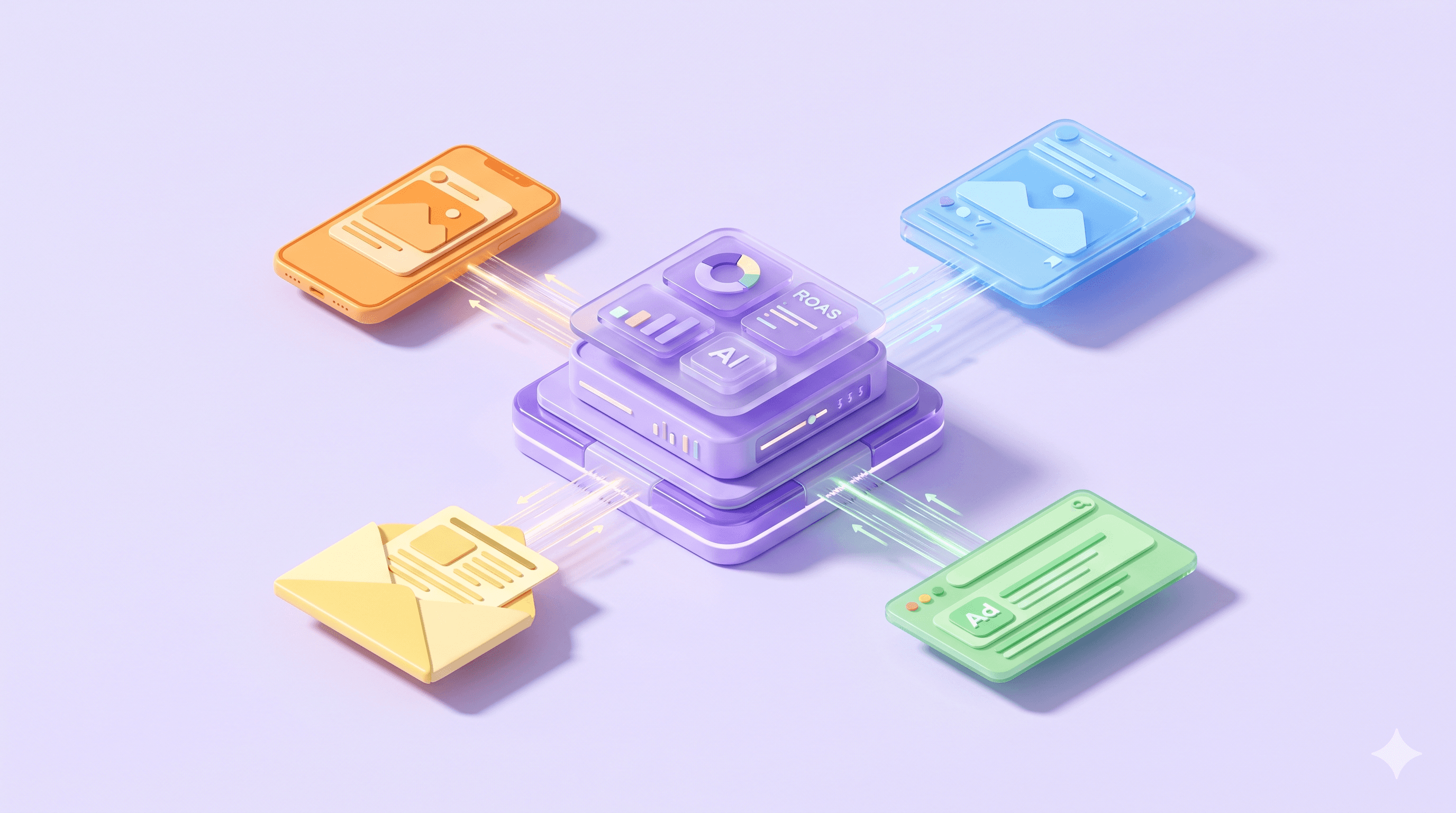
Omnichannel advertising coordinates messaging across every touchpoint a customer encounters, from paid social and email to CTV and in-store displays. Most marketing teams already run ads on multiple platforms. The hard part is getting those platforms to share audience data, react to each other’s signals, and adapt creative based on where a customer sits in their buying journey. The adoption numbers reflect how far the industry has moved: 95.4% of B2C marketers now use AI in their cross-channel strategy, up from 77.2% in 2024.
Key Takeaways
Omnichannel advertising is journey-driven coordination across all customer touchpoints, built on unified data, consistent messaging, and adaptive creative. It differs from multichannel (channels operating independently) and cross-channel (partial data sharing between 2-3 platforms).
Coordinated campaigns across fewer channels outperform disconnected campaigns across many. The gains come from channels sharing audience data and reacting to each other's signals, not from adding more platforms.
Adding channels to a coordinated campaign lowers both cost per action and cost per household reached. The efficiency gain comes from reduced audience duplication and better frequency distribution across platforms.
Most conversions require multiple touchpoints across different channels before a buyer commits. Advertisers run campaigns across more platforms than most teams can manually coordinate, which makes shared audience data and automation a practical necessity.
CTV inventory is now available through major DSPs for performance buying, not just brand campaigns. Integration with identity graphs allows cross-device targeting so a CTV viewer can be retargeted on mobile or desktop without relying on cookies.
Last-click attribution credits only the final touchpoint and misses every interaction that built the conversion. Three models address this: marketing mix modeling (top-down, strategic), multi-touch attribution (bottom-up, weakened by cookie deprecation), and incrementality testing (controlled experiments measuring true lift).
Four failure patterns account for most omnichannel breakdowns: data silos between platforms, channel fatigue from uncoordinated frequency, attribution confusion that over-funds bottom-funnel channels, and organizational silos where teams optimize their own metrics independently.
The three infrastructure layers behind omnichannel are the data layer (CDPs and CRMs for unified customer profiles), the execution layer (marketing automation and DSPs for campaign orchestration), and the identity layer (cross-device graphs linking a single customer across devices).
Omnichannel is not the right investment when a single channel drives the large majority of revenue, creative production capacity is limited to one ad format, or ad spend has not reached the level where cross-channel coordination moves results.
What is omnichannel advertising?
Omnichannel advertising is journey-driven coordination across all customer touchpoints, built on unified data, consistent messaging, and adaptive creative. The channel list matters less than where each person sits in their buying process. A retargeting ad on Instagram, a cart-recovery email, and a push notification about restocked inventory all reference the same customer profile and respond to what that person did last.
The difference from traditional campaign-level channel selection comes down to the integration layer. Running Facebook Ads, Google Search, and email campaigns simultaneously is multichannel. Omnichannel means those channels share audience data, react to each other's signals, and adapt messaging based on what a customer has already seen or done. Salesforce research found that 76% of customers expect consistent interactions across departments. PwC put the cost of failing at this more directly in a 2018 survey: 59% of U.S. consumers stop engaging a brand after several bad experiences, and 17% walk away after just one.
Omnichannel vs multichannel vs cross-channel
Most brands claiming omnichannel are actually somewhere between multichannel and cross-channel. The distinction sits on a maturity spectrum, and being honest about where you fall determines what to build next.
Multichannel | Cross-channel | Omnichannel | |
Data integration | None. Channels operate independently. | Partial. Some data shared between platforms. | Full. Unified customer profile across all touchpoints. |
Customer view | Per-channel. Each platform sees its own slice. | Linked. Some cross-referencing between channels. | Single. One view of each customer, updated in real time. |
Coordination | Manual or none. Campaigns planned per channel. | Some sequencing. Retargeting across 2-3 channels. | Automated orchestration. Real-time decisions across all channels. |
Typical tools | Individual platform dashboards. | Basic data integration, some cross-platform retargeting. | CDP, marketing automation, identity resolution, DSPs. |
Best for | Brands testing new channels with limited resources. | Teams ready to coordinate their top 2-3 channels. | Brands with unified data infrastructure and creative production capacity. |
Advertisers use an average of 7 platforms daily and 9 per campaign (Basis, 2021; note: this figure predates the current CTV and AI creative expansion). That platform volume makes coordination the central challenge. You can be present everywhere and still fail at omnichannel if each platform runs in isolation.
Why omnichannel advertising works
The data case for omnichannel sits in three areas. Revenue: campaigns using three or more channels produce a 494% higher order rate than single-channel campaigns. Retention: the often-cited claim that omnichannel companies retain 89% of customers versus 33% for weak cross-channel performers traces to Aberdeen Group research from 2013, though the original study is no longer accessible and the exact methodology is unclear. Take the specific numbers with caution, but directionally the gap between integrated and disconnected retention is well supported. Cost efficiency: each additional channel in a campaign correlates with a 14% decrease in cost per action and a 21% decrease in cost per household reached.
The less-discussed angle is neurological. A 2024 study by The Trade Desk and PA Consulting found that balanced omnichannel exposure across multiple ad formats is 1.5 times more persuasive and 2.2 times less cognitively fatiguing than heavy single-channel repetition. For media buyers, that changes how frequency planning works. Spreading 12 impressions across CTV, display, and social drives more persuasion per impression than stacking all 12 on a single platform, because the viewer's brain registers each format shift as new information rather than repetition.
One caveat on those numbers. The 494% lift and the 14% CPA decrease come from campaigns where channels shared audience data and adapted messaging in sequence. Running the same creative on five platforms without connecting them is multichannel, and the lift data does not apply.
The omnichannel channel mix
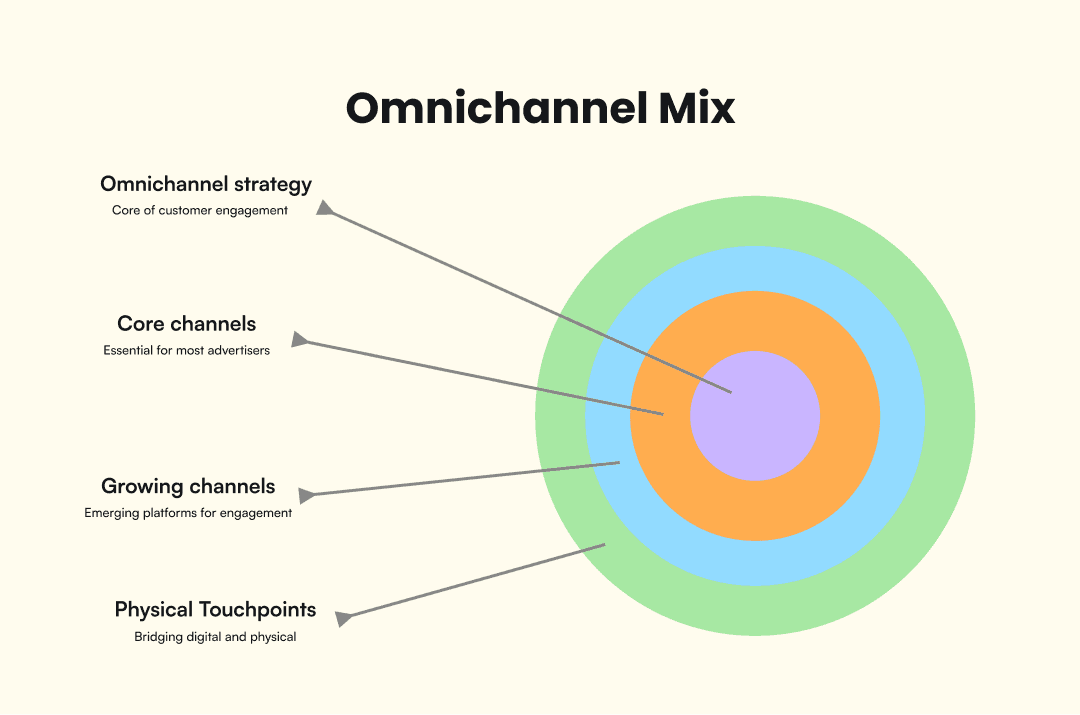
How channels interact matters more than which ones you pick, but the mix still shapes what your team needs to build and maintain. Email remains the highest-performing owned channel for most B2C advertisers, and paid social, search, and display make up the standard paid foundation. CTV and streaming are absorbing more budget each quarter as measurement improves. SMS, mobile push, and WhatsApp are growing fastest in commerce messaging, with WhatsApp particularly strong outside North America.
Physical touchpoints round out the mix. In-store experiences, BOPIS (buy online, pick up in-store), and events let advertisers reach the same customer across screens and physical spaces. Click-and-collect adoption has grown steadily since 2020, and mobile commerce now accounts for more than half of U.S. e-commerce spend, which means the line between "digital channel" and "physical channel" barely exists for most shoppers. With six to eight touchpoints typically needed before a conversion, the operational question is which channel combination gets your specific audience there at the lowest cost per acquisition.
CTV and streaming as a performance channel
Connected TV advertising reaches over 185 million streaming viewers in the U.S, a number that exceeds the roughly 131 million total U.S. households because multiple people per household subscribe to and watch streaming services independently. What changed in the past two years is access. CTV inventory is now available through major DSPs for performance buying alongside brand campaigns. Identity graphs built into major DSPs now let advertisers follow a viewer from a CTV spot to a retargeting ad on mobile or desktop, filling the gap that cookie deprecation left in cross-device tracking.
For media buyers running cross-channel campaigns, CTV fills a gap that display and social cannot. It delivers long-form video attention in a lean-back environment, and it is now measurable at the household level through programmatic platforms.
Building an omnichannel advertising strategy
Building an omnichannel advertising strategy starts with knowing your audience and ends with a measurement system that can tell you whether the channels you picked are working together or just coexisting.
Audience mapping. Start with where your customers actually spend time during a purchase. Demographics tell you who they are; behavioral data tells you which touchpoints they use and in what order. B2B buyers touch an average of 10 channels per purchase, with 42% using 11 or more. B2C paths are shorter but less predictable. A shopper might discover a product on TikTok, compare prices on Google, and convert through an email three days later.
Channel selection. Your channel list should follow from the audience map. Choose the channels your audience already uses during their buying journey, then add channels that fill gaps in the sequence. If 80% of your conversions come from paid social and email, coordinate those two first. CTV or programmatic display comes after the core loop is producing consistent results.
Journey design. Sequence your touchpoints around intent. An awareness ad on Instagram should not serve the same message as a retargeting email three days later. From there, map the creative assets you need per channel and stage. That list becomes your production brief.
Measurement setup. Before you launch, lock in your attribution model, define KPIs per channel and per journey stage, and build a testing cadence. Bolting on measurement after the fact means your first month of spend generates no usable learning.
Budget allocation. Each channel's budget should reflect its contribution to the full journey rather than its standalone ROAS. A channel that assists six conversions but closes none looks worthless in last-click reporting, and that misread is exactly how teams end up cutting their best upper-funnel spend. Journey-based attribution shows what each touchpoint is actually doing for the sequence.
Omnichannel for DTC and e-commerce brands
The typical DTC omnichannel stack looks different from enterprise retail. Most DTC brands operate with Shopify or equivalent, one marketplace like Amazon, Meta and social ads, email, and SMS. The physical touchpoints that define enterprise omnichannel, in-store, BOPIS, and retail partner integrations, do not apply until much later in a brand's growth.
Start by getting email and paid social to work in coordination. Share audiences between your email platform and ad accounts. Sequence messaging so abandoned cart emails do not compete with retargeting ads showing the same product at a different price. Skip full CDP investment, digital out-of-home, and in-store integrations until your monthly ad spend and customer base justify the infrastructure cost.
Creative production across channels
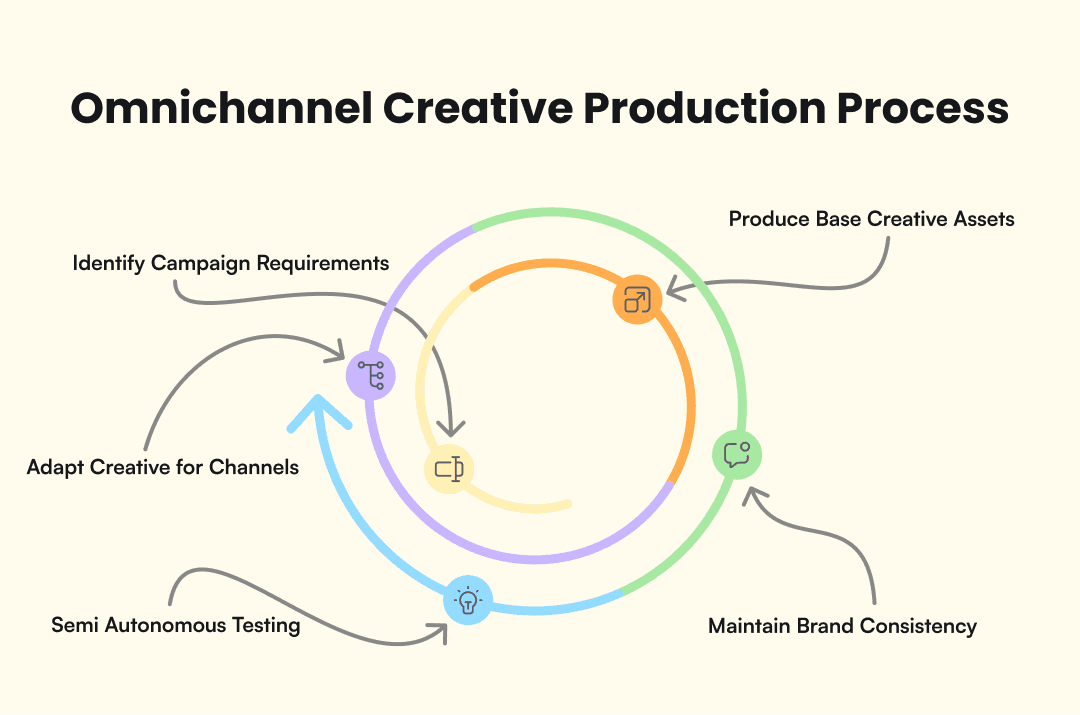
Omnichannel multiplies creative needs faster than most teams expect. A single campaign across five channels, three audience segments, and two creative variants requires over 30 individual assets: vertical video for Reels and TikTok, horizontal for CTV, statics for display, copy for email and SMS. Every new channel or segment adds another layer.
Deciding which audiences get personalized messaging is a strategy question. Producing those messages in every format and aspect ratio for every channel is a volume problem, and volume problems compound fast when you scale from three channels to seven.
AI-driven tools close that gap by generating channel-specific variations from a base concept. Instead of building 30 assets by hand, teams produce core creative and let the system handle format adaptation. Tools like AdMove run this as an autonomous workflow: feed in a concept, and platform-ready variants come out across the full channel mix without manual resizing.
The hard constraint is consistency. A viewer who sees your CTV spot and later encounters your Instagram Story ad should recognize both as the same brand and the same message, adapted for each screen. That thread has to hold across every format, or the channel variations work against each other instead of reinforcing the journey.
Common challenges and how to avoid them
Data silos, channel fatigue, attribution confusion, and organizational silos. These four failure patterns account for most omnichannel breakdowns.
Data silos. Each channel collects customer data independently. Your email platform knows purchase history, your ad accounts know click behavior, and your CRM knows support interactions, but none share a unified view. If you see different customer counts across platforms or cannot tell whether an email subscriber also engaged with a social ad, data silos are the root cause. The fix starts with a CDP or, at minimum, a shared customer ID across your core channels.
Channel fatigue. More touchpoints mean more messages without coordination. A customer who sees the same product in a display ad, a Facebook retargeting ad, an email, and an SMS within the same day is not experiencing omnichannel. They are experiencing spam from four directions. If your unsubscribe rates climb as you add channels, frequency capping and cross-channel message orchestration need immediate attention.
Attribution confusion. Without a clear measurement model, budgets migrate toward whichever channel has the easiest-to-track conversions, which usually means over-investing in bottom-funnel search and under-investing in the awareness and consideration touchpoints that feed it. If your team argues about which channel "gets credit" for conversions, the attribution model is the problem, not the channel performance.
Organizational silos. When the email team, social team, and paid media team each optimize their own channel metrics without cross-channel coordination, you get three well-optimized channels that do not function together. Shared KPIs and a single cross-channel calendar are the minimum fix.
When omnichannel isn't the right approach
If one channel drives 80% or more of your revenue, mastering that single channel will probably outperform splitting your attention and budget across five. Omnichannel is an infrastructure investment, and like any infrastructure investment, it has a minimum scale where the return justifies the cost.
Signs you are not ready:
Your team cannot produce more than one ad format per campaign.
You do not know which customers overlap between your email list and your ad audiences.
Your monthly ad spend sits below the threshold where cross-channel coordination moves the needle. For most DTC brands, that threshold lands around $30,000 to $50,000 per month.
You have no unified customer ID, no creative production capacity for multi-format output, and no measurement infrastructure to track cross-channel impact.
What to do instead: pick your two or three strongest channels, share audiences between them, and coordinate messaging so those channels reinforce each other rather than repeat the same message. Audience-based buying across a small set of coordinated channels delivers most of the omnichannel benefit at a fraction of the infrastructure cost. Full orchestration can follow when your data, creative production, and measurement systems are ready.
Brands getting omnichannel right
Starbucks connects its rewards app, in-store experience, and mobile ordering into a single loop where every purchase, regardless of channel, updates the customer's profile and triggers relevant offers. The data infrastructure behind the program is genuinely unified, which is why it remains the default example of omnichannel retail.
Nike runs a unified commerce model across its DTC site, Nike app, Amazon marketplace, and retail partners. The Nike app connects online browsing with in-store availability and exclusive product drops. A shopper who saves a shoe on the app can check stock at their nearest store and reserve their size before walking in.
Sephora's Beauty Insider program pairs augmented reality virtual try-on with its in-store and online experience. The AR tool generates engagement data that feeds tailored recommendations across email, app, and in-store consultations.
Where the work actually sits
If you're still at multichannel, coordinate audiences and messaging across your top two or three channels before adding anything new. If you're already running cross-channel, the bigger return comes from investing in unified data and creative adaptation, not from adding a sixth platform. The operational needs are the same at every stage: producing creative across formats at speed, building audiences from first-party data, and measuring across the full journey instead of the last click. AdMove handles the creative production side of that, generating platform-ready variants from a base concept so teams can cover more channels without hiring more people.