

Scaling Facebook ads means spending more while keeping returns stable or improving them. That’s different from optimizing, which improves performance at your current spend level. Scaling pushes into new budget territory where different rules apply. Most scaling attempts fail within the first week, and the reason is mechanical: budget increases over 20-30% often trigger Meta’s learning phase reset, which can raise your CPA by 25-40%. Your campaign forgets what it learned and starts over.
On a platform with 3.07 billion monthly active users, the audience isn’t the bottleneck, but most scaling approaches are. Most scaling guides cover one dimension: raise budget (vertical scaling) or find new audiences (horizontal scaling). A complete scaling system covers five dimensions: readiness diagnostics, budget mechanics, audience expansion, creative velocity, and measurement infrastructure.
This guide covers all five. Advantage+ campaigns, server-side tracking through CAPI, and the growing dominance of creative as the primary scaling lever have reshaped how scaling works since 2023. Here’s the system built for 2026.
Are You Ready to Scale? The Scaling Readiness Checklist
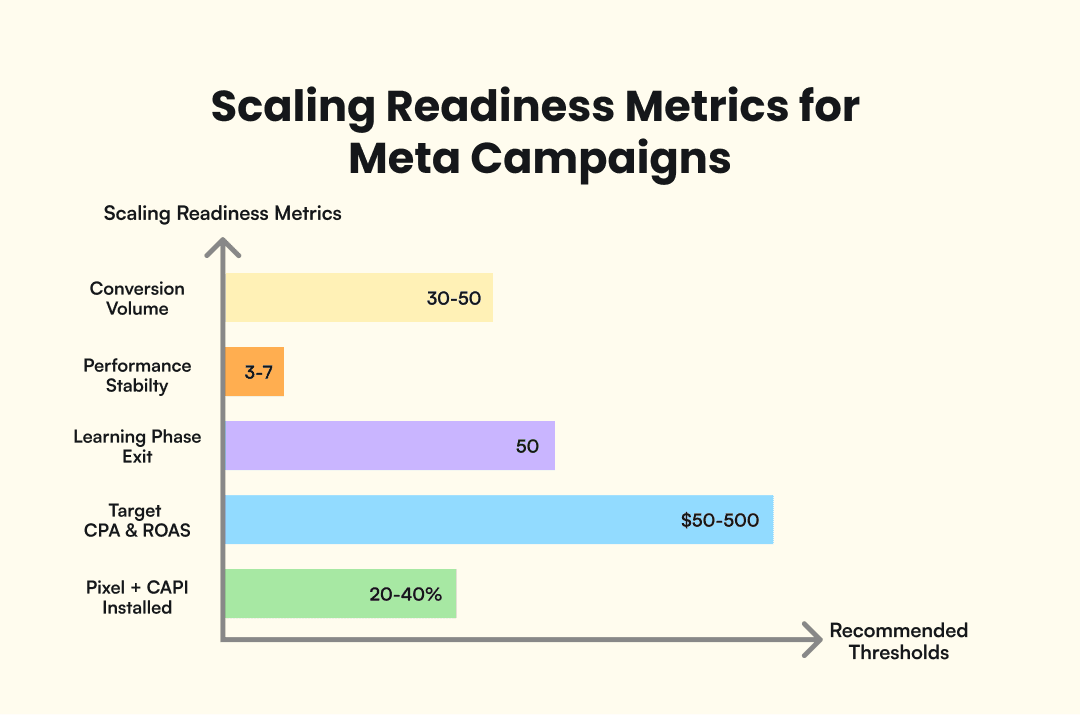
Scaling a campaign that isn’t ready is the fastest way to waste budget. Before you touch a budget slider, every item below should check out. Missing even one of these creates a crack that widens under increased spend:
Conversion volume: At least 30-50 conversions per week. Below that, Meta’s algorithm doesn’t have enough data to adjust delivery after a budget change.
Performance stability: Your KPIs (CPA, ROAS, CTR) should hold steady for 3-7 days before any scaling move. You can monitor these trends through AdMove’s Product Intelligence or directly in Ads Manager. A single good day isn’t a trend.
Learning phase exit: Each ad set needs roughly 50 optimization events to exit Meta’s learning phase. If your ad set still shows “Learning” in Ads Manager, scaling will reset that progress.
Profitable baseline: Your current CPA and ROAS need to be within your target range. Scaling amplifies what already exists. If your unit economics don’t work at $50/day, they won’t work at $500/day.
Pixel + CAPI installed: Meta Pixel alone captures roughly 40% of conversion events. CAPI recovers 20-30% of that lost data. Without server-side tracking, you’re scaling on incomplete signals.
Don’t scale until you’ve checked every box.
Vertical Scaling: Increasing Budget the Right Way
Vertical scaling means one thing: increasing budget on campaigns that are already profitable. The concept is simple, but the execution has a tripwire built in.
The 20% rule (and its range): Increase your budget by 10-20% every 3-5 days. Budget jumps over 20-30% often push ad sets back into Meta’s learning phase, where CPA can spike 25-40% while the algorithm relearns who to target. The goal is to push spend upward without tripping that reset.
Learning phase math: Meta needs roughly 50 optimization events per ad set to exit learning phase. The minimum budget to clear that bar: cost per purchase × 50 ÷ your conversion window. For a $30 CPP with a 7-day window, that’s $30 × 50 ÷ 7 = $214/day. This varies by campaign objective and optimization event, so run the calculation for your specific setup.
Daily vs. weekly cadence: At higher budgets ($500+/day), small daily bumps of 10-15% keep the algorithm stable. Campaigns using CBO (Advantage Campaign Budget) have more flexibility here because Meta distributes the increase across ad sets automatically. At smaller budgets ($50-100/day), weekly increases of 15-20% give enough time between changes to read actual performance shifts. The mistake is applying high-budget cadence to a small account, where each increase creates a bigger proportional disruption.
Ceiling signals tell you vertical scaling has hit its limit. Watch for these signals.
Frequency climbing above 3.0 (audience seeing your ads too often)
CPM spiking without a corresponding CTR lift
CPA drifting beyond your target for 3+ consecutive days
When these signals appear, it’s time to shift to horizontal scaling or refresh your creative.
Horizontal Scaling: Expanding Your Audience
When vertical scaling hits its ceiling, horizontal scaling picks up. Instead of spending more on the same audience, you’re reaching new people through new audiences, placements, and geographies. The goal is to find additional pockets of profitable demand without competing against your own campaigns.
Lookalike expansion ladder: Start with a 1% lookalike audience built from bottom-of-funnel actions like purchases or high-LTV conversions. Once that performs, expand to 3-5%, then test 10%. Value-based lookalikes, built from purchase value rather than just conversion counts, tend to outperform standard lookalikes at every tier because they attract higher-intent buyer personas.
Broad targeting as the new default: The 2025-2026 consensus among media buyers has shifted. Meta’s algorithm, especially inside Advantage+ campaigns, performs best with open targeting and strong creative. Instead of layering dozens of interests, many top advertisers now run broad with zero interest targeting and let the creative do the filtering. This works because Meta’s AI matches ads to users based on creative signals, not just audience parameters.
Other horizontal scaling methods worth testing.
Method | How It Works |
Interest stacking | Combine 3-5 related interests into a single ad set. Gives the algorithm a focused pool without over-restricting delivery. Best for niche products where broad burns budget. |
Geographical expansion | Test Tier 2 markets (outside US/UK/AU) where CPMs run 40-60% lower. Start by testing your best creative in these markets before developing region-specific angles. |
Audience overlap management | Use Meta’s Audience Overlap tool to check if ad sets share >20-30% of the same users. Build exclusion lists of existing customers to keep each ad set reaching new people. |
Advantage+ and Automation: The Modern Scaling Stack
Advantage+ Shopping Campaigns (ASC) changed how scaling works at the infrastructure level. Instead of manually building audiences and choosing placements, ASC hands those decisions to Meta’s AI. You set a budget and provide creative. The algorithm handles targeting, placement, and delivery across Meta’s entire inventory.
The performance data backs this up: ASC delivers $4.52 in revenue per $1 spent, 22% higher than manual campaigns. Adoption has grown 70% year-over-year, and 35% of US retail ad spend now runs through ASC, up from 19% the prior year. The scope has expanded too: ASC now supports ecommerce, lead generation, and app install objectives, making it relevant beyond product catalog campaigns. For scaling specifically, ASC reduces the manual overhead of audience segmentation, freeing you to focus on creative and measurement.
CBO (Advantage Campaign Budget) distributes your budget across ad sets automatically, pushing spend toward whichever ad set performs best. Use CBO when scaling (it adapts to performance shifts in real time) and ad set budgets when testing (you need controlled spend per variable).
Automated safeguard rules protect scaling from runaway spend. Every scaling account needs three safeguard rules.
Rule | Trigger | Action |
Scale rule | CPA below target for 3+ days | Increase budget 15-20% |
Stop rule | CPA exceeds ceiling by 20% | Pause the ad set |
Fatigue rule | Frequency crosses 3.0 | Reduce budget or refresh creative |
Use cost caps or bid caps as additional guardrails at higher spend levels.
CAPI (server-side tracking) is the technical ceiling most advertisers don’t see. With iOS privacy changes and browser restrictions, pixel-only tracking captures roughly 40% of actual conversions. CAPI sends first-party conversion data directly from your server to Meta, recovering 20-30% of lost signals. Brands that implemented CAPI report 15-20% performance improvement. Fix your tracking before you scale, because the algorithm can only improve toward what it can measure.
Meta Andromeda, the retrieval engine behind ad delivery, uses these signal inputs to match your ads with the right users. Stronger signals through CAPI mean Andromeda distributes your ads to higher-intent audiences, which produced an 8% improvement in ad quality and relevance.
Creative Velocity: The #1 Scaling Lever
With Advantage+ handling targeting and CAPI feeding clean data, the variable that determines how far your campaigns scale is creative. Meta’s algorithm adjusts delivery based on which creative connects with which audience segment. At scale, creative accounts for an estimated 56-70% of campaign performance differences.
Creative fatigue is the silent scaling killer. The average ad creative lasts roughly 21 days before performance degrades. Frequency above 3.0 confirms the audience has seen your ad too many times. At budgets above $100/day, fatigue accelerates because you’re burning through your audience faster, which means your production cadence needs to increase proportionally.
The 3-2-2 method gives you a repeatable system for scaling creative output without starting from scratch each time. Take one winning concept and build:
3 different hooks
2 body copy versions
2 headlines
That’s 12 ad variations from a single idea. Top-scaling brands produce 20-50 creatives per month using systems like this, and the key word is “system” because volume without structure just creates noise.
Post-ID engagement preservation is a tactic most advertisers miss entirely. When you move a winning ad to a new campaign or ad set, use the Post-ID (the unique identifier for that specific ad post) to carry over all existing likes, shares, and comments. Social proof compounds performance, and resetting it by duplicating the ad instead of referencing the Post-ID wastes the engagement you already built.
Format diversification matters more than it used to. Short-form placements like Reels and Stories (9:16 vertical) are projected to account for 35-55% of total Meta impressions for active video advertisers. If you’re only running static images or square video, you’re missing where a growing share of attention actually sits. Test across static, video, carousel, and UGC-style content to find which formats scale best for your product.
Scaling Metrics That Actually Matter
Scaling changes your relationship with metrics. Numbers that looked stable at $50/day behave differently at $500/day, and the averages that guided your testing phase can mask problems at higher spend. Tracking the right metrics at the right level keeps you from pulling the wrong levers.
Level | Metrics | What They Tell You |
Health check (daily) | ROAS, CPA, CTR | Whether the return justifies the spend, acquisition costs are on target, and creative is connecting. If any move sharply after a scaling change, that’s your first alert. |
Diagnostic (investigate) | Frequency, CPM, CTR decay | Frequency above 3.0 = audience oversaturation. Rising CPM with flat CTR = audience saturation or auction competition. CTR decay over 3-5 days = creative fatigue, not an audience problem. |
Full picture (cross-channel) | MER, Overall ROAS | MER (total revenue ÷ total spend across all channels) captures what in-platform ROAS misses: Amazon sales from FB awareness, organic lifts, repeat purchases. Overall ROAS extends this to non-ecommerce with indirect revenue. |
When to pause vs. push: If CPA exceeds your target by more than 20% for 3+ consecutive days after a scale, roll the budget back. If frequency climbs above 3.0 and CPM rises alongside it, shift to horizontal scaling or a creative refresh. If in-platform ROAS drops but MER holds steady, the scaling is actually working at the business level. Don’t kill what you can’t fully measure.
FAQ
What does scaling Facebook ads mean?
Scaling means increasing your ad spend while maintaining or improving return on investment. It goes beyond raising a budget and involves expanding audiences, refreshing creative, and building technical infrastructure (CAPI, Advantage+) to handle higher spend without performance drops.
Is vertical or horizontal scaling better for Facebook ads?
They work together, not against each other. Start with vertical scaling on winning campaigns until ceiling signals appear (frequency above 3.0, rising CPM), then expand horizontally into new audiences. Most successful strategies use both.
When should I start scaling my Facebook ads?
When you hit at least 30-50 conversions per week, your campaigns have exited learning phase, your KPIs have been stable for 3-7 days, and your CPA and ROAS sit within your target range.
Is $10 a day enough for Facebook ads?
$10/day works for testing creative and validating your offer, but it’s tight for scaling. Most scaling tactics become practical at $50+/day, where there’s enough data flow for Meta’s algorithm to perform effectively.
What is the 3-2-2 method for Facebook ads?
The 3-2-2 method produces 12 ad variations from one concept: 3 hooks × 2 body copies × 2 headlines. It’s a system for scaling creative output without rebuilding ads from scratch.