

The AI avatar vs. humans debate keeps producing the same article: a pros-and-cons list that ends with “use both.” That advice isn’t wrong, but it’s not useful either. What advertisers need to answer is when each option makes strategic sense for your specific production context, budget, and audience.
One market projection estimates the AI avatar market will grow from $0.80 billion in 2025 to $5.93 billion by 2032 at a 33.1% CAGR. Roughly a third of brands already use avatars in their content. But the growth story alone doesn’t tell you which to pick for your next campaign. This article brings findings from four independent studies, a structured decision framework, and an advertising-specific lens that most comparisons skip. The hybrid approach is the destination, but getting there takes more than generic advice.
Key Takeaways
AI avatar platforms produce finished video from a typed script at a fraction of the cost and time of traditional production, making them the stronger choice for high-volume, repeatable content like product demos, multilingual campaigns, and creative testing at scale.
Multiple independent studies from 2024 to 2026 found no meaningful difference in engagement, retention, or trust between AI avatar and human-presented videos for standard informational and educational content.
Picture-in-picture format, where the avatar appears as a small overlay on screen content, sidesteps uncanny valley discomfort. Fullscreen avatar formats make robotic traits easier to spot and lower perceived quality.
Mixing AI and human elements within a single video hurts comprehension. Pairing an AI avatar with a human voice, or a human presenter with an AI voice, increases cognitive load. Production teams should commit fully to one format per video.
Humans hold clear advantages in four areas AI avatars cannot replicate yet: emotional resonance through real micro-expressions, trust during high-stakes messaging like crisis communications, improvisation and real-time adaptability, and brand personality through recognizable faces.
The hybrid approach works best when it's intentional: AI avatars handle the high-frequency, multilingual, scripted content while humans cover moments that require genuine emotional connection or real-time responsiveness.
What AI Avatars Are (and What They’re Not)
AI avatars are AI-generated video presenters that deliver scripted content using synthetic voice and lip-synced visuals. You type a script, choose an avatar appearance, and the platform produces a finished video of that avatar speaking your words. The underlying technology stack combines text-to-speech synthesis, lip-sync mapping, and natural language processing for pacing and intonation.
AI avatars are different from digital humans, which are real-time interactive characters built for customer service and gaming. Avatars are pre-rendered and script-based. You don’t have a conversation with them; they deliver your message. Current-generation models offer 50 to 160+ languages from a single script, diverse avatar appearances, and brand-matched visual styling.
What AI avatars still cannot do:
They don’t improvise or react to unscripted moments
They don’t read a room or adjust to audience energy in real time
They don’t convey genuine surprise, humor, or frustration
They follow the script you give them, and only that script
For scripted, controlled content, these limitations rarely matter. For anything that depends on spontaneity, they’re disqualifying.
Where Humans Still Win
A 2024 University of South Florida study found no significant difference in engagement, retention, or trust between a hyper-realistic AI avatar and a human presenter for standard content. That’s a meaningful finding, but “standard content” is doing heavy lifting in that sentence. When the stakes rise, when the topic gets personal or the message carries weight, humans hold clear advantages.
Emotional depth is the biggest one. Humans convey micro-expressions and spontaneous reactions that AI avatars can’t replicate yet. A founder explaining why they started their company, a customer service lead addressing a product recall, a CEO responding to a public crisis. These moments call for a real face and the trust it carries. Then there’s improvisation: humans adapt mid-sentence, read audience energy during a live demo, and adjust tone when a message isn’t landing.
The four core advantages humans maintain over AI avatars:
Emotional resonance through real micro-expressions and unscripted reactions
Trust in high-stakes messaging: crisis communications, sensitive announcements, brand apologies
Improvisation and real-time adaptability when things go off-script
Brand personality through recognizable faces that build long-term audience loyalty
These are practical advantages for specific content types, and no amount of rendering quality will close these gaps anytime soon.
Where AI Avatars Pull Ahead
Cost is the headline advantage, and the gap is wide. Traditional video production runs $1,000 to $5,000 per minute with freelancers and $15,000 to $50,000 per minute at agency level. AI avatar platforms charge between $0.50 and $30 per minute.
Speed matches the cost story. A 60-second marketing video averages 13 days from brief to delivery through traditional production. With AI avatars, that drops to roughly 27 minutes. These are industry estimates from a marketing aggregator, not controlled studies, but the direction is consistent across sources.
Multilingual reach scales without reshoots. A single script produces output in 50 to 160+ languages with matched lip-sync and localized delivery. For brands running campaigns across multiple markets, this single capability can justify the platform cost on its own. Brand consistency comes with the format: same avatar, same tone, same visual identity across every video, with no scheduling conflicts or talent availability gaps to manage. AdMove’s AI Video Generator applies this speed advantage to ad production specifically.
Factor | AI Avatar | Traditional | Scalability | Multilingual |
Cost / min | $0.50–$30 | $1K–$50K | — | — |
Time (60s video) | ~27 minutes | ~13 days | — | — |
Scale capacity | 50x increase documented | Crew-limited | 50x (Whole Life Pet) | — |
Languages | 50–160+ per script | Reshoot per language | — | Single-script output |
Consistency | Identical every time | Varies by session | No talent scheduling | — |
What the Research Says
A December 2024 study from University College London tested AI-generated instructional videos against human-presented versions with 500 participants. The result: equal learning gains and engagement across both formats. Participants using AI avatar videos completed training 20% faster with no negative impact on knowledge retention.
The University of South Florida reached a similar conclusion in 2024. Researchers found no significant difference in engagement, retention, or trust between a hyper-realistic AI avatar and a human presenter. The parity held across standard educational and informational content, though the study did not test emotionally complex or high-stakes scenarios.
TechSmith’s Camtasia study added a production format layer. Over 92% of viewers rated AI avatar videos as professional quality. The most actionable finding was format-dependent: picture-in-picture layouts, where a small avatar overlay appears on screen content, produced the strongest learning retention. Fullscreen avatars lowered quality ratings because the larger format made robotic traits easier to spot.
A June 2025 study published in Springer’s Education and Information Technologies journal introduced a consistency requirement. Significant engagement improvement occurred only when both voice and avatar were AI-generated. Mixed formats performed worse: pairing an AI avatar with a human voice, or a human presenter with an AI voice, increased extraneous cognitive load (ECL) and hurt comprehension. The takeaway for production teams is practical: if you use AI avatars, commit fully to the format. Don’t mix and match.
Study | Year | Key Finding | Practical Implication |
UCL | Dec 2024 | Equal learning gains; 20% faster completion | AI avatars match human instruction for training content |
USF | 2024 | No engagement or trust difference | Parity confirmed for standard informational content |
TechSmith / Camtasia | Feb 2026 | 92%+ professional rating; PiP outperforms fullscreen | Use picture-in-picture to avoid uncanny valley triggers |
Springer Nature | Jun 2025 | AI voice + AI avatar outperforms mixed formats | Commit fully to AI or human; don’t hybrid the presenter |
The Uncanny Valley Problem (and How It’s Shrinking)
The uncanny valley remains the biggest perceptual barrier to AI avatar adoption. When a synthetic face looks almost human but misses subtle cues like natural eye movement or fluid micro-expressions, viewers feel discomfort rather than connection. The effect is real, well-documented, and still relevant in 2026, even as rendering quality improves with each model generation.
The Camtasia study from February 2026 offers a direct workaround. Picture-in-picture format, where the avatar appears as a small overlay on screen content, sidesteps the uncanny valley almost entirely. Viewers focus on the primary content and treat the avatar as a visual guide rather than scrutinizing its realism. Fullscreen formats trigger the opposite reaction: the bigger the avatar on screen, the easier it is to spot what’s off.
Spiel Creative raises a related concern: AI presenters can become visually monotonous over time, especially when the same avatar appears across dozens of videos without variation in style or setting.
Three developments are narrowing the gap:
HeyGen’s Avatar IV deliver noticeably better micro-expressions and natural movement than their 2024 predecessors, pushing toward hyper-realism
Format choices like picture-in-picture reduce viewer scrutiny regardless of underlying avatar quality
Rotating avatar appearances, visual settings, and presentation styles across a content series reduces the fatigue effect
AI Avatars in Advertising: The Use Case Nobody’s Covering
Most AI avatar comparisons focus on training videos and corporate communications. Advertising barely gets mentioned, which is odd given that ad production is where the speed and scale advantages hit hardest.
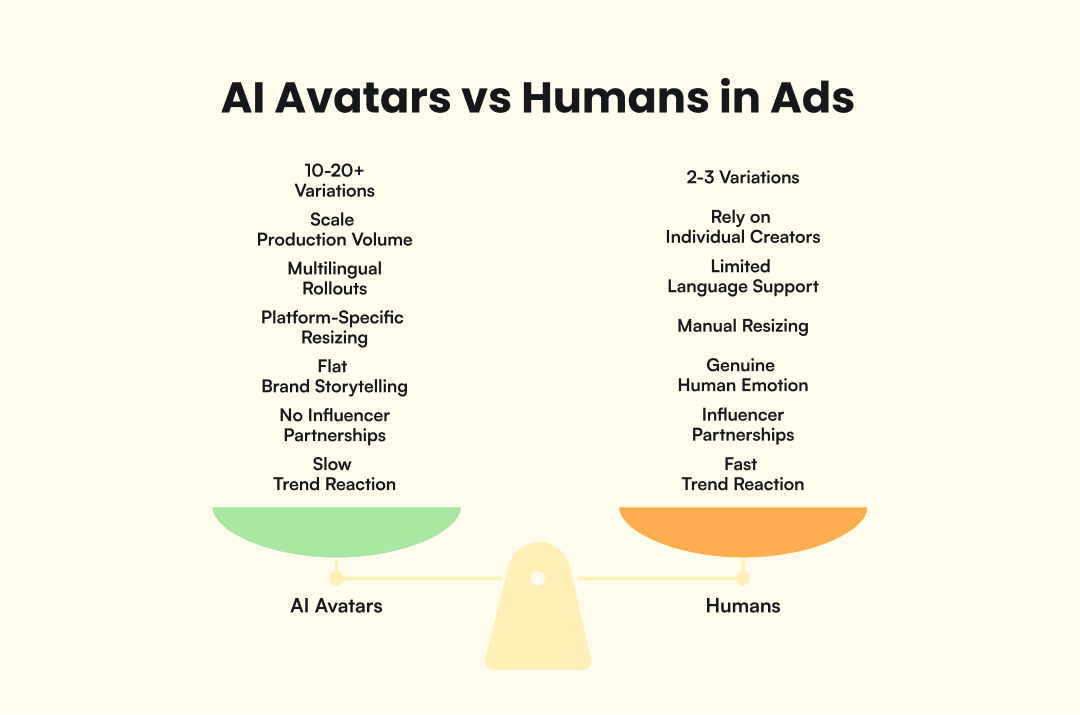
Creative testing velocity is the application that changes the math. Traditional production limits most advertisers to two or three creative variations per campaign cycle. The time and cost to film, edit, and deliver each version bottlenecks how fast your team can learn what works. With AI avatars, you can produce 10 to 20+ variations from the same base script, testing different hooks, presenter styles, and delivery tones against real performance data in days rather than months.
The practical advertising applications span multiple formats:
Product demo videos with a consistent presenter across your entire catalog
UGC-style ads that scale production volume without relying on individual creators
Multilingual campaign rollouts from a single script across Meta, TikTok, and YouTube markets
Platform-specific resizing: vertical for TikTok and Reels, square for Instagram feed, horizontal for YouTube pre-roll
AI avatars don’t work everywhere in advertising, though. Brand storytelling that requires genuine human emotion falls flat with synthetic presenters. Influencer partnerships depend on real personalities with existing audience trust. And trend-reactive content, where speed of a real person picking up a phone beats any scripted AI pipeline, still favors humans.
How to Decide: A Framework That Goes Beyond “It Depends”
Every comparison article ends with “it depends.” This section replaces that with specific criteria mapped to directional recommendations. Use the matrix below to match your production context to the right approach. Each row is a decision point; find the ones that apply to your next campaign and read across.
Criteria | AI Avatar | Human | Either / Hybrid |
Training / onboarding | Best fit: repeatable scripted modules | ||
UGC / performance ads | For scale and volume | For authenticity-led campaigns | Depends on campaign objective |
Brand storytelling | Emotional depth needs a real face | ||
Customer service videos | For FAQ and how-to libraries | For complaint resolution or empathy-driven content | |
Low emotional stakes (tutorials) | Strong fit | ||
High emotional stakes (crisis, founder story) | Strong fit | ||
One-off production | May be simpler and cheaper | Either viable | |
High volume / ongoing | Cost advantage compounds over time | ||
Budget under $1K/video | Likely the only viable option | ||
Budget $5K+/video | Human production viable at this level | ||
B2B / professional audience | Higher tolerance; content > personality | ||
B2C / Gen Z audience | Authenticity expectations higher | Either, with careful format choice | |
Single language | Either works | ||
Multilingual reach | Significantly more cost-efficient |
A useful mental model for hybrid production: AI handles roughly 70% of your content volume (the repeatable, scripted, high-frequency work) while humans handle the remaining 30% that needs creativity, emotional weight, or real-time responsiveness. This framing surfaces across AI strategy discussions and works as a starting point, not a rigid formula. The exact split depends on your brand, audience, and content calendar. The creative strategy behind the split matters more than the ratio itself.
The matrix above turns “which should I use?” into “what am I producing, for whom, at what scale, and for which audience?” That second question has a clear, data-informed answer for most campaigns. Start with the criteria that constrain you most, whether that’s budget, language requirements, or content volume, and let those drive the format decision.
Beyond the Binary: Alternatives Worth Considering
The AI avatar vs. human debate frames the choice as binary, but several production formats fall between or outside those poles. These are worth evaluating before you commit to either approach:
Voice-only / faceless video. Screen recordings, product walkthroughs, or footage paired with AI voiceover narration. This format sidesteps the uncanny valley entirely and works well for tutorials, demos, and technical content. AdMove’s AI Voiceover Generator handles the narration layer.
Animated characters and motion graphics. Stylized visuals that avoid realism expectations altogether. Strong for explainer content where clarity matters more than presenter personality.
Stock footage combined with AI voice. Pair existing footage libraries with synthetic narration. Cost-effective, fast, and free of avatar limitations. Good for brands with extensive product footage that needs narrated context.
Digital twins and voice cloning. Clone a real person’s likeness and voice to produce content at scale without scheduling the real person for every session. An emerging capability sometimes called the “2026 Sweet Spot” in AI strategy discussions, with significant ethical and consent considerations.
Screen recordings with human voiceover. The low-tech middle ground that still delivers for internal training and product demos where information outweighs presenter personality.
Ethics, Disclosure, and the Rules You Need to Know
AI avatar technology shares foundational methods with deepfake technology, which makes transparency non-negotiable for advertisers using synthetic presenters. If your audience discovers they’ve been watching a synthetic presenter without clear disclosure, the trust damage is difficult to reverse and can undermine the campaign entirely.
The regulatory picture is tightening across major markets. Key touchpoints:
China’s Cyberspace Administration enacted mandatory AI content labeling rules effective September 2025, requiring visible disclosure on all AI-generated video content
The FTC has signaled increasing scrutiny of AI-generated content in advertising, particularly around consumer deception and undisclosed synthetic presenters
GDPR implications apply when AI platforms process voice data, likeness data, and scripts, adding a data privacy layer for campaigns targeting European audiences
The practical checklist is short: label AI-generated content visibly, get explicit consent before cloning anyone’s likeness or voice, understand what data your avatar platform retains and where it’s stored, and build disclosure into your production workflow from the start rather than retrofitting it later.
FAQ
Can AI avatars fully replace human presenters?
AI avatars cannot fully replace human presenters. Humans hold advantages in emotional resonance through micro-expressions, trust during crisis communications, real-time improvisation, and brand personality through recognizable faces. Most advertisers get the best results from a hybrid model where AI handles high-volume scripted content and humans cover moments that require genuine emotional connection.
What is the best video format for AI avatar content?
Picture-in-picture format produces the strongest results for AI avatar videos. A small avatar overlay on screen content sidesteps uncanny valley discomfort because viewers focus on the primary content rather than scrutinizing the avatar's realism. Fullscreen formats lower perceived quality by making robotic traits more noticeable.
Do advertisers need to disclose AI-generated video content?
Disclosure is legally required in some markets and a trust-building practice everywhere else. China enacted mandatory AI content labeling rules effective September 2025, the FTC has signaled increasing scrutiny of synthetic presenters in advertising, and GDPR adds data privacy requirements for campaigns targeting European audiences. Building disclosure into your production workflow from the start is cheaper and safer than retrofitting it later.
How much do AI avatar videos cost compared to traditional production?
AI avatar platforms charge between $0.50 and $30 per minute, while traditional video production runs $1,000 to $5,000 per minute with freelancers and $15,000 to $50,000 per minute at agency level. Production time also drops from an average of 13 days for a 60-second video to roughly 27 minutes with AI avatars.
Conclusion
The useful question has always been “which one, for what, and when?” The decision matrix above gives you a specific answer for most production scenarios, matching content type, emotional stakes, volume, and audience to the right format.
The hybrid approach wins for most advertisers, but only when it’s intentional. Use AI avatars for high-volume, multilingual, repeatable work where speed and cost drive the decision. Reserve humans for moments that require genuine emotional connection or the trust that only a real face carries.
Platforms like AdMove make the AI side of that equation faster by treating avatar-based video as one capability inside an autonomous ad production pipeline. The creative bottleneck stops being the reason your campaigns stall, and the production decision becomes strategic instead of reactive.