The Real Impact of AI Ad Generators on Marketing Teams
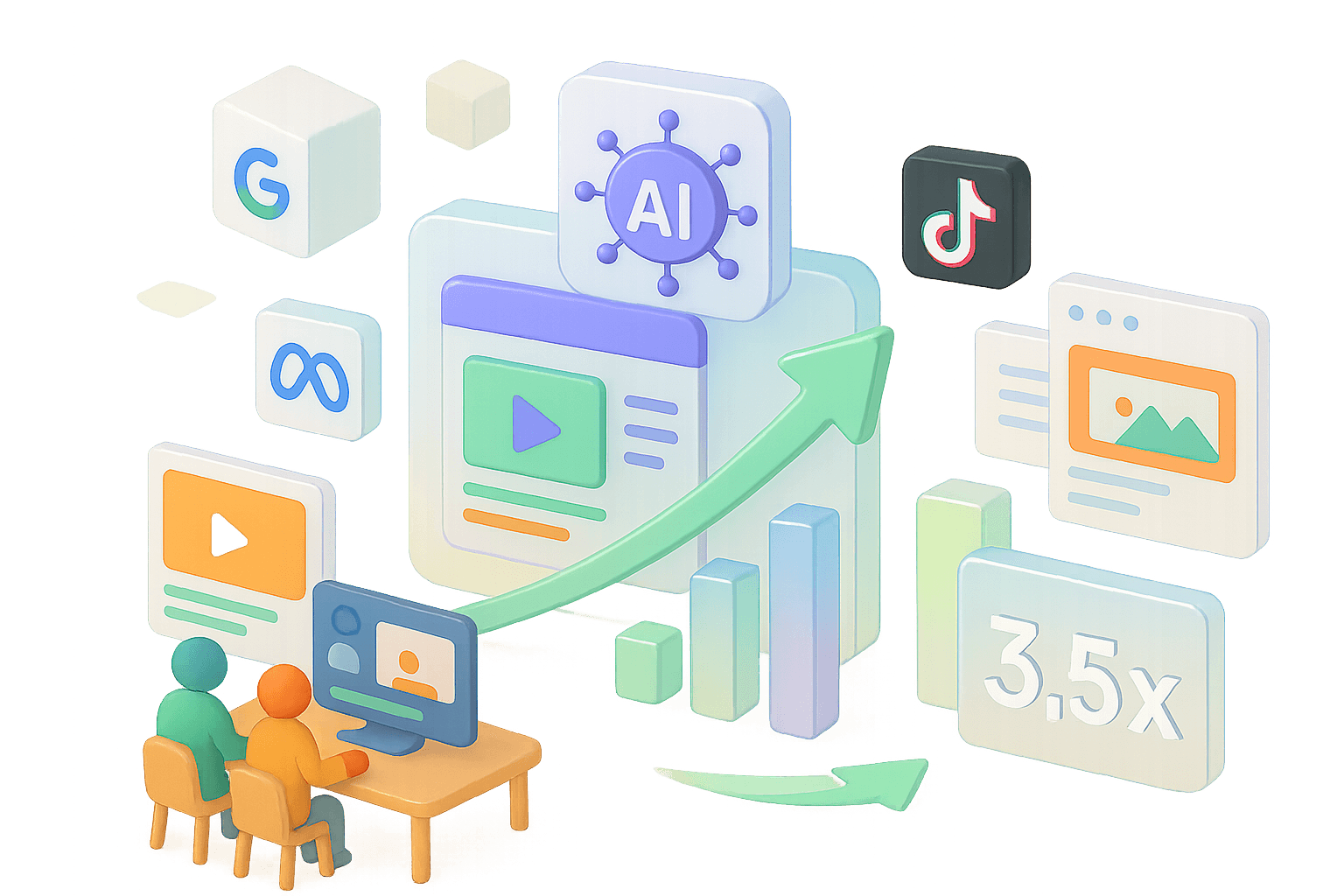
AI ad generators have moved past the experimental phase. They're now handling creative production at a scale that was impossible three years ago. The real impact isn't about replacing designers or copywriters, but rather eliminating the bottlenecks that keep high-performing campaigns from scaling.
Most marketing teams face the same constraint. You find a winning creative, but by the time you've produced 20 variations for testing, the algorithm has already burned through your original asset. Enter AI Ad Generators. They solve this issue by reducing creative production time by 70-85% while maintaining brand consistency across thousands of variants.
But here's what’s more important than speed. The best AI ad generators integrate with your ad operations workflow. They understand platform requirements, testing frameworks, and performance patterns. That's the difference between a tool that creates assets and one that improves your ROAS.
Why Traditional Ad Creation Can't Scale
Traditional ad creation follows a linear path. Brief goes to design, design sends mockups, stakeholders request revisions, designer makes changes, repeat. For a single campaign launch, you might spend 2-3 weeks producing 15-20 static ads and a handful of video variants.
That timeline worked when you were running campaigns quarterly. Now you're launching new tests weekly or daily.
Consider what happens when you want to test creative angles across platforms. You need different aspect ratios for Facebook feed, Instagram Stories, TikTok, and LinkedIn. That's four formats minimum. Multiply that by three messaging angles and two product focuses. You're at 30 assets before you've even started variant testing.
What is an AI Ad Generator
The term "AI ad generator" covers a wide range of tools now. Some are glorified template libraries with basic automation. Others use sophisticated machine learning to predict creative performance before you spend a dollar on testing.
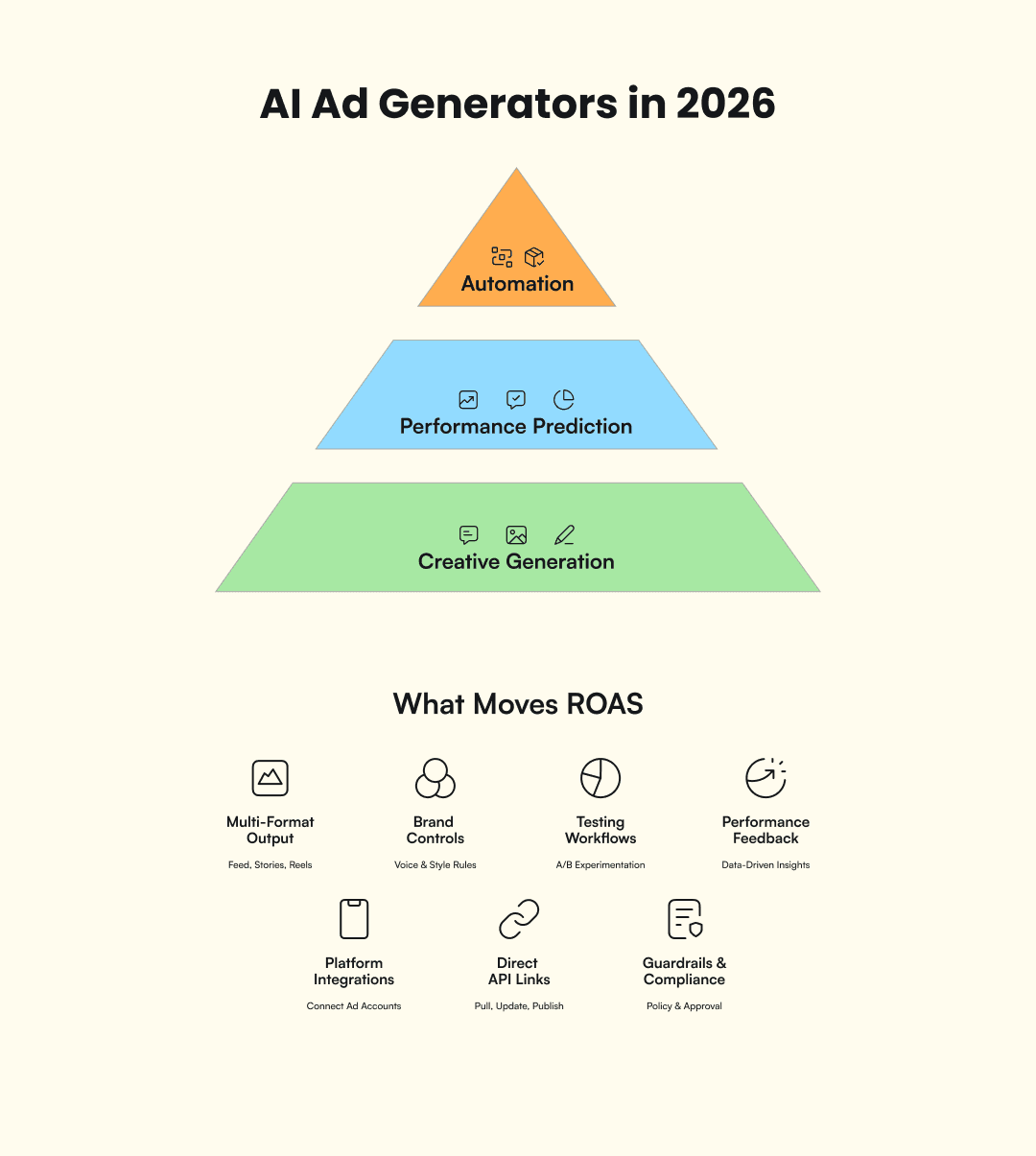
In 2026, the most effective AI ad generators combine three core capabilities:
Creative generation that produces platform-native assets across all major formats (static, carousel, video, Stories).
Performance prediction using historical data to score creative variants before launch.
Operational automation that handles trafficking, budget allocation, and optimization decisions without manual input.
Most tools only handle the first capability. They'll generate pretty images, but you're still manually uploading them to Ads Manager, setting up campaigns, writing copy variations, and checking performance daily. That's not really solving your workflow problem.
The tools that move the needle are the ones that automate the entire process from creative concept to live campaign. They understand that generating an image is 20% of the work. The other 80% is getting it into the right campaign structure, with the right targeting, at the right budget level.
How AI Ad Generators Transform Creative Workflows
Speed Gains: From Weeks to Hours
The speed improvement is dramatic, but not always in the way people expect. You can generate 100 image variants in an hour with most AI tools. That's impressive until you realize you still need to upload them, write unique primary text for each, create ad sets, and set budgets.
The real speed gains come from end-to-end automation. Tools that generate creative and immediately deploy it to your ad accounts cut production time from 2-3 weeks down to 2-3 hours for a complete campaign launch.
This lets you test more angles faster. When you can launch 50 creative variants on Monday and have performance data by Wednesday, you're making optimization decisions based on real market feedback instead of gut instinct.
Shifting Roles: What Marketers and Designers Do Differently with AI
AI doesn't eliminate creative roles. It changes what those roles focus on. Your designers no longer spend hours resizing assets and adjusting templates. Instead, they're developing brand guidelines, analyzing what creative patterns perform best, and ideating new concepts based on data.
Marketers shift from campaign babysitting to strategic planning. When the system handles daily optimization, budget pacing, and creative rotation automatically, you have bandwidth to think about customer journey mapping, offer testing, and audience strategy.
What to Look for in the Best AI Ad Generators
Multi-platform optimization is non-negotiable. Your tool should understand the technical specs for Meta, TikTok, LinkedIn, Google, and any other platform you're running. It should automatically output the right aspect ratios, file sizes, and format requirements without you manually adjusting settings.
Brand consistency controls are more important than people realize. Generating 1,000 ads is pointless if half of them don't match your visual identity. Look for tools that let you set strict brand guidelines (colors, fonts, logo placement, messaging guardrails) that the AI can't override.
Performance feedback loops separate decent tools from great ones. The AI should learn from your campaign results. If certain image compositions or copy structures perform better for your brand, the system should recognize that and generate more variants following those patterns.
Integration depth determines whether the tool saves you 30% of your time or 80%. Surface-level integrations that push creative files to your drive don't solve the operational burden. You want direct API connections to your ad platforms that handle campaign setup, launch, and optimization.
Testing framework support should be built in. The tool should understand concept testing, A/B testing, and multivariate testing methodologies. It should set up proper test structures rather than dumping 50 ads into one campaign.
Common Pitfalls to Avoid
Feature bloat is everywhere now. Tools market themselves on having 37 different creative styles and 14 AI models. What’s important is whether those features integrate into a cohesive workflow or if you're clicking through eight different screens to launch one campaign.
Creative-only solutions leave you with the same operational burden. You still need to manually campaign structure, write copy variants, set budgets, monitor performance, and optimize. The creative generation becomes a small time-saver in a still-broken workflow.
No learning mechanism means you're getting slop output forever. If the tool isn't analyzing your performance data and improving its recommendations, you're only getting templated content with slightly randomized elements.
Weak brand controls lead to off-brand assets. Some tools will generate creative that technically looks good but it doesn't match your established visual identity. You end up spending time filtering out unusable assets instead of launching campaigns.
Top 7 AI Ad Generators Compared
1. AdMove: Autonomous Ad Operations (Best Overall)
Best for: Scaling teams managing $50K+ monthly ad spend across multiple platforms
AdMove stands out with a full autonomous ad operations platform. The system handles everything from creative production to campaign launch to ongoing optimization. You set strategic parameters and the AI executes.
Key differentiators:
True automation across creative generation, campaign setup, budget allocation, and performance optimization
Multi-platform orchestration for Meta, TikTok, LinkedIn, Google, and Pinterest from one interface
Learning system that improves based on your specific campaign performance data
24/7 monitoring with automatic budget shifts based on real-time performance
The platform is built for teams that need to scale without scaling headcount. Instead of hiring three more media buyers and two designers, you route that budget into more ad spend and let AdMove handle the operational execution.
Pricing: Multiple subscription plans based on your needs starting from $49/month.
2. Superside: AI + Human Hybrid Model
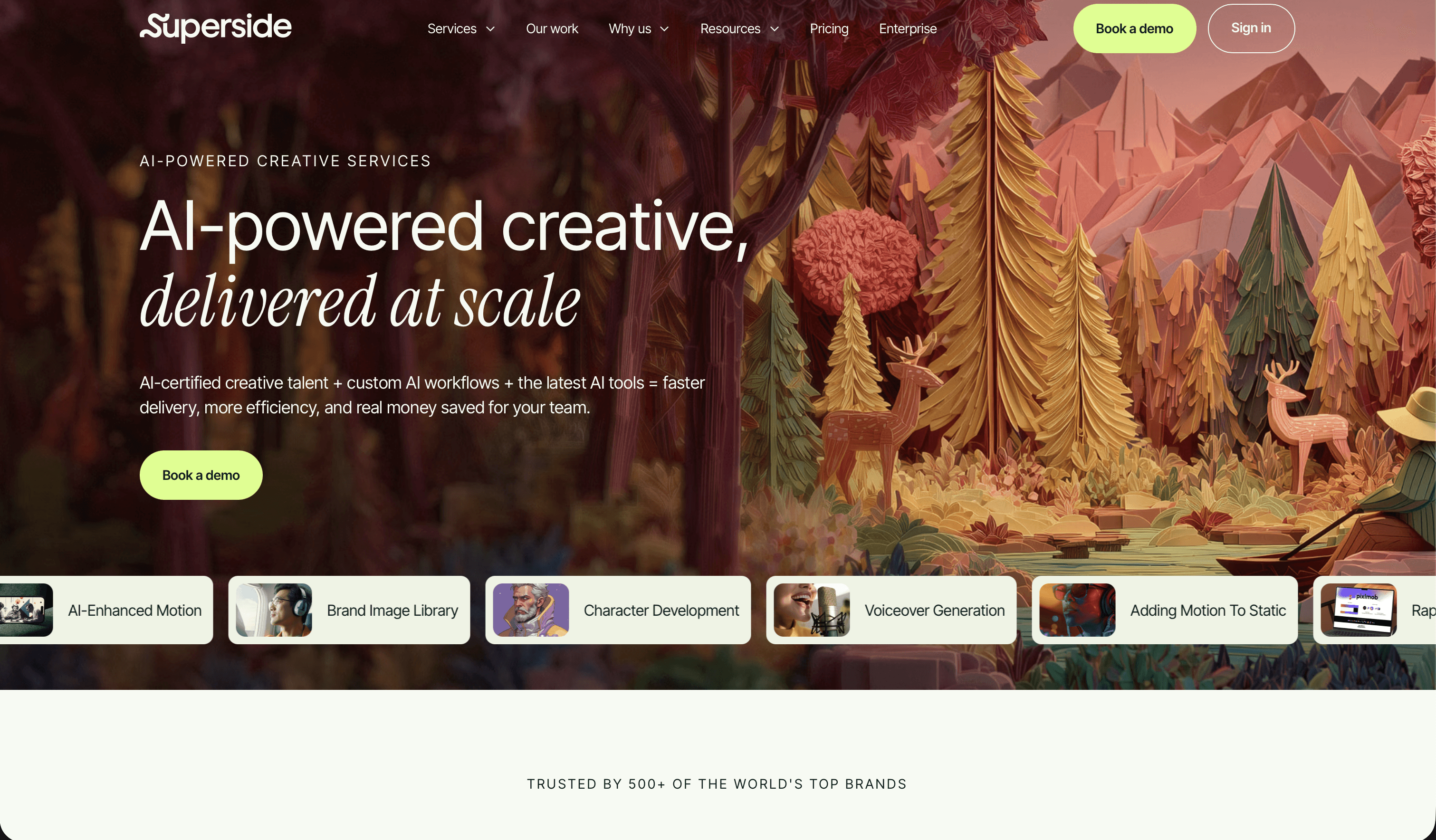
Best for: Brands needing custom creative work alongside production scaling
Superside combines AI generation with human creative teams. You get AI-powered asset production plus access to designers who can handle more complex custom work. This works well if you need both high-volume testing and premium creative for flagship campaigns.
The hybrid model costs more than pure AI tools, but you're not dealing with the quality ceiling that fully automated systems sometimes hit. Human designers review AI output and can step in for projects requiring more nuanced creative execution.
Pricing: Project-based or subscription starting around $3,000/month
3. Pencil: Predictive Analytics for Creative Performance
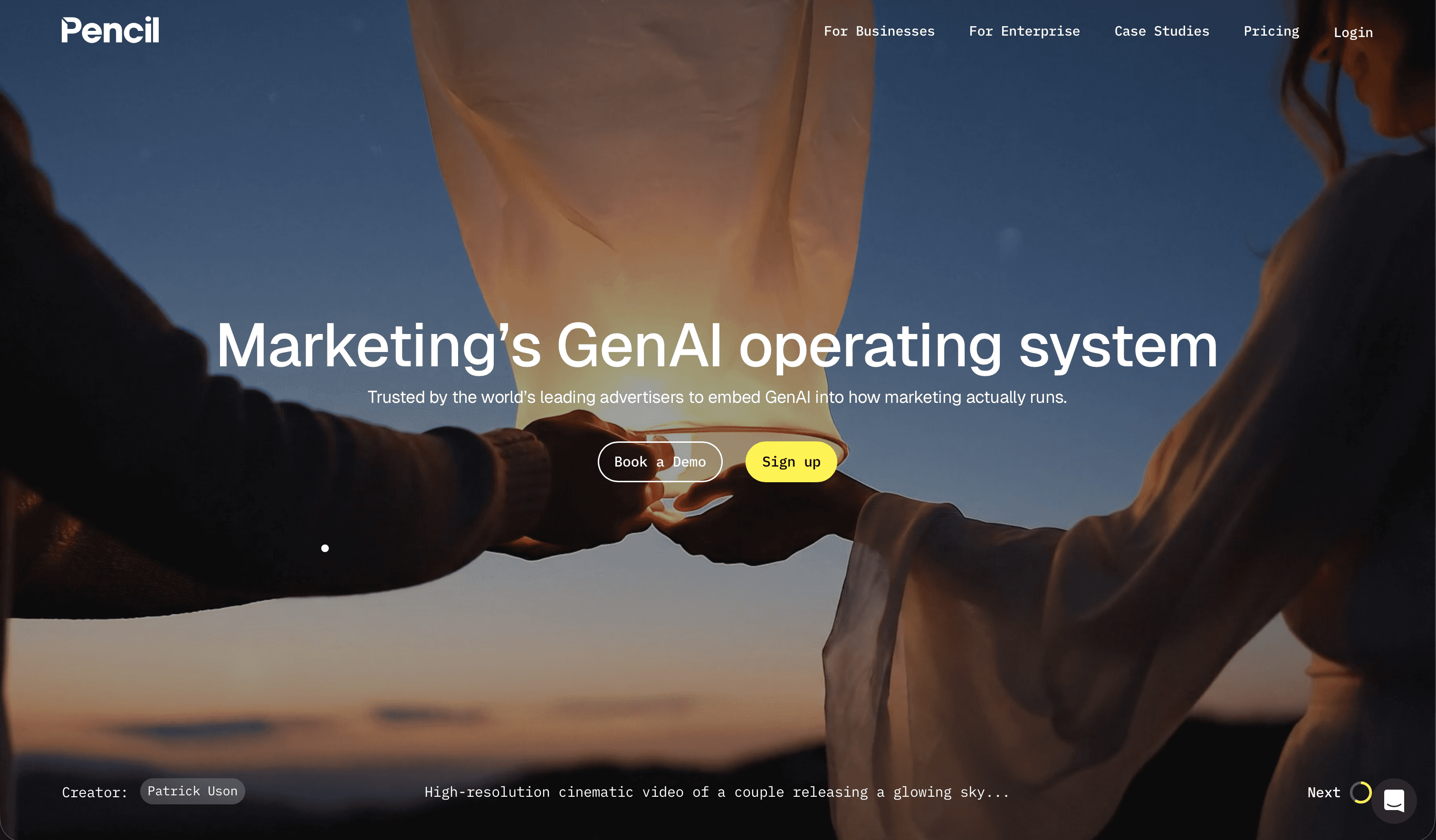
Best for: Performance marketers focused on data-driven creative decisions
Pencil's strength is its predictive scoring system. Before you launch creative, the AI scores each variant based on historical performance patterns. This helps prioritize which assets to test first and reduces wasted spend on concepts unlikely to perform.
The platform pulls from a database of $1 billion+ in ad spend data to identify creative elements correlated with performance. It can't predict with certainty, but it gives you probability estimates that improve testing efficiency.
The tradeoff is that Pencil requires more manual workflow integration than fully automated platforms. It generates and scores creative, but you're still handling the campaign setup and optimization yourself.
Pricing: Starts at $119/month for small teams, scales to custom enterprise pricing
4. Madgicx AI: Ecommerce-Specific Automation
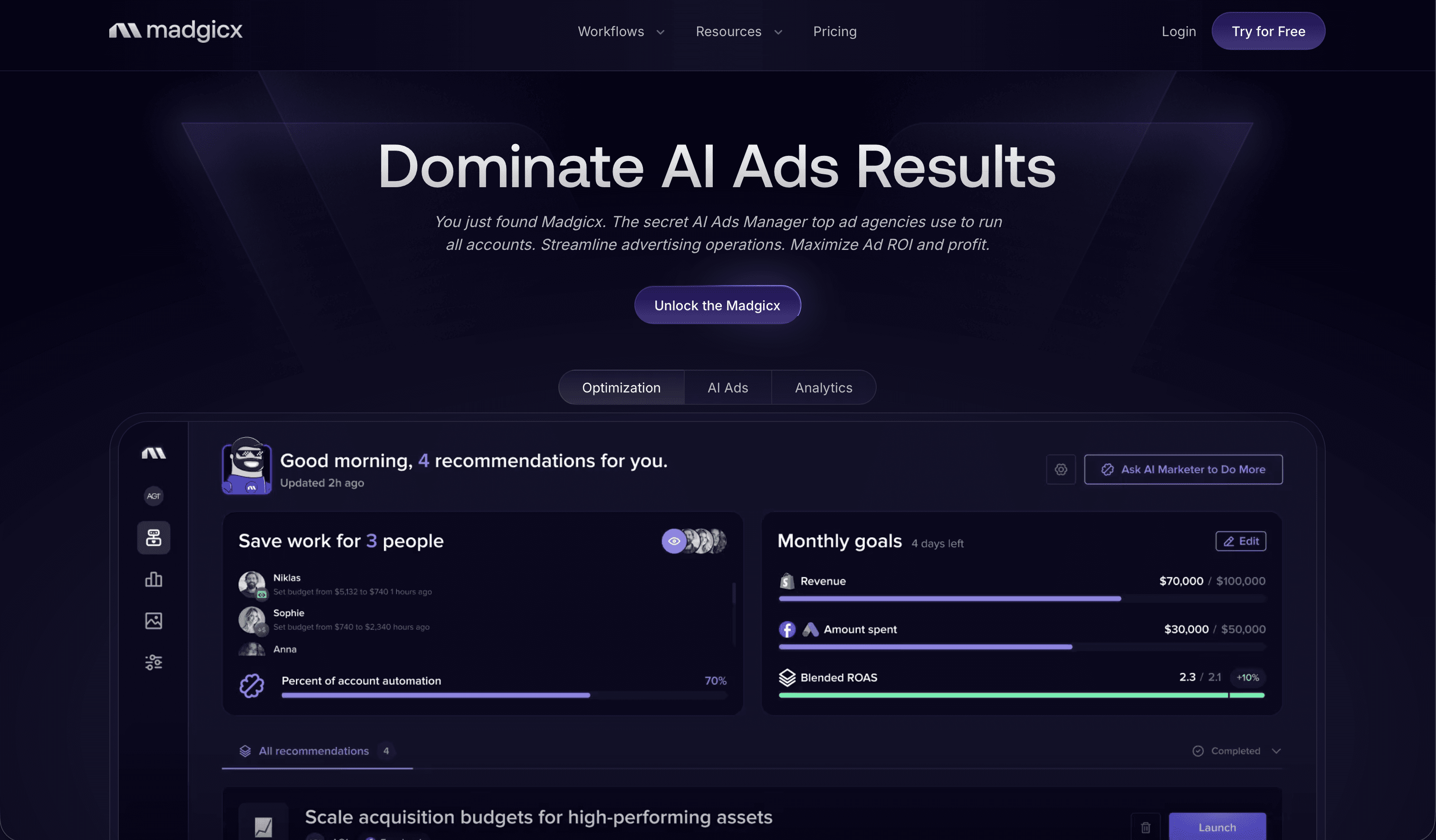
Best for: Shopify and ecommerce brands running primarily on Meta
Madgicx built its platform specifically for ecommerce performance marketing. The AI understands product feeds, dynamic creative, and catalog campaigns. If you're running a product-based business on Meta, the ecommerce-specific features add meaningful value.
The autonomous budget optimization is particularly strong. The system shifts spend between campaigns and ad sets based on real-time ROAS without you setting manual rules. It accounts for seasonality, day-of-week patterns, and audience fatigue in its allocation decisions.
The limitation is platform focus. Madgicx is heavily Meta-centric. If you're running significant spend on TikTok, Google, or LinkedIn, you'll need additional tools to manage those platforms.
Pricing: Starts at $29/month, scales to $999+/month based on features and ad spend
5. AdCreative.ai: High-Volume Creative Production
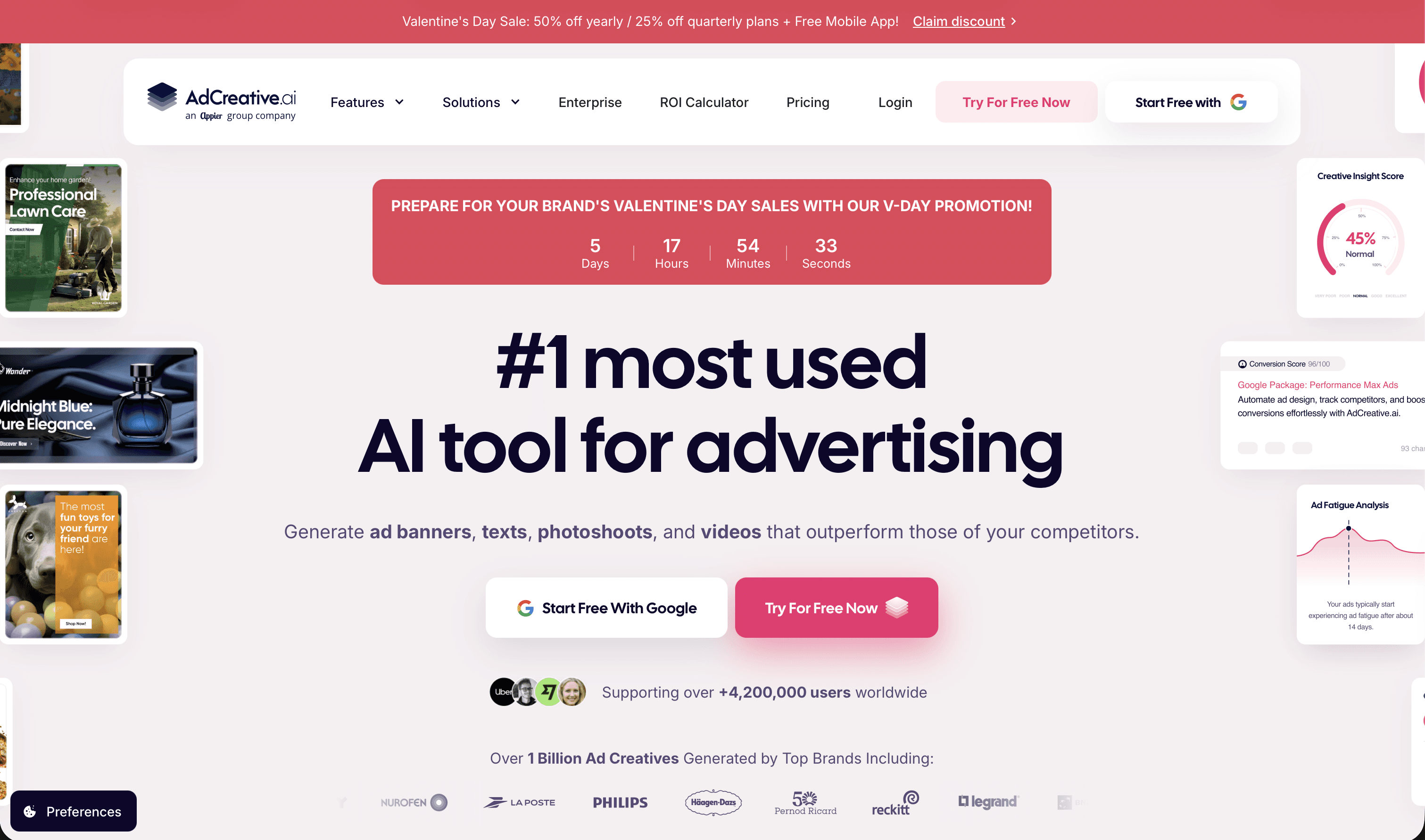
Best for: Agencies and brands needing hundreds of creative variants quickly
AdCreative.ai optimizes for volume. You can generate 100+ image and video variants in minutes. The platform supports multiple formats and does a decent job maintaining brand consistency through customizable templates.
The interface is straightforward. You upload brand assets, select creative styles, input copy variants, and generate. The AI handles different aspect ratios automatically and outputs ready-to-use files.
What it doesn't do is handle the operational side. You're getting creative files, not campaign management. You still need to upload assets to ad platforms, build campaign structures, and manage optimization manually. For pure creative production at scale, it works. For end-to-end workflow automation, it falls short.
Pricing: Starts at $29/month for individuals, $99-$299/month for teams
6. Quickads.ai: Multi-Format Agency Solution
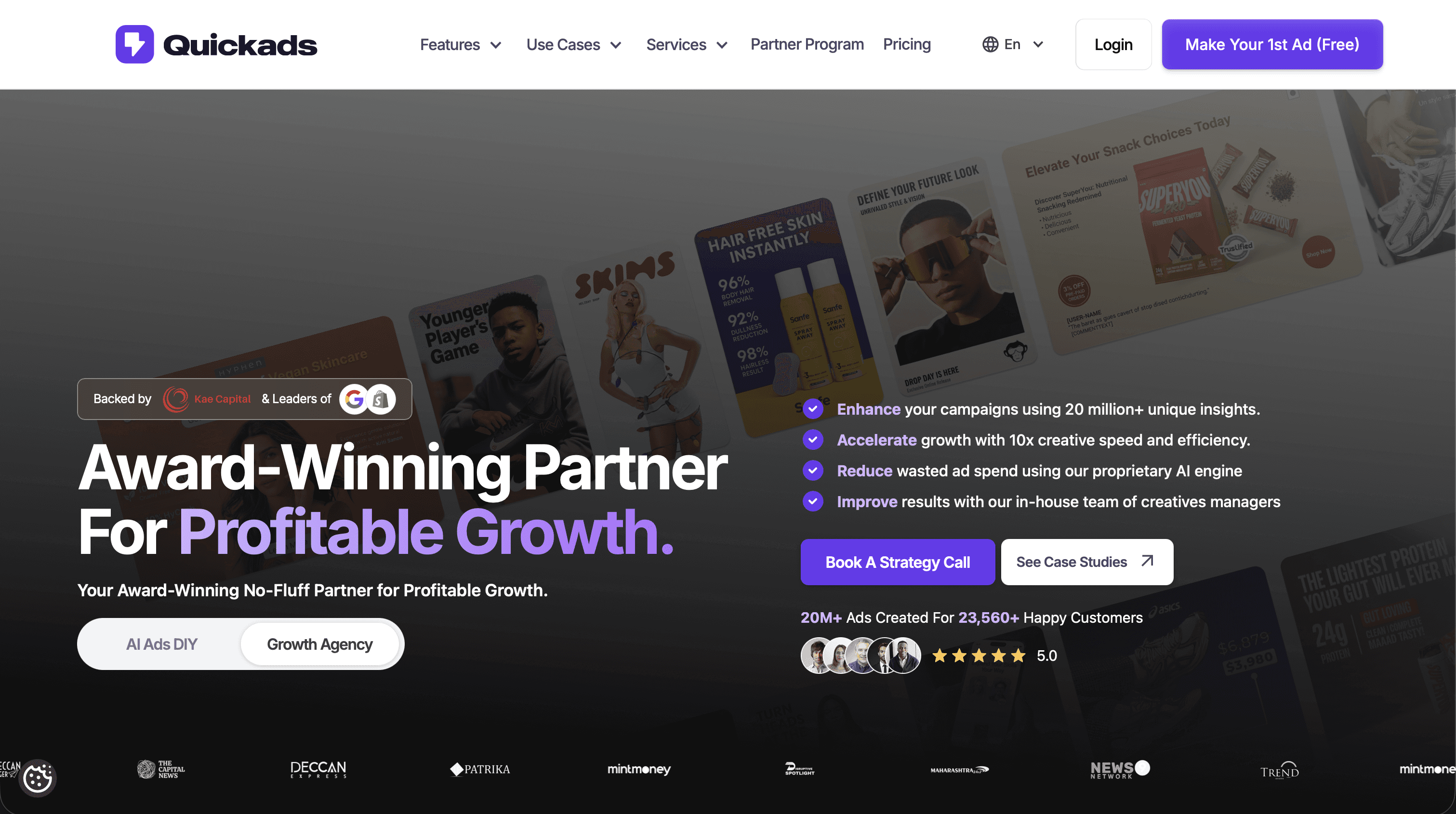
Best for: Agencies managing multiple client accounts across platforms
Quickads focuses on multi-brand management. The platform lets you set up separate brand profiles for each client with unique visual guidelines, tone of voice, and asset libraries. This helps agencies maintain brand separation while using one tool across their client roster.
The creative output is solid across static images, carousels, and short video formats. The AI handles multiple languages reasonably well, which matters for agencies with international clients.
The limitation is depth of automation. Like most creative-focused tools, it generates assets but doesn't integrate deeply enough with ad platforms to handle campaign management and optimization. You're still manually trafficking campaigns.
Pricing: Starts at $39/month, custom pricing for agencies
7. Pippit: Social Video Specialist
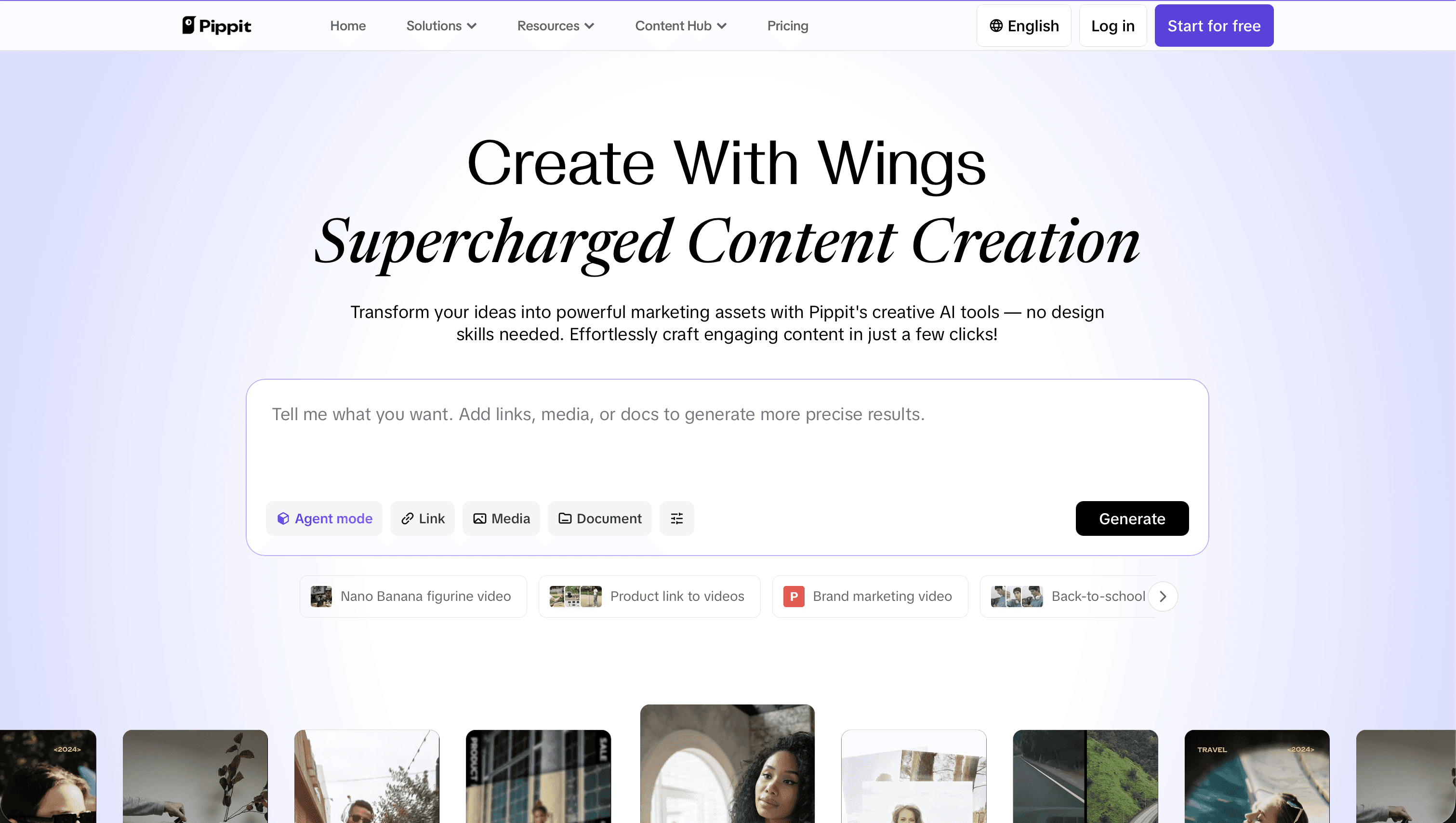
Best for: Brands prioritizing short-form video for TikTok and Instagram
Pippit specializes in social video content. It won't handle your full ad operations workflow, but if you need high-volume short-form video production, it's one of the better options. The AI understands platform trends and can generate videos that match current creative patterns on TikTok and Instagram.
The platform works well for testing different video hooks and formats quickly. You can produce 20-30 video variants from one source clip and test which opening scenes, captions, and pacing perform best.
You're limited to video creation. Static ads, carousels, and operational automation aren't part of the offering. It's a specialized tool for a specific creative need.
Pricing: Starts at $49/month
Quick Comparison Table: At-a-Glance Overview
Tool | Best Use Case | Automation Level | Platform Coverage | Starting Price |
AdMove | Full autonomous operations | Complete (creative + ops) | Meta, TikTok, LinkedIn, Google, Pinterest | $49/month |
Superside | AI + human hybrid | Medium (creative focus) | Platform-agnostic | ~$3,000/month |
Pencil | Predictive creative scoring | Medium (creative + analytics) | Meta, TikTok, YouTube | $119/month |
Madgicx | Ecommerce on Meta | High (Meta-specific) | Primarily Meta | $29-$999+/month |
AdCreative.ai | High-volume production | Low (creative only) | Platform-agnostic | $29/month |
Quickads.ai | Multi-client agencies | Low (creative only) | Multi-platform | $39/month |
Pippit | Social video specialist | Low (video only) | TikTok, Instagram | $49/month |
Why AdMove Outperforms Creative-Only Tools
Creating assets quickly is valuable. But it's not the main issue for most scaling brands. The real constraint is operational capacity.
Think about what happens after you generate 50 new ad variants. Someone needs to upload them to Ads Manager. Write unique primary text for each. Create the campaign structure. Set up ad sets with proper targeting. Allocate budgets. Set schedules. Launch. Then monitor daily, shift budgets based on performance, pause underperformers, scale winners.
That operational work consumes 4-6 hours per day for media buyers managing $100K+ monthly spend. More time than they spend on creative production. And it doesn't scale linearly. Managing $500K/month doesn't take 5x the time of managing $100K/month because you physically can't multiply yourself by five.
The Autonomous Operations Advantage
AdMove's autonomous operations model means you're not just generating creative faster. You're removing yourself from the daily execution entirely. The system:
Generates platform-optimized creative based on your brand guidelines and performance data
Writes copy variants that match your tone and messaging frameworks
Builds campaign structures using proven testing methodologies
Launches campaigns across multiple platforms simultaneously
Monitors performance 24/7 and shifts budgets toward winning combinations
Pauses underperformers based on statistical significance, not arbitrary time windows
Scales winners while maintaining efficiency targets
This means your team focuses on strategy (which offers to test, what audiences to target, which creative concepts to explore) while the AI handles execution. You're not logging into five different ad platforms checking campaign performance multiple times per day.
The efficiency gains compound. One person can effectively manage the ad operations that previously required a team of three or four. That capacity can be redirected toward higher-leverage activities like customer research, landing page optimization, or offer development.
Common Questions About AI Ad Generators (And Honest Answers)
Are AI-Generated Ads Effective?
Yes, when the AI learns from your specific performance data. Generic AI-generated ads using stock patterns perform about the same as generic human-designed ads. Both are mediocre.
The effectiveness comes from feedback loops. AI that analyzes what's working for your brand specifically and generates more variants following those patterns will outperform manual creative production. You're testing more concepts, identifying winners faster, and scaling proven patterns.
Research from McKinsey shows that brands using AI-driven personalization see 10-15% revenue increases, largely driven by more effective creative testing and optimization.
Will AI Make My Ads Look Generic?
Only if you use it that way. Tools with weak brand controls will produce generic output. Platforms that enforce strict brand guidelines and learn from your performance data produce ads that match your visual identity while optimizing for performance.
The risk of generic creative is higher with tools that just apply templates without learning your specific brand patterns. That's why brand consistency controls should be a primary evaluation criterion when choosing an AI ad platform.
Is AI Accessible to SMBs?
Some tools are priced for SMBs ($29-$99/month) but offer limited functionality. You get creative generation without operational automation. That can still add value if you're spending under $10K/month on ads.
For brands spending $50K+ monthly, the ROI on comprehensive platforms like AdMove is clear. You're replacing the need to hire additional media buyers and designers as you scale. The platform cost is significantly lower than the salary burden of expanding your team.
How Does AI Improve Over Time?
Performance-based AI platforms build learning models from your campaign results. Every launched campaign generates data. The system identifies correlations between creative elements (colors, compositions, copy structures) and performance outcomes (CTR, CPA, ROAS).
Over 3-6 months, the AI develops a performance profile specific to your brand. It knows that product-focused imagery outperforms lifestyle shots for your audience. That benefit-driven headlines convert better than feature lists. That carousel ads work better than static images for your offer type.
This brand-specific learning is what separates tools that improve over time from ones that stay static.
Is My Brand Data Safe?
Reputable platforms use enterprise-grade security with encryption and data isolation. Your creative assets, performance data, and campaign information should never be shared with other clients or used to train public models.
Ask about data governance policies before committing to any platform. You want guarantees that your proprietary performance insights stay proprietary.
Will AI Replace Creative Teams?
No. It changes what creative teams do. The repetitive production work (resizing, templating, variant creation) gets automated. Creative strategy, brand development, and conceptual ideation remain human-owned.
Teams that resist this shift will find themselves capacity-constrained as competitors using AI can test 10x more concepts. The competitive advantage goes to teams that embrace AI for execution while focusing human creativity on strategy.
Conclusion: The Future of Ad Operations Is Autonomous
The trajectory is clear. Manual campaign management can't keep up with the testing velocity required to stay competitive. Brands running successful performance marketing programs in 2026 are testing more creative concepts, across more platforms, with faster optimization cycles than was operationally possible three years ago.
The tools enabling this aren't faster creative generators. They're autonomous systems that handle the full workflow from concept to optimization. That's why platforms like AdMove represent the next evolution beyond creative-only AI tools.
Next Steps: How to Get Started with AdMove or the Right Tool for You
For brands not ready for full automation, start with a tool that matches your current spend level and workflow. But plan your scaling roadmap now. The operational constraints you'll hit at 2x or 3x your current spend won't wait for you to find solutions after you're already overwhelmed.
The competitive advantage in performance marketing doesn't come from having better creative ideas. It comes from testing more of those ideas faster and scaling the winners more efficiently. That's what AI ad generators enable. And it's why brands that adopt them early are building operational moats their competitors can't easily replicate.