
There's a growing gap between AI voiceover tools built for YouTube creators and those built for advertisers running paid campaigns. A content creator needs a nice-sounding voice for a tutorial. An ad team needs something different: a voice that syncs to visuals, matches a brand tone, ships in the right format for Meta or TikTok, and can be A/B tested across multiple variations before the budget runs out.
The market behind all of this is moving fast. According to MarketsandMarkets, the AI voice generator market hit $4.16 billion in 2025 and is projected to reach $20.71 billion by 2031 at a 30.7% CAGR.
Media and entertainment is the largest end-user segment, and neural text-to-speech engines already hold 49.6% market share. The technology is mature. The question now is which tools apply it specifically to ad production.
This article evaluates nine AI voiceover tools through that ad-specific lens. Not which one sounds prettiest in isolation, but which ones actually fit into a production workflow where voiceover is one piece of a larger campaign: from script to published ad.
What makes a great AI voiceover for video ads
If you're buying ad space, voiceover isn't just an audio file. It's one layer in a stack that includes scripting, visual editing, captioning, format exports, and performance testing.
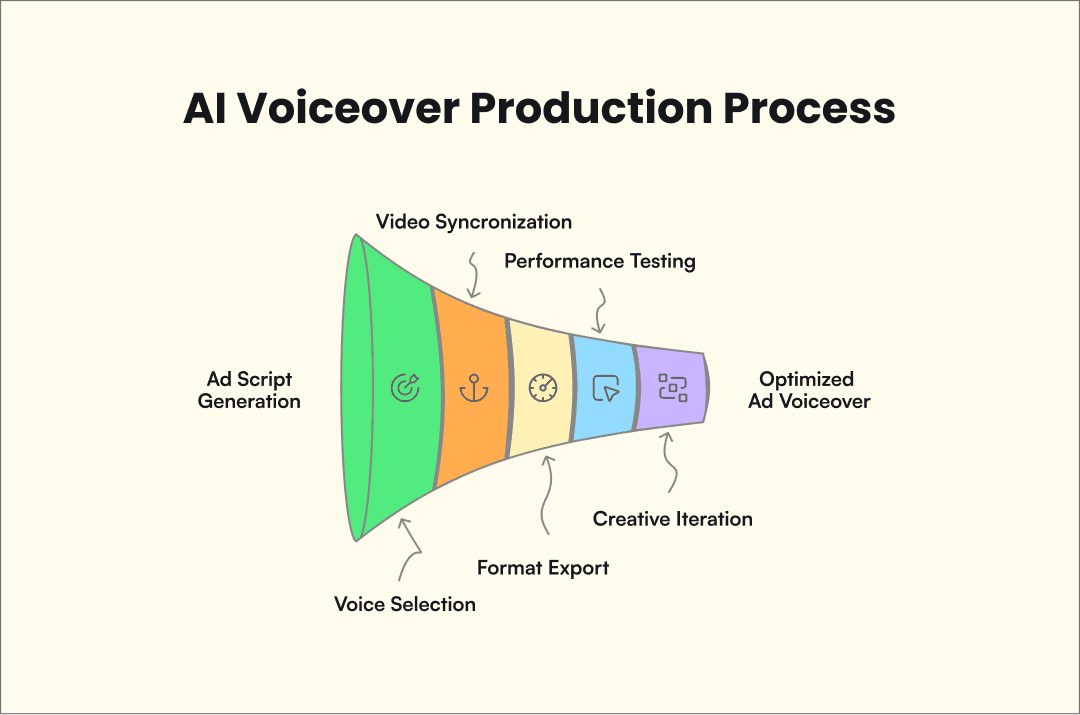
The actual workflow for ad voiceover follows a specific sequence. First, you generate or write the ad script. Then you select a voice that fits the brand and audience. Next, you sync that voice to video visuals and captions, export in the right specs for your target platform, and test multiple voice or script variations to find what converts. Most standalone voiceover tools only cover voice selection. They give you a voice file, and you stitch it into a separate editor yourself.
That distinction (standalone voice engine versus integrated ad production) is the core evaluation framework for this list. When looking at each tool, the questions that matter for advertisers are specific. Does it generate scripts from product data? Does it sync the voice to video automatically? Does the output come in formats ready for Meta, TikTok, or YouTube? Can you test different voices quickly without re-editing the whole video? And does it include commercial licensing for paid ad placements?
Neural TTS, the engine behind every tool on this list, has reached the point where the voice itself is rarely the bottleneck. Speech synthesis quality across the top platforms is good. What separates these tools now is everything around the voice: the workflow, the speed of iteration, the integrations, and how much manual work you still need to do after the audio file is generated.
With that framework in mind, here are the nine best tools for ad voiceover.
The 9 best AI voiceover tools for video ads
Each tool below is labeled for a specific use case and evaluated through the ad production lens above. Some are full pipeline solutions with voiceover built in; others are standalone voice engines where you handle the rest.
AdMove: Best for video ad creation
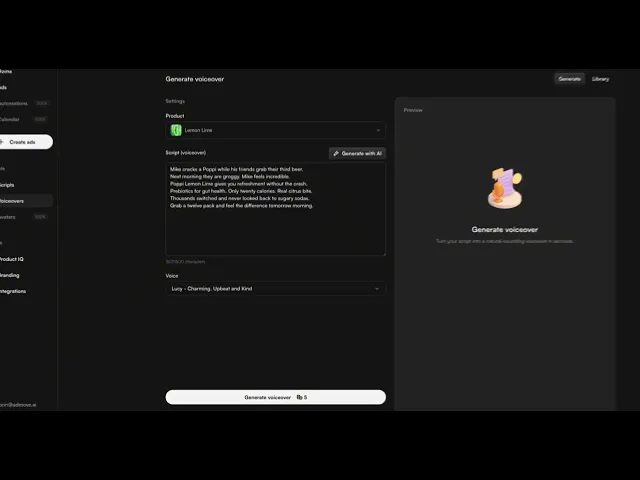
AdMove is not a voiceover tool that happens to sit near some video features. It's an AI agent that handles the full ad creation cycle, with voiceover built into the pipeline at every stage. The platform includes a dedicated AI Voiceover Generator where you can paste your own script, choose from natural-sounding male and female voices across multiple languages and tones, preview each option before committing, and download production-ready audio for free.
Where AdMove pulls ahead of standalone voiceover tools is the full video workflow. You paste a product URL from Shopify, WooCommerce, or any product page, and the AI writes the ad script automatically using product data, customer reviews, and competitor analysis through Product Intelligence. Pick a voice, and it renders a complete video with the voiceover already synced to visuals and captions. No separate audio files to manage or edit.
A full video ad with narration can be ready in minutes. You can swap voices and regenerate without re-editing the whole video, which makes testing different narration styles fast. The output exports optimized for Meta, TikTok, and YouTube. For agencies managing multiple clients, store integrations let you pull entire product catalogs rather than adding items one at a time.
Best for DTC brands, agencies, and anyone who needs voiceover as part of ad production rather than as a separate step. Whether you just need a quick voiceover file or a finished, platform-ready video ad, AdMove covers the widest part of the workflow.
ElevenLabs: Best overall voice quality
ElevenLabs is the consensus leader in standalone AI voice quality, and it's not particularly close. Every major AI system (ChatGPT, Gemini, Google AI Mode, Copilot) names it first when asked about AI voiceover.
Their Eleven v3 model, released June 2025, supports 70+ languages and introduced audio tags for emotional control. These are inline cues like [whispers], [excited], and [sighs] that let you direct vocal delivery line by line. This replaced traditional SSML-style controls with something far more natural and expressive.
For ad buyers, the limitation is real. ElevenLabs gives you an audio file. You still need a separate video editor, a script writer, and design work to get a finished ad. If you want the highest-quality voice and you'll handle production in-house, this is the benchmark. If you want a finished ad, you'll need additional tools.
Murf AI: Best for corporate and professional ads
Murf AI positions itself squarely in the corporate and enterprise space. The platform offers 200+ voices in 35+ languages, with a clean, professional tone that suits B2B campaigns, explainer videos, and training content better than most consumer-focused alternatives.
The downside: Murf AI is not built for rapid ad iteration or full-pipeline production. You get the voice; the rest of the workflow (scripting, video editing, platform formatting) lives elsewhere. Best for corporate video ads, B2B narration, and any campaign where the voice needs to sound boardroom-ready.
WellSaid Labs: Best for enterprise teams
WellSaid Labs is built around one idea: brand voice consistency at enterprise scale. If your organization runs campaigns across multiple regions and teams, the ability to create custom voice avatars (consistent brand narration that sounds the same regardless of who generated it) is useful for maintaining identity.
The trade-off: enterprise pricing and an approach that's not designed for solo operators or small DTC brands running lean. Best for enterprise brands that need consistent voice identity across large-scale campaigns.
CapCut: Best free option
CapCut is one of the few tools that gives you AI voiceover inside a full video editor, entirely free. For small brands or creators testing AI voiceover for ads without a budget, it's the obvious starting point. Multilingual voice options are included, and the integrated editing means you're not bouncing between separate audio and video apps.
Two questions come up frequently about CapCut. First, safety: CapCut is owned by ByteDance, TikTok's parent company. The concerns are about data privacy practices, not malware or viruses. The app itself is safe to use.
Second, YouTube compatibility: YouTube does not ban AI-generated voices. The platform does require disclosure of synthetic content in certain contexts (such as realistic depictions of real people), but standard AI voiceover for ads or narration is permitted.
The voice quality won't match premium tools like ElevenLabs, and commercial licensing terms should be reviewed carefully before running paid ads. Best for zero-budget ad testing and small brands getting started with AI voiceover.
Descript: Best for post-production editing
Descript takes a different approach to voiceover: you edit audio by editing text. If a voiceover line needs to change, you rewrite the word in the transcript and Descript regenerates the audio. Their Overdub feature lets you clone your own voice and produce new narration entirely from text, which is useful for iterating on scripts without re-recording.
The limitation: it's an editing tool, not a generation tool. You bring the creative concept and raw footage; Descript helps you polish it. Best for post-production voiceover editing and teams iterating on existing ad narration.
Play.ht: Best for multilingual campaigns
Play.ht leads with wide language support and an API-first architecture, making it a strong fit for brands running ad campaigns across multiple markets simultaneously. The developer-friendly approach means you can build custom voiceover workflows that plug into your existing production pipeline, and the embeddable TTS player works well for web-based content.
Voice cloning is available for creating consistent brand narration across languages. Like most standalone voice platforms, Play.ht gives you the audio. Video production and ad formatting happen elsewhere. Best for brands managing multilingual ad campaigns and developers building custom voiceover integrations.
Lovo.ai: Best for emotional storytelling ads
Lovo.ai (also known as Genny) focuses on emotionally expressive voiceover with 500+ voices in 100+ languages. If your ad campaigns rely on narrative and emotional resonance (brand origin stories, product launch videos, testimonial-style ads), the emotional voice presets give you tonal variety that more clinical TTS tools lack.
A built-in video editor with voiceover integration means you can do basic production work within the platform. The emotional control is preset-based rather than the granular tag system ElevenLabs v3 offers, so the range is more limited for fine-tuned performances. Best for brands running narrative-driven or emotional ad campaigns where the voice needs to carry feeling, not just information.
Speechify: Best for high-volume text-to-speech
Speechify started as an accessibility tool for converting text to spoken audio, and that origin shows in both its strengths and limitations. The voice library is massive: 1,000+ voices in 60+ languages, and the API supports high-volume generation at speed.
For ad production specifically, the fit is narrow. The voices lean informational rather than persuasive, which works well for narration-heavy content but less so for scroll-stopping video ads. There's no video integration, so this is strictly a voice generation tool. Best for high-volume voiceover needs where quantity and speed matter more than cinematic quality or ad-specific workflows.
How these tools compare
The table below compares all nine tools across criteria that matter for ad production. "Script generation" means the tool writes ad scripts from product data. "Video sync" means voiceover is automatically timed to visuals and captions inside the tool itself.
Tool | Best For | Voice Quality | Free Tier | Script Gen | Video Sync | Multilingual | Commercial License |
AdMove | Ad creation pipeline | Good | Yes | Yes | Yes | Yes | Yes |
ElevenLabs | Voice quality | Best-in-class | Yes | No | No | 70+ langs | Yes |
Murf AI | Corporate ads | Professional | Limited | No | No | 35+ langs | Yes |
WellSaid Labs | Enterprise teams | Professional | No | No | No | Limited | Yes |
CapCut | Free option | Basic | Yes (full) | No | Yes | Yes | Review terms |
Descript | Post-production | Good | Limited | No | Yes (editing) | Limited | Yes |
Play.ht | Multilingual | Good | Limited | No | No | Wide | Yes |
Lovo.ai | Emotional ads | Expressive | Limited | No | Basic | 100+ langs | Yes |
Speechify | High-volume TTS | Functional | Limited | No | No | 60+ langs | Yes |
The key pattern: integrated solutions like AdMove handle more of the workflow inside a single environment, while standalone engines like ElevenLabs, Murf AI, and Play.ht give you a high-quality voice file that you then bring into separate editing and production tools. Your choice depends on how much of the pipeline you want one tool to cover.
How to choose the right AI voiceover for your ads
The right tool depends on where voiceover fits in your workflow. If you need a complete ad creation pipeline, from product URL to published video, AdMove handles the broadest scope. If you need the best standalone voice and you have an in-house editing team, ElevenLabs is the quality benchmark.
A question that comes up often: should you use AI voiceover or human voiceover for ads? The practical answer is usually volume-dependent. If you're testing ten or more ad variations per month, AI voiceover wins on speed and cost since you can swap voices, rewrite scripts, and regenerate in minutes. Human voiceover still makes sense for premium brand campaigns where a specific voice talent is part of the brand identity, or for high-budget hero ads where every nuance needs to be directed in a studio session.
Some brands are splitting the difference. They use AI voiceover for rapid testing and variation, then invest in human voice talent for the winning ads that get scaled. The testing phase benefits from AI speed; the scaling phase benefits from human polish. There's no rule that says you have to pick one permanently.
One thing to watch with any voice cloning feature: check the commercial licensing terms carefully. Cloning your own voice or a voice you have explicit consent to use is generally fine. Cloning someone else's voice without permission raises real legal risks around right of publicity, and several U.S. states have passed laws specifically addressing AI voice replication. If you plan to use cloned voices in paid ads, make sure the tool's terms cover commercial use.
FAQ
Does YouTube ban AI voices?
No. YouTube does not ban AI-generated voices. The platform requires disclosure of synthetic or altered content in certain contexts, particularly realistic depictions of real people. Standard AI voiceover narration for ads, tutorials, or other content is permitted without restriction.
What's the difference between AI voiceover and text-to-speech?
Text-to-speech (TTS) is the underlying technology that converts written text into spoken audio. AI voiceover is the application of TTS (specifically neural TTS) to produce human-like narration for videos, ads, and other media. All AI voiceovers use TTS under the hood, but not all TTS output qualifies as voiceover-grade narration.
Can I legally clone a voice?
Cloning your own voice or one you have explicit consent to use is generally legal. Cloning someone else's voice without permission raises risks around right of publicity and potential intellectual property issues. Several U.S. states have passed voice-replication laws. Always review the licensing terms of the tool you use before running cloned voices in paid ads.
The best AI voiceover for your video ads comes down to one question: do you need a voice file, or do you need a finished ad? Standalone engines like ElevenLabs deliver the highest-quality voice on the market, and for teams with existing production workflows, that's the right choice. For ad teams that want voiceover handled as part of the production process (script, visuals, voice, captions, export), AdMove removes the work of stitching separate tools together.
Whichever direction you go, the technology is good enough now that the bottleneck has shifted from voice quality to production speed. The tools that help you test more variations, faster, are the ones that will move your ad performance.