
A creative brief is a strategic document that aligns the team on the business problem, audience, message, and desired outcome before creative work begins. Done well, it inspires creative execution. Done poorly, it produces rounds of revisions, misaligned expectations, and work that misses the mark.
Almost every marketing team has a creative brief somewhere in their process. Far fewer would say the brief actually works. Industry surveys consistently put adoption above 90%, but satisfaction barely cracks a third. That gap exists because filling in a brief and writing a good one are two different exercises, and most teams never get past the first.
Guides on this topic are written by project management platforms for generic marketing teams. If you’re a performance advertiser deciding how many ads to test this week, a media buyer translating strategy into platform-specific creative, or a DTC brand owner briefing a freelancer for a Meta campaign, the advice here is built for your context: fast timelines, measurable outcomes, and creative work that has to perform.
Key Takeaways
A creative brief is a short strategic document that connects business objectives to creative execution. It tells the team where to aim without prescribing how to get there, and every production decision should trace back to it.
The single-minded proposition (SMP) is the anchor of the brief. It states what the audience should believe after seeing the creative, while the key consumer benefit (KCB) answers what's in it for the audience. Both belong in the brief, but the SMP drives creative direction.
A useful target audience definition goes beyond demographics. Psychographics, behavioral triggers, and pain points give the creative team a person they can picture, not a spreadsheet filter.
Deliverables must specify exact formats, dimensions, and platform requirements. Undefined formats become scope negotiations later and are the primary source of creative production scope creep.
Most creative briefs fail because of vague objectives, prescriptive creative direction, missing success metrics, no stakeholder sign-off before production, or briefing by email instead of a live conversation.
The five-step writing process starts with research (competitors, context, category), builds the brief around the core message, locks sign-off with stakeholders before execution, presents the brief live, and keeps the document active through production and testing.
Brief formats shift by use case: advertising briefs prioritize success metrics and platform specs at high volume, video briefs add storyboard and talent detail, branding briefs are longer-term and strategy-heavy, and UGC briefs balance brand guardrails against creator authenticity.
Not every project needs a formal brief. A tiering model sorts work into full briefs for large campaigns, condensed templates for mid-size pushes, and verbal briefings for quick-turn derivative assets.
What is a creative brief (and who is it for)?
A creative brief is a short strategic document that connects what the business needs to achieve with what the creative team actually produces. It tells the team where to aim without telling them how to get there. Every decision the creative team makes during production, from headline direction to visual tone, should trace back to what the brief says.
Who the brief is written for matters more than who writes it. Most guides frame the creative brief as an alignment tool, but practitioners see it differently. The brief is the creative team’s working document, the reference they return to when deciding between two headline directions or debating whether a concept stays on strategy.
Who writes the brief depends on the setup. In agencies, account managers typically own it. In-house teams hand it to a marketing manager. DTC brand owners often write their own. The convention is consistent regardless: a creative brief fits on one to two pages. Anything longer becomes a strategy document, and strategy documents don’t get read by the people holding the camera.
What goes into a creative brief
Every brief varies by project, but a set of core components appears consistently across agency practice, training programs, and the answers AI tools generate when asked about creative briefs. The components below follow the pattern most commonly cited across those sources.
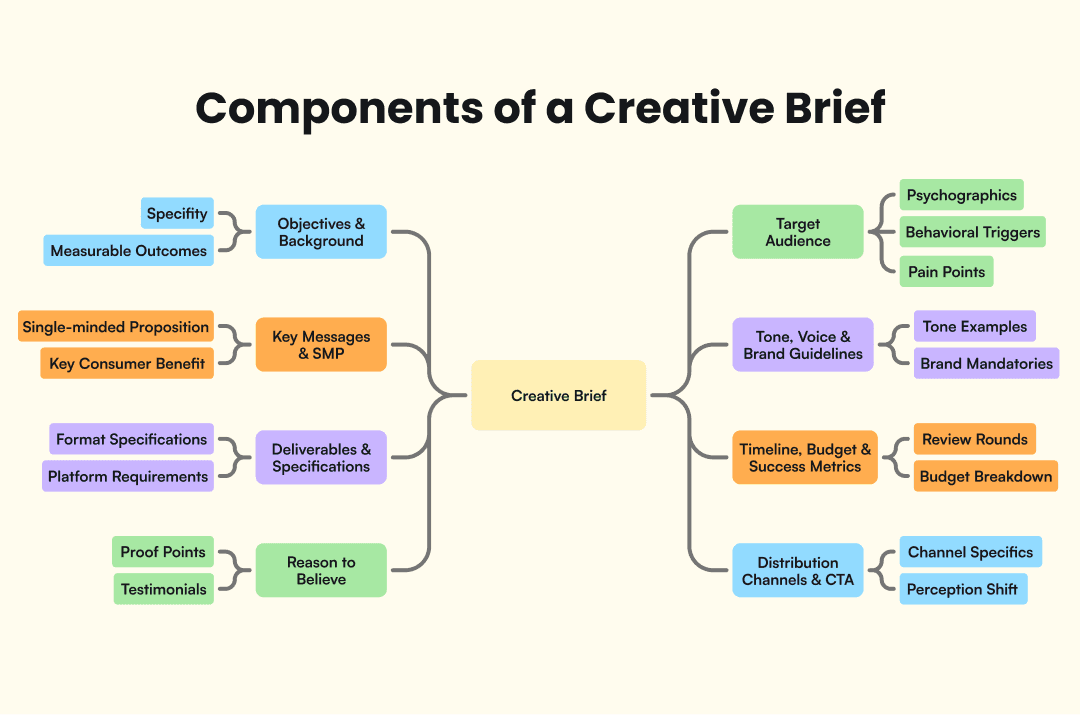
Objectives and background
Objectives define what the campaign needs to achieve and why. The difference between a useful objective and a useless one comes down to specificity. “Increase brand awareness” gives the creative team nothing to aim at. “Drive 500 sign-ups at $12 CPA within 30 days” tells them exactly what success looks like. The SMART framework is a reasonable starting point, but committing to a measurable outcome matters more than the acronym.
Target audience
The target audience section defines who the creative speaks to. A bracket like “25–45 women who shop online” gives the creative team a spreadsheet filter when they need a person they can picture sitting across from them. A useful audience definition includes psychographics, behavioral triggers, and pain points. What keeps them up at night? What have they already tried? The brief should paint the audience as someone the creative team can imagine talking to.
Key message and single-minded proposition
The single-minded proposition (SMP) is an agency term for one focused message the audience should take away. Think of it as the strategic layer underneath the tagline, the reason the tagline works even when people forget the exact words. If the SMP takes more than one sentence to state, it hasn’t been distilled far enough. The SMP differs from the Key Consumer Benefit (KCB): the KCB answers “what’s in it for me?” from the audience’s perspective, while the SMP answers “what do we want them to believe?” from the brand’s. Both belong in the brief, but the SMP drives creative direction.
Tone, voice, and brand guidelines
Tone direction works better when it includes examples alongside adjectives. “Professional” means nothing. “Confident but not arrogant, like explaining something technical to a smart friend” gives a creative team an actual register to write in. This section also includes brand mandatories: logo usage, color palette, font restrictions, and any legal disclaimers or compliance requirements. Platform-specific constraints belong here too.
Deliverables and specifications
“A social media ad” is not a deliverable. Deliverables must specify exact formats, dimensions, and platform requirements. For paid social, that means listing each asset: Meta 1080×1080 static, 9:16 Reels, 4:5 feed video, TikTok specs, Google display sizes. Vague deliverables are the primary source of scope creep in creative production. Every undefined format becomes a negotiation later.
Timeline, budget, and success metrics
Realistic timelines account for review rounds on top of delivery dates. Budget should break down by creative type and promotion channel. We recommend breaking down budget by line item, separating ad spend, design, and copy costs with specific ad dimensions attached to each.
Success metrics are the component most briefs skip. Only three of the top six competitor guides include them. If the brief doesn’t define what success looks like, no one will know whether the creative worked.
Reason to believe
The reason to believe is the evidence supporting the key message: proof points, testimonials, performance benchmarks, or user reviews. This component matters most in ad briefs where proof drives conversion. “Our product is the best” is a claim. “4.8 stars from 12,000 reviews” is a reason to believe it. Zero of the top six competitor guides include this component; only Gemini’s AI-generated brief template covers it.
Distribution channels and CTA
Where the creative runs changes what the brief contains, a Meta carousel ad brief looks different from a YouTube pre-roll brief: different runtimes, different hooks, different information hierarchy. Specifying the distribution channel keeps the creative team from designing something that doesn’t fit the platform.
The CTA section defines the desired action, but the best briefs frame it as a perception shift: what should the audience think or feel differently after seeing this creative?
Why most creative briefs fail
The 93%/67% gap in Monday.com’s research tells a specific story: creative briefs are nearly universal, but most don’t work. High adoption combined with low satisfaction points to a process problem. The concept works. The execution is where teams lose the thread.
The root causes tend to repeat across teams and industries:
Vague objectives. “Increase awareness” or “drive growth” gives the creative team nothing measurable to aim at. Without a specific outcome, every direction looks equally valid.
Prescriptive creative direction. “Make it pop” and “I’ll know it when I see it” replace strategy with personal taste. The brief should define the destination, not dictate the color of the car.
Missing success metrics. If no one defines what “done” looks like, done never arrives. The brief becomes a starting point that no one circles back to.
No sign-off before creative starts. Feedback arrives mid-production instead of at the brief stage, where changes cost a fraction of what they cost later.
Brief by email instead of live briefing. The brief arrives as a PDF attachment in an inbox. No conversation, no questions, no shared understanding of intent.
The deeper tension runs through all of these failures. A brief that prescribes too much kills the creative spark; a brief that says too little lets the brand disappear. Structure helps, but only when the structure is focused.
How to write a creative brief step by step
Writing a creative brief is a research and distillation process that breaks down the moment someone treats it like a form to fill in. These five steps assume you’ve already decided the brief is necessary and you know who will execute the creative.
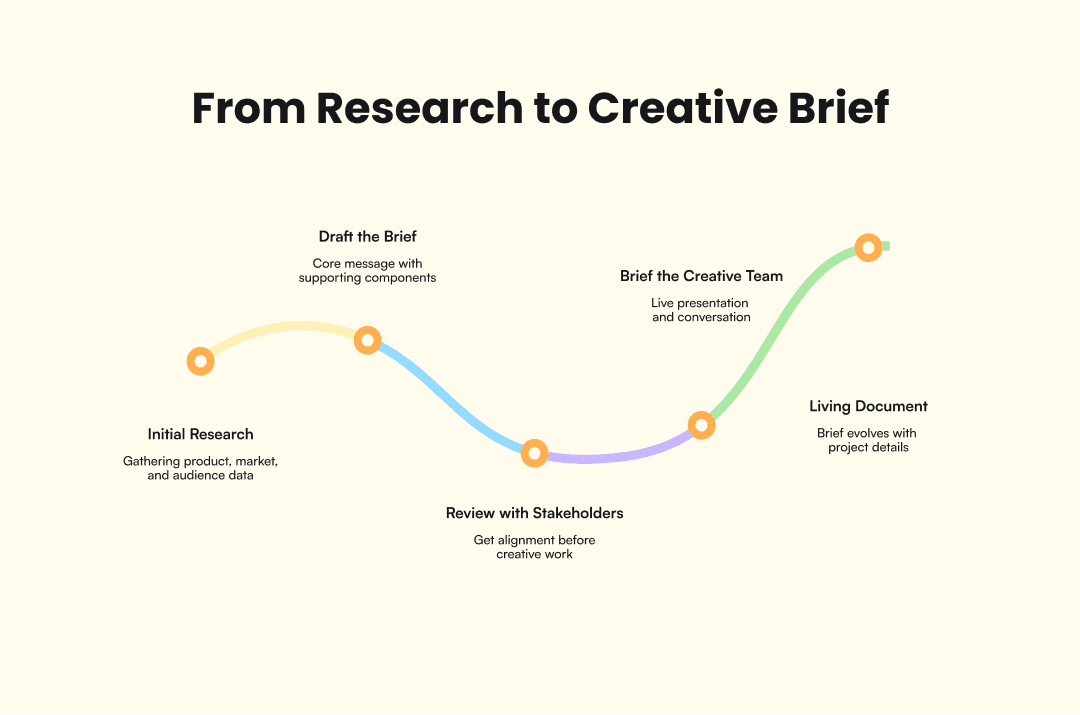
Research before you write. Know the product, market, audience, competitors, and campaign context before opening a blank document. The Three C's work well as a pre-brief checklist: competitors, context, and category. Who else is advertising to this audience? What's the market doing right now? Where does the product sit in the category? One useful clarity exercise is writing a hypothetical press release announcing the campaign's result. If you can't summarize the outcome in one headline, you're not ready to brief.
Draft the brief around the core message. Start with the single-minded proposition and build outward to the supporting components. The SMP is the anchor, and objectives, audience, tone, and deliverables orbit around it. Keep the full brief to one or two pages. Use a template as scaffolding, but recognize that a template with empty boxes produces empty thinking.
Review with stakeholders. Every stakeholder who can reject the final creative should see the brief before the creative team touches it. Changes after production begins cost three to five times more than changes at the brief stage. Lock the brief with explicit sign-off before any execution starts.
Brief the creative team live. Present the brief in person or on a live call. A PDF in someone's inbox gets skimmed, misread, or ignored. The briefing itself matters as much as the document because the creative team's questions sharpen the strategy in ways a static file never will.
Treat the brief as a living document. Lock the core message, but allow the details to flex when new audience data arrives, scope changes, or platform requirements shift. The brief should stay active through production, testing, and iteration. When the creative team pushes back on the message itself, have the conversation. When they push back on ad dimensions, update the brief.
Creative brief types by use case
Not all creative briefs follow the same format. The project type determines which components carry the most weight and how much tactical detail the brief needs.
Advertising and performance briefs
Advertising briefs for Meta, TikTok, and Google campaigns demand more tactical precision than general creative briefs. Success metrics, distribution channels, platform specs, and testing frameworks take priority alongside strategic direction. At volume, this becomes a production challenge: top DTC brands produce 50 to 70 new ads on Meta every week, according to Gil Chaimovski, a Meta Creative Strategist. At that pace, briefs need to be templatized without becoming generic.
Video production and branding briefs
Video briefs add storyboard references, shot lists, talent requirements, and runtime constraints to the standard brief structure. Branding briefs are longer-term and identity-focused: less tactical, more strategic, with heavier emphasis on tone and voice direction. Both formats require more detailed creative guardrails than a performance ad brief, because the margin for misalignment is wider and more expensive to correct.
UGC and creator briefs
With 61% of marketers planning to increase creator content investment in 2026, UGC briefs are becoming a standard format rather than an improvised add-on. The core challenge is calibration. Give too much brand direction and the creator’s authentic voice disappears. Give too little and the brand disappears entirely. Kantar’s Marketing Trends report captures this: “Over-direct and the spark dies; under-brief and the brand risks disappearing.”
The table below summarizes how brief requirements shift across these three categories:
Brief type | Priority components | Typical volume | Level of prescription | Typical length |
Advertising / performance | Success metrics, platform specs, CTA, testing framework | High (50–70 ads/week at scale) | Moderate: strategy + tactical specs | 1 page |
Video production | Storyboard refs, shot list, talent, runtime | Low to moderate | High: visual and narrative detail | 2–3 pages |
Branding | Brand positioning, tone/voice, visual identity | Low (campaign or rebrand level) | Low: strategic territory, not execution | 2–4 pages |
UGC / creator | Messaging guardrails, brand mandatories, creative freedom zones | Moderate to high | Low: direction without prescription | 1 page |
Creative brief vs design brief vs project brief
These three documents overlap in practice, and teams often confuse them. They serve different purposes, audiences, and stages of a project.
A creative brief is strategic: it defines the audience, message, and creative direction for campaigns or content.
A design brief is visual: it extends the creative brief into specific visual execution for designers, covering layouts, typography, color systems, and UI specifications.
A project brief is operational: timelines, resource allocation, milestones, and budget tracking for project managers.
The practical question is when you need more than one. A large campaign often requires all three: a creative brief to set direction, a design brief to execute the visual identity, and a project brief to keep everything on schedule.
Brief type | Purpose | Primary audience | Typical length | Trigger |
Creative brief | Strategic direction for campaigns | Creative team | 1–2 pages | New campaign or content initiative |
Design brief | Visual execution specifications | Designers | 2–5 pages | Visual deliverable needed |
Project brief | Operational planning and tracking | Project managers | 3–10 pages | Any scoped project with milestones |
Creative brief examples that work
Theory is useful until it isn’t. Two examples show what the principles look like in practice.
Iconic campaign briefs
Nike’s “Just Do It” campaign, developed by TBWA\Chiat\Day, is one of the most studied creative briefs in advertising. The brief worked because it identified a specific audience insight (everyday athletes without pros), built a single-minded proposition around personal motivation, and chose emotional territory over product features.
Dove’s “Real Beauty” campaign, briefed by Ogilvy, took a similarly sharp approach: one provocative audience truth (real women don’t see themselves as beautiful) that redefined the entire personal care category. Both briefs succeeded because of clarity and focus. Neither prescribed a specific execution.
Practical ad brief example
A DTC skincare brand running a Meta prospecting campaign might condense their brief to the following:
Single-minded proposition. “Clear skin without a 10-step routine.”
Target audience. Women 25–35 frustrated with complicated regimens and skeptical of overpriced serums.
Deliverables. 3x 9:16 Reels, 2x 1080×1080 statics.
Budget. $3,000 ad spend, $1,200 production.
Success metrics. 500 purchases at $18 CPA within 14 days.
Reason to believe. 92% of trial users saw results within 4 weeks (brand study).
Every component is specific, measurable, and tied to a clear outcome. A creative team can read this in two minutes and start concepting immediately.
When you don’t need a creative brief
Not every project needs a formal brief. A tiering approach, adapted from Adobe’s project complexity model, helps sort the question:
Tier 1 (full brief required). Large campaigns, new brand launches, multi-channel initiatives. Getting the brief wrong at this scale is expensive and visible.
Tier 2 (condensed brief or template). Mid-size seasonal campaigns, single-channel pushes. A one-page template with the core message and specs is enough.
Tier 3 (verbal briefing or playbook reference). Quick-turn assets, minor copy updates, derivative formats from existing campaigns. A five-minute conversation or moodboard will do.
The danger lies in treating Tier 1 work like Tier 3. What Adobe calls “sticky notes and hallway conversations” might feel faster, but they produce scope creep and conflicting direction that costs more time downstream.
Treat the brief like strategy
Nearly every team has a creative brief, but most treat it as a form to fill in rather than a strategic exercise. The brief is the most sacred document in advertising, and it deserves the same rigor as the creative work it produces. Start with the core message, build around the audience, and never email a brief you can present in person.
If you’re scaling creative production and need a structured starting point, AdMove’s AI Brief Generator can produce a first draft from a product URL in seconds.