
Facebook video ads dominate social advertising heading into 2026, and the reason isn’t budget size. CPMs are climbing, attention spans are shrinking, and 3.07 billion monthly active users are scrolling past anything that doesn’t grab them in the first frame. You need creatives that stop the scroll right away.
The execution side is where most advertisers stall: writing scripts, producing videos, testing variations, and managing campaigns burns through time and momentum.
Here’s how to create Facebook video ads that work for you and your budget.
Key Takeaways
The 3-Second Rule: Capture attention immediately with a specific problem-based hook to stop the scroll.
Short-Form Dominance: Videos under 15 seconds hit 53% higher completion rates than longer formats.
Sound-Off Design: Design for sound-off viewing. Use captions and benefit-driven visuals so your message lands on mute.
Creative Testing: Advertisers testing 5+ variations report up to 2x higher ROAS than single-creative campaigns.
AI Efficiency: Use AI tools to compress scriptwriting and video production from days into minutes.
What Are Facebook Video Ads?
Facebook video ads are paid video placements that run across Facebook, Instagram, Messenger, and the Audience Network. They appear in Feed, Stories, Reels, Marketplace, and in-stream content. You can run them for awareness, traffic, conversions, leads, or app installs. One format that covers the entire funnel.
The audience is almost entirely mobile. 98.5% of Facebook users access the platform on a phone, and square (1:1) or vertical (9:16) video fills more of that screen than any other format, which means video is the native format your ads compete in. Every creative decision from here forward starts with that reality.
Why Run Facebook Video Ads?
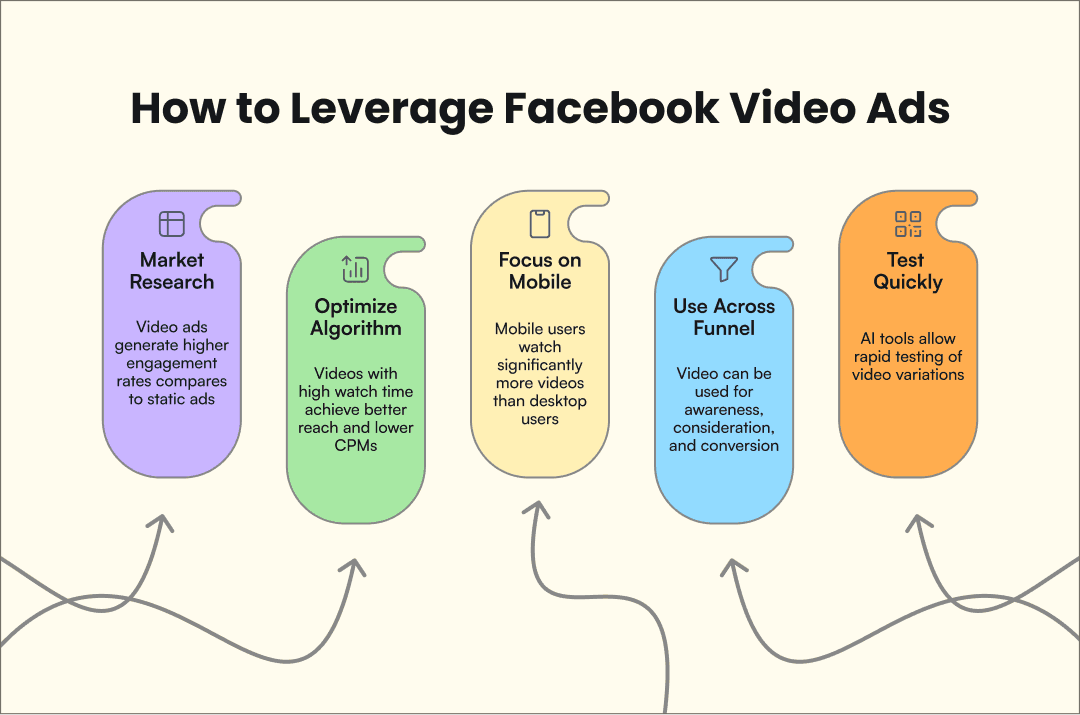
The numbers make the case. Video ads deliver 47% higher engagement than image-only ads, and vertical videos with audio achieve a 12% higher conversion rate than other formats. Static images still work, but video consistently outperforms them on the metrics that matter: watch time, click-through rate, and cost per result.
Facebook’s algorithm rewards content that keeps people on the platform. High watch times signal quality, which leads to better distribution and lower CPMs. That creates a compounding advantage for advertisers who invest in strong video creative rather than just increasing spend.
Video also works across the entire funnel. Use it for cold audience awareness, warm audience consideration, or retargeting conversions. Facebook ads reach 2.28 billion people globally, and with 98.5% of users on mobile and video accounting for 37.5% of total Facebook ad spend, the platform’s audience is already trained to consume video in-feed. Your ads meet them where they already are.
Set Your Campaign Objective and Audience
Your campaign objective determines how Meta Ads Manager handles delivery. Awareness campaigns reach cold audiences at scale. Traffic campaigns drive clicks to landing pages. Conversion campaigns push specific actions like purchases or sign-ups. Pick the objective that matches where your audience sits in the funnel, then shape your creative around that stage.
Campaign Objective | Audience Awareness | Video Focus | CTA Type |
Awareness | Cold (never heard of you) | What you do and why it matters | Soft (Learn More, Follow) |
Traffic | Warm (some familiarity) | Specific value proposition that creates curiosity | Click-focused (See How, Get Started) |
Conversions | Warm to hot (engaged or retargeting) | Address objections, create urgency, clear path to action | Direct (Sign Up, Buy Now, Book Demo) |
Your audience shapes every creative decision. A video for CFOs at enterprise companies needs different language, pacing, and proof than one targeting small business owners. If you’re unsure where to start, AdMove’s buyer persona generator builds audience profiles from your product data.
For targeting, Advantage+ audience is the 2026 default. 82% of Facebook advertisers now use Meta’s Advantage+ tools, and for good reason: broad targeting with AI-driven delivery outperforms narrow manual targeting in most cases. Start broad unless you have a specific exclusion reason, and let Meta’s delivery system find the highest-value users within your budget.
Write a Script That Hooks in 3 Seconds
The script is where most ads win or lose. Hook viewers in the first 3 seconds by calling out a specific problem or creating a pattern interrupt. Generic openings like “Looking to grow your business?” get scrolled past instantly. Specific works: “Spending $5K monthly on Facebook ads with dropping ROAS?”
After the hook, follow a tight problem-solution-CTA flow. Videos under 15 seconds hit 53% higher completion rates than longer formats, so every second of script needs to earn its place. Get to the point, show the solution, and tell viewers what to do next.
AdMove’s AI script generator changes this workflow. Input your product URL and target audience, and it analyzes your product, researches competitors, and generates multiple script variations using frameworks like AIDA or PAS. What takes most of a day manually takes minutes with AI, which means you can test more angles faster.
Turn Your Script into a Video
Three production paths exist, each with different trade-offs.
Recording original footage gives you full creative control over every frame. It’s the highest-quality option, but also the most time-intensive. You need equipment, locations, and editing time. For brands with in-house production teams, this is worth it. For everyone else, the turnaround kills testing velocity.
Stock footage with editing is faster and cheaper. Grab clips from a library, cut them to your script, add text overlays and music. The risk: your ad ends up looking like everyone else’s. Generic visuals blend into the feed instead of standing out.
AI video generation is the fastest path from script to finished ad. AdMove’s AI video generator takes your script, matches it to visuals from your brand library, applies your colors and typography, adds voiceover and captions, and produces ready-to-run ads in minutes. You can also start from a product URL and skip the script step entirely.
Authentic, phone-recorded content often outperforms polished studio production on Facebook. The platform rewards native-looking creative, and UGC-style ads tend to feel less like advertising to the viewer. You don’t need a production budget to make video ads that perform.
Design for Facebook’s Environment
Design for sound-off first. Around 80% of users react negatively to unexpected auto-playing audio, so your video needs to land without a single word being heard. Use 4:5 vertical for Feed (fills more mobile screen than 1:1) and 9:16 for Stories and Reels. Add captions to every ad. Use text overlays that carry your core message visually. If the viewer never turns the sound on, they should still understand exactly what you’re offering.
Creative specs differ by placement, and getting them wrong wastes budget on ads that look cropped, stretched, or out of place. Here’s what each placement needs:
Placement | Aspect Ratio | Resolution | Recommended Length | Creative Tip |
Feed | 4:5 or 1:1 | 1080 × 1080 px min | 15–30 seconds | 4:5 takes more mobile screen space than 1:1. Front-load the hook. |
Stories | 9:16 | 1080 × 1920 px | Under 15 seconds | Full-screen vertical. Keep text in the center safe zone. |
Reels | 9:16 | 1080 × 1920 px | Under 15 seconds | Avoid the top and bottom 14–15% where UI overlays appear. |
In-stream | 16:9 | 1080 × 1080 px min | 5–15 seconds (up to 60s) | Viewers are mid-content. Hook fast or they’ll skip. |
All placements accept MP4 or MOV, max 4 GB, minimum 1080 × 1080 pixels.
Rather than adjusting creatives for each placement, use Advantage+ placements to let Meta’s delivery system distribute your ad across Feed, Stories, Reels, and in-stream. It tests where your creative performs best and shifts spend accordingly.
Launch and Test Systematically
Don’t launch with a single creative. Start with 3–5 video variations per ad set, testing different hooks, formats, and lengths against the same audience. Advertisers testing 5+ creative variations report up to 2x higher ROAS than single-creative campaigns. Change one variable at a time so you know what’s actually driving results.
For budget, use Advantage+ campaign budget and let Meta’s AI allocate spend across ad sets. This replaces the old Campaign Budget Optimization (CBO) setting and works better with broad audiences. Meta reports Advantage+ campaigns deliver roughly 22% higher ROAS than manually managed setups. Average CPC for Facebook traffic campaigns sits around $0.70, but your actual cost depends on audience, industry, and creative quality.
Install the Meta Pixel and Conversions API before you launch. Tracking needs to be in place before the first impression serves. Kill underperformers once you have sufficient data, and scale winners by duplicating into new ad sets.
FAQ
How much do Facebook video ads cost per 1,000 views?
Most advertisers see $1–3 CPM in the U.S., though costs shift with audience size, competition, seasonality, and creative quality. Average CPC for traffic campaigns sits around $0.70 as of 2025. Strong engagement signals the algorithm to lower your CPM over time.
Can I add my logo and brand colors to videos made with AdMove?
Yes. AdMove’s Brand Hub pulls your brand foundation from your website. Set your logo, colors, typography, and voice rules once, and every video the AI generates stays on-brand without extra editing.
How many video ad variations should I test before scaling spend?
Start with at least 3–5 variations per concept. Campaigns testing 5+ creatives consistently outperform single-creative setups. Test different hooks, formats, and lengths, not just different visuals. Push budget toward the top performers once you have enough data to call winners.
Is $10 a day enough for Facebook video ads?
It’s enough to start testing. You won’t drive volume at scale, but $10/day is sufficient for validating creative and audience combinations. Use Advantage+ campaign budget to let Meta allocate even small budgets. Scale after you identify winning creative.
How long should Facebook video ads be?
Under 15 seconds is ideal for most placements. Videos at that length hit 53% higher completion rates than longer formats. Stories and Reels perform best under 15 seconds. Feed ads can stretch to 30 seconds. In-stream can run up to 60 seconds if the content holds attention.
What mistakes should I avoid with Facebook video ads?
The most common: wrong aspect ratio for the placement (landscape video in a Reels slot gets cropped), no captions (most viewers watch without sound), and videos that run too long before delivering the message. Only testing one creative is another frequent miss. Also check your Reels safe zones: UI overlays block the top and bottom 14–15% of the frame.
Start Creating Video Ads That Perform
The biggest advantage you can build right now is creative volume. Most advertisers launch one video and hope it works. The ones winning are testing 5+ variations per concept, killing losers fast, and scaling what the data says is working. Every section above gives you a piece of that system.
AI tools like AdMove compress the timeline from days to minutes: strategy, scripting, production, and campaign management all run through one platform. Start with AdMove AI to create ready-to-run ads.