Slow ad production was the primary reason eCommerce brands saw poor results on Meta last year.
And it’s not just “because of competition.” It’s because Meta rebuilt the way ads get selected in the first place.
Meta Andromeda's upgrade to the retrieval layer creates a more efficient way for the algorithm to match your creative with the right audience: the system that pulls a few thousand ads from tens of millions before the auction even happens. If your ad doesn’t make it through retrieval, it never really competes.
So now there’s a new reality for ecommerce brands heading into 2026:
Creative volume is going up (fast)
Advantage+ automation keeps expanding the number of eligible ads
Generative AI tools are pumping more creatives into the system than ever
The brands that can ship real creative variety consistently will keep finding new pockets of buyers
The brands that can’t will hit a ceiling and live there, even with a “good product”
This article breaks down what changed (based on Meta’s own engineering write-up), what to do differently to prepare for 2026, and why autonomous creative systems like AdMove are quickly becoming the only scalable answer.
Why Ecommerce Brands Struggle First when Meta Shifts to Retrieval
Your team is still waiting on briefs, approvals, and someone to “just quickly tweak the edit.”
In a retrieval-first world, performance volatility often stems from a single issue: fatigue outpaces production.
Your best ad gets matched more often (because it fits), it burns out faster, and then you’re stuck trying to “iterate” your way back into performance.
And fatigue is not subtle. In one widely cited data set, ad fatigue sets in after ~7–8 exposures per user, and excessive frequency can drive major CTR decline. That’s the environment you’re heading into.
That’s why a lot of ecommerce brands moving toward 2026 are seeing:
Launch momentum that disappears after the first seven days.
Ad budgets concentrated on too few successful visuals.
Persistent pressure to outrun creative fatigue with new content.
Internal teams burnt out by production bottlenecks and revision requests.
Creative Strategy is the Gatekeeper
Andromeda amplifies the strategic direction you provide.
Meta built this system to reward ads with clear, distinct signals. Success now requires meaningful variety rather than high volume. Every asset must define:
Identity: Who is this for?
Desire: What do they want most?
Urgency: Why should they care right now?
Repeating these three answers across different ads creates a variation, not a new concept. Relying on variations is how brands burn budget.
The Difference:
Wasteful Variation: Changing only the music or caption while keeping the same hook.
Scalable Concept: Testing a "frustration hook" against an "ingredient transparency angle" or a "nighttime routine" setup.
What Creative Testing Looks Like Inside Winning Teams
In 2025, ecommerce teams already knew they needed more creatives, but the real problem is execution.
Maintaining a steady stream of new ideas is the biggest hurdle for most marketing teams. A reliable production system is more important than the total count of ads.
Because volume only helps when it’s built on real variation. If new ads don’t introduce a different angle, pain point, or motivation, Meta’s retrieval system just sees the same signal repeated and you waste budget faster.
That’s why “preparing for 2026” isn’t about adding more ads.
It’s about building an operating model that supports:
A weekly creative pipeline
Repeatable planning instead of one-off brainstorms
Production that keeps moving without burning the team
Examples of Strong Andromeda-Friendly Ads You Can Find
Look at top-performing ads to see how Andromeda functions. These examples share the same brand and targeting while providing unique creative signals.
Below are real examples pulled directly from live ad libraries, along with why Andromeda treats them as fundamentally different.
Beauty / Supplements
Lemme
What’s happening in these ads
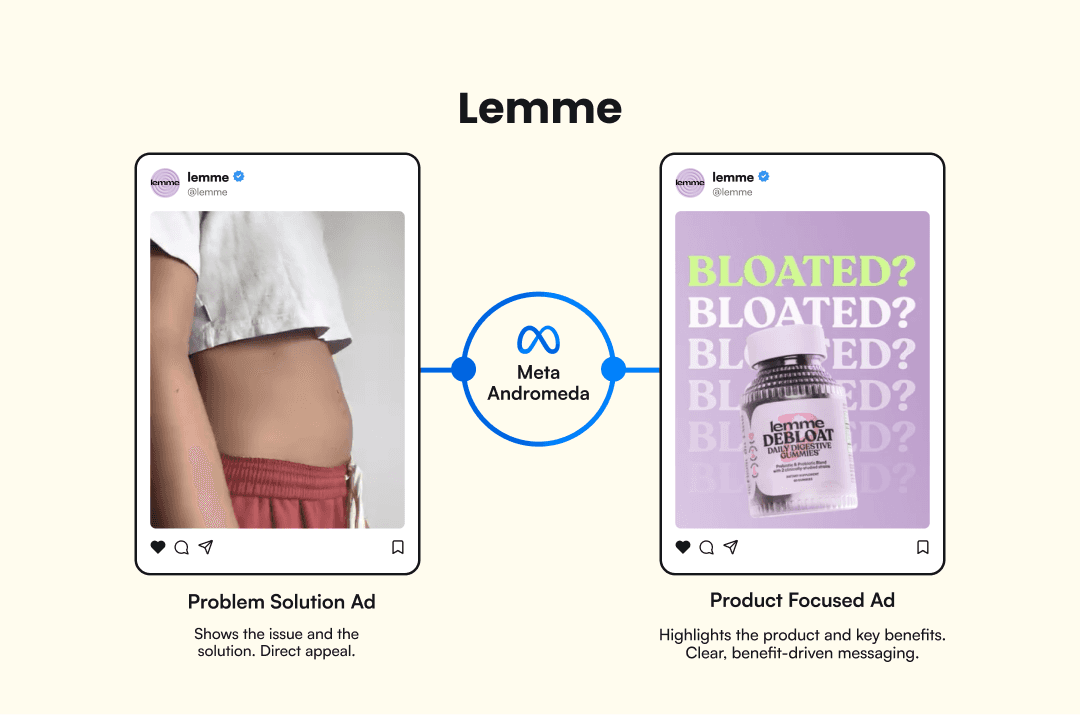
One Lemme ad leads with the problem. A close-up stomach shot. “Bloated?” repeated visually. Minimal explanation. High emotional immediacy.
The second ad flips the frame. Product front and center. Clear benefit bullets. Probiotics, digestion, microbiome support. Clinical reassurance.
Same product. Different awareness stage.
Why this works for Andromeda
These creatives signal two distinct user states:
Emotionally triggered, problem-aware
Solution-aware, credibility-seeking
Andromeda doesn’t need manual segmentation here. The creative itself tells the system which mindset it’s speaking to, and retrieval follows.
Apparel & Fashion
Lululemon & TrueClassic
What’s happening in these ads
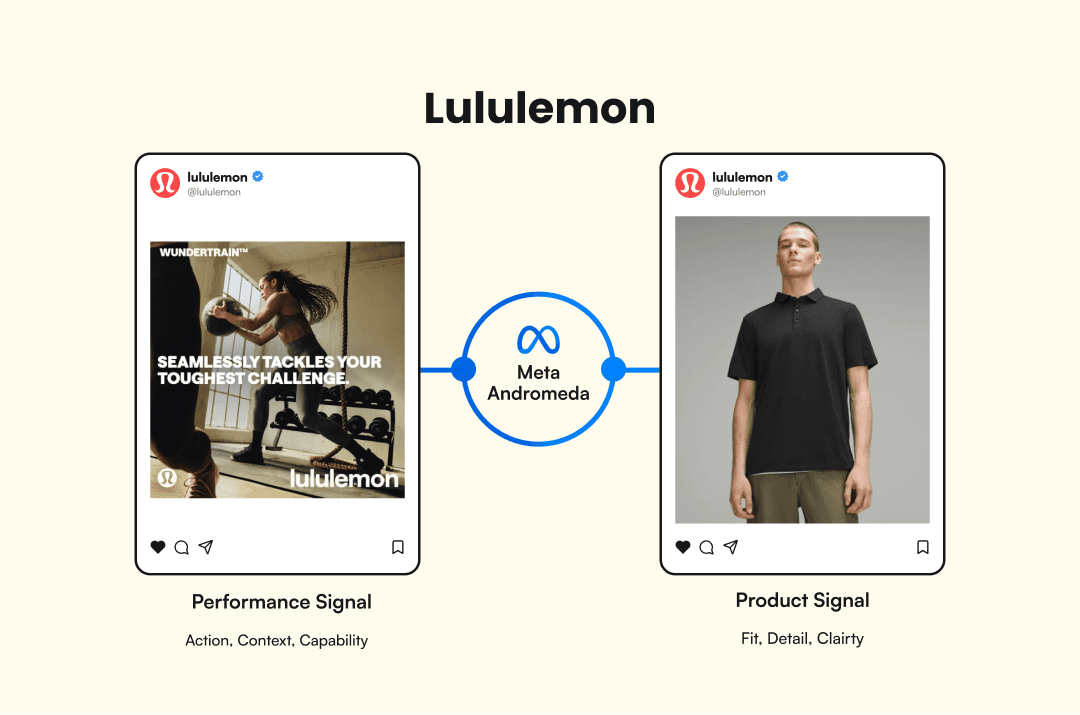
In the Lululemon examples, one ad shows intense training, sweat, and movement. The copy reinforces performance and progress.
The other strips everything back: neutral background, clean pose, product-first framing.
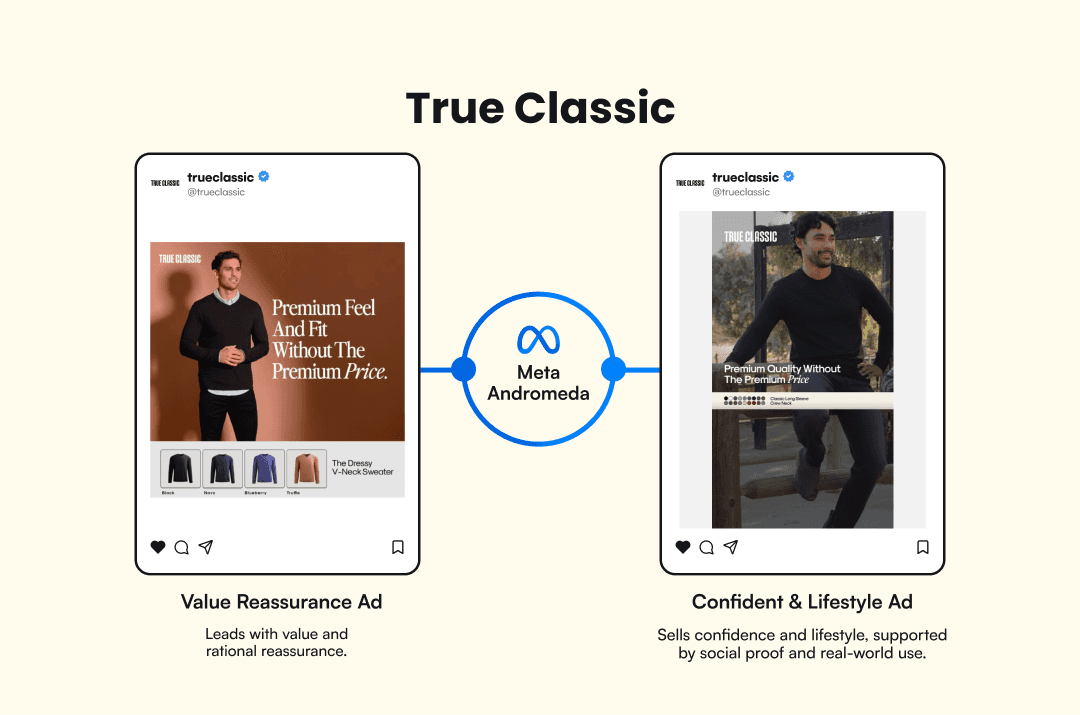
True Classic does something similar. One ad leads with value and rational reassurance (“premium feel without the premium price”). The other sells confidence and lifestyle, supported by social proof and real-world use.
Why this works for Andromeda
These specific signals help Meta identify and reach the correct buyer for each ad.
Andromeda retrieves:
Performance-driven ads for people who buy athletic wear as a tool
Lifestyle-driven ads for people who buy clothing as self-expression
Broad targeting works because the creative already tells the system who this is for.
Food & Beverage
Poppi
What’s happening in these ads
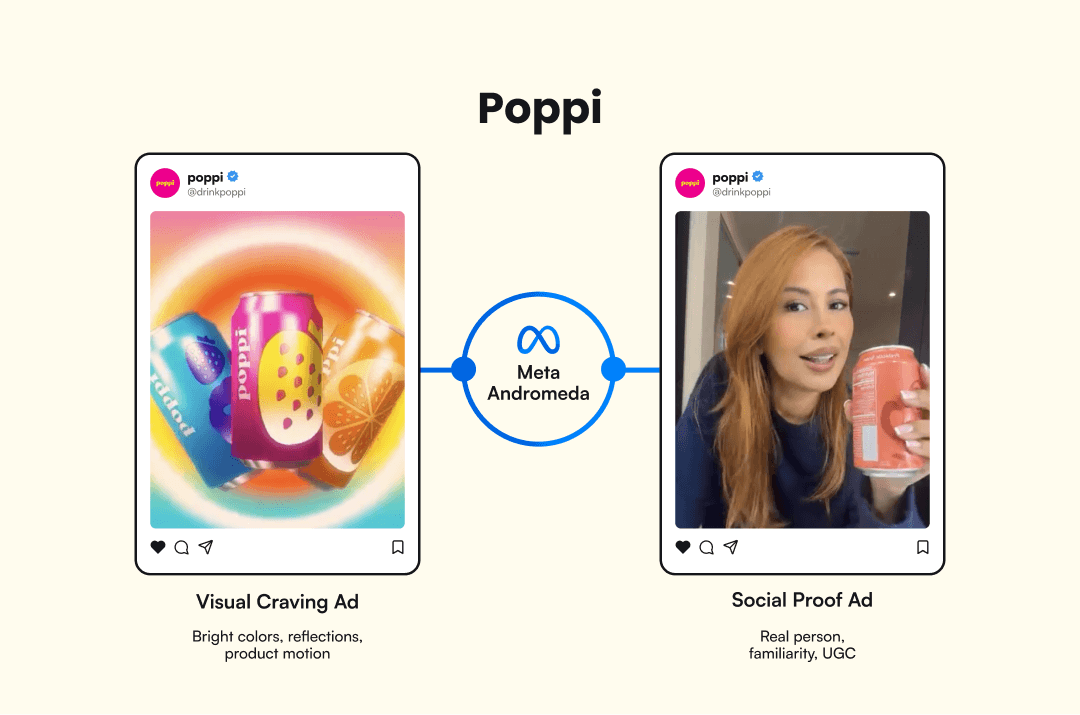
One Poppi ad is pure visual craving. Bright colors, reflections, product motion. No explanation. It’s about desire.
The other ad is creator-led. A real person holding the product, talking directly, offering social proof and familiarity.
Same drink, but with a different decision shortcut.
Why this works for Andromeda
Some users buy because something looks good.
Others buy because someone they trust drinks it.
Andromeda reads those cues. The creative tells the system which shortcut applies.
Home & Living
IKEA
What’s happening in these ads
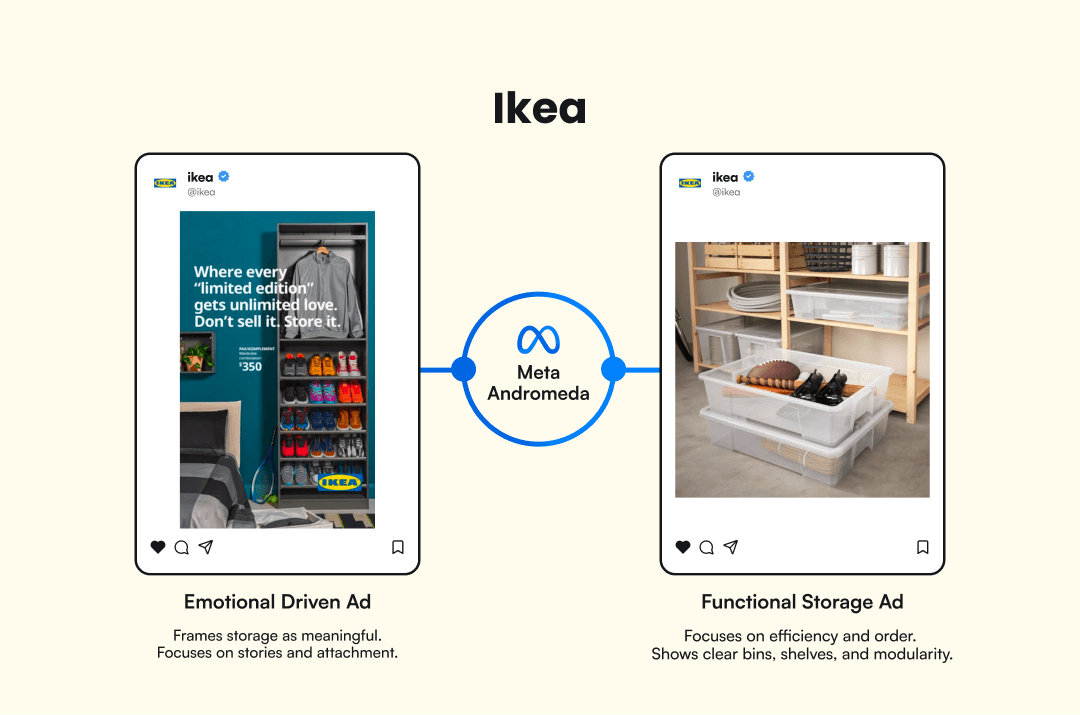
One IKEA ad frames storage emotionally. Personal items. Copy about stories, attachment, and care. Storage as something meaningful.
The other ad is purely functional. Clear bins, shelves, modularity. Storage as efficiency and order.
Same category. Different problem.
Why this works for Andromeda
These ads answer different questions:
How do I make my home feel calmer?
How do I organize more efficiently?
Andromeda focuses on the specific customer problem addressed in your ad. Each unique pain point creates a different path for the system to reach new audiences.
The algorithm identifies the right audience by analyzing the specific signals inside each ad.
And when those signals are clear, retrieval does the rest.
Creative Planning for Andromeda
A simple planning lens that works well for ecommerce:
Persona: who is this for?
Desire: what outcome do they want?
Moment: what situation are they in right now?
That “moment” layer is ecommerce gold:
Getting ready for work
Scrolling at night
Shopping for a gift
Frustrated after a failed product
Trying to save money
Trying to feel confident
If your creative plan covers multiple moments, Meta has more ways to match your product to real behavior. And that’s precisely what Andromeda is built to do at scale.
Campaign Structure
We’re not turning this into a campaign architecture guide. But you do need a structure that supports learning.
The setup most ecommerce brands should be using for 2026:
fewer campaigns per objective
broad ad sets (minimal restrictions)
stable structure
rotating creative packs inside the ad set
Why Manual Creative Planning Breaks (And Why 2026 Will Make it Worse)
The primary challenge is maintaining a consistent weekly schedule for launching new ads.
Creative strategy → briefs → scripts → production → revisions → ad sets → refresh cycles
That pipeline collapses as soon as you try to run it at Andromeda pace.
And Meta has been explicit about the direction: more automation, more eligible ads, more creative volume.
Ad platforms require faster creative output in 2026. Brands need a reliable workflow to handle the increased volume of new ads required to stay competitive.
How AdMove Helps You Prep for 2026
This is the part most Andromeda explainers can’t offer: an execution system.
AdMove is built for exactly what Meta is scaling toward: automation-first campaign management, higher creative volume, and faster iteration cycles.
And AdMove’s AI Agent doesn’t “hand you assets”.
It runs the weekly loop:
decide what to test → generate the brief → produce the pack → ship the ad set.
Specifically, AdMove:
Researches your brand and market
Generates weekly creative strategy briefs
Builds persona-based angles (and ecommerce moments)
Produces video + static creatives
Assembles ready-to-test ad sets automatically
A faster workflow lets your team focus on scaling winning ads and testing new concepts.
The Bottom Line: 2026 is the Year to Build Your Creative System
Meta Andromeda provides the core system needed to scale ads effectively.
So if you want to win in 2026, the work starts now:
Build real creative coverage
Ship weekly creative packs
Keep campaign structure simple and stable
Remove human bottlenecks from production
In a retrieval-first system, your creative determines which ads the algorithm selects for the auction. These signals control both who sees your ad and who eventually buys your product.
Conclusion
If you’re serious about being ready for 2026, don’t wait until your best ad fatigues and performance drops.
AdMove’s AI Agent creates your weekly creative strategy briefs, generates diverse ecommerce-ready creatives, and builds ready-to-test ad sets automatically so Meta always has fresh signals to learn from.
Try AdMove and see what autonomous creative testing feels like.