
Every media buyer has heard the advice: rotate your creatives before they fatigue. Helpful in theory, useless in practice, because nobody ever attaches a number to it. How many new creatives per week? The answer depends on math most teams never run.
The data makes the urgency clear. A Meta study found that click likelihood drops 45% after just four repeated exposures to the same ad. A 2025 Harris Poll put the consumer perspective in stark numbers: 61% of U.S. adults say they are less likely to buy from brands that show them the same ads over and over, and 88% say repetitive ads make them pay less attention entirely.
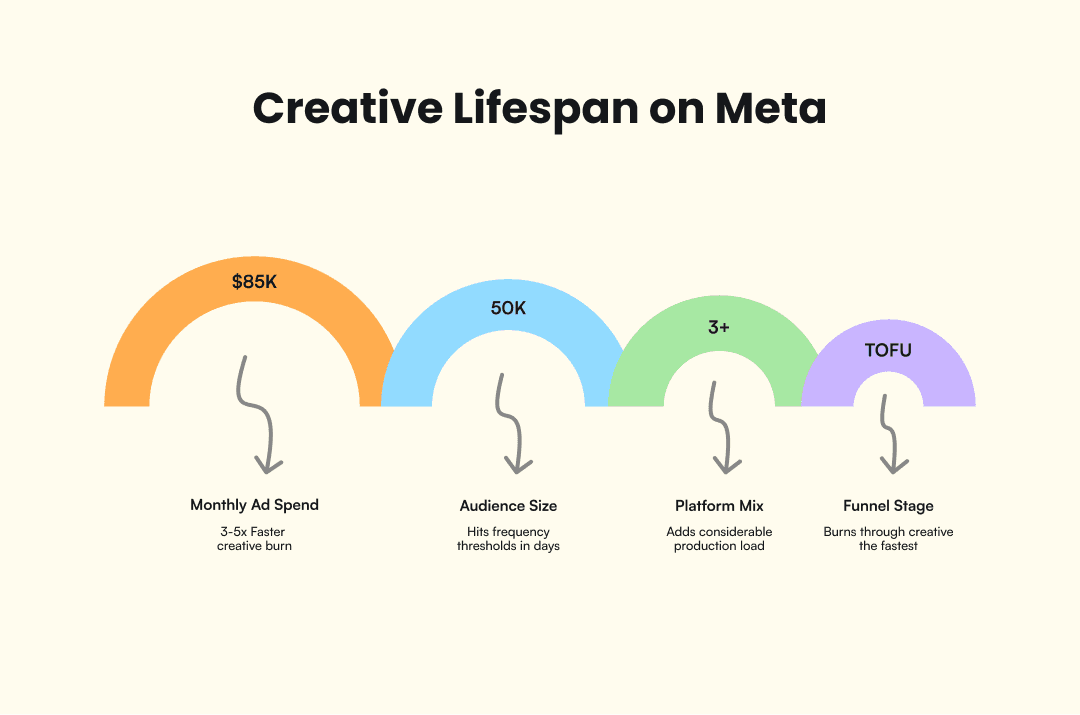
Four variables determine where your brand sits on the production spectrum: monthly ad spend, audience size, platform mix, and funnel stage. Each one shifts the weekly target in a different direction, and solving it starts with understanding how quickly ads lose their effectiveness.
Key Takeaways
Ads lose their effectiveness between three and six exposures per user. Three is where diminishing returns start; six is where negative returns take over. That range is the foundation for every creative volume calculation in this article.
Four variables determine how many new creatives a brand needs each week: monthly ad spend, audience size, platform mix, and funnel stage. Each one shifts the weekly target in a different direction.
The weekly creative replacement formula is (active ad sets × creatives per ad set) / average creative lifespan in weeks. Creative lifespan is the variable that changes the output most, and it shifts by platform and audience type.
TikTok burns through creative the fastest, sometimes within days. Meta averages two to three weeks before performance declines. Google and YouTube fatigue the slowest due to auto-rotation of assets.
A DTC brand spending $30K/month across Meta and TikTok needs roughly 10 to 14 new creatives per week. A B2B company at $10K/month needs 3 to 5.
70% of weekly creative output should be iterations on winning concepts (hook swaps, visual treatments, CTA variations), while 30% should be new angles. Meta's Creative Similarity metric flags ads that look too alike and clusters them rather than treating them as distinct tests.
Three production approaches close the gap when teams cannot keep up: sprint batching (focused sessions instead of ad-hoc requests), modular creative systems (swappable hooks, body segments, and CTAs), and AI-driven production that moves the bottleneck from creation to selection.
How fast do ads die?
The frequency research nobody aggregates
Ad fatigue research exists in dozens of scattered studies, but nobody pulls it into a single picture. Doing that reveals a consistent pattern: ads lose their effectiveness somewhere between three and six exposures per user, regardless of platform.
Purchase intent peaks on the first viewing (+5.7%), holds relatively stable through views two through five, then drops sharply: -4.1% between views six and ten, and another -4.2% at eleven or more. The decay is not gradual. It steps down in chunks, which means frequency thresholds function more like cliffs than slopes.
Meta's own research, reported by Northbeam, confirms the pattern with a different metric: a 45% drop in click likelihood after four repetitions. PepsiCo ran a controlled frequency cap test on Twitter and found that capping at three exposures reduced costs by 18% while increasing recall by 15%.
The functional range across all of this research is remarkably consistent. Three exposures is where diminishing returns begin. Six is where negative returns take over. That range is the foundation for every creative volume calculation that follows.
Platform fatigue speeds are not equal
The three-to-six exposure window plays out on very different timelines depending on where the ads run. TikTok burns through creative the fastest. Ads can fatigue overnight in high-spend accounts because the algorithm aggressively shows winning content to the same users in a compressed window. A creative that performs well on Monday may be spent by Wednesday.
Meta operates on a more gradual curve, typically two to three weeks before performance declines. Meta also provides two built-in diagnostic signals. The Creative Fatigue metric triggers when an ad's cost reaches 2x its historical average, flagging it as fatigued before performance craters completely. The Creative Similarity metric catches a different problem: visual duplication within ad sets, where ads that look too alike get clustered rather than treated as distinct tests.
Google and YouTube fatigue more slowly, with Performance Max auto-rotating assets to extend lifespan. But asset-level reports still reveal declining components, and HubSpot's frequency data confirms that YouTube is not immune to the same thresholds. WifiTalents' 2026 benchmark adds a useful comparison: e-commerce brands refresh their creatives 2.5x more often than B2B companies, reflecting the faster consumption cycles and higher impression volumes in DTC advertising.
Four variables that decide your weekly number
Monthly ad spend
Higher spend means faster frequency accumulation, which means shorter creative lifespan. A brand spending $50K/month on Meta burns through creative 3 to 5x faster than one spending $5K, because more budget buys more impressions served to the same audience pools. As a rough heuristic, every additional $10K in monthly Meta spend shortens creative lifespan by 20 to 30% compared to the previous increment. The relationship is not perfectly linear, but it is directionally reliable enough to plan around.
Audience size
Audience size works inversely with spend. A 50K lookalike audience at $20K/month hits frequency thresholds in days because the same people keep seeing the same ads. A 2M broad audience at the same budget stays below thresholds for weeks, sometimes stretching a single creative's useful life to three or four weeks on Meta.
Prospecting campaigns with broad targeting can run the same creative far longer than retargeting campaigns with tightly defined segments. Scaling spend without widening audiences is a recipe for accelerated fatigue: the budget increases, the audience stays the same, and frequency climbs faster than anyone expected.
Platform mix
Running ads on multiple platforms does not triple your creative needs, but it adds considerable production load. Each platform has its own format requirements and its own fatigue timeline. The hidden multiplier is cross-channel frequency. Frequency caps operate per platform, not across them. Someone who sees your ad three times on Meta and three times on TikTok has seen it six times total, but neither platform registers a problem.
Funnel stage
Top-of-funnel prospecting burns through creative the fastest. Cold audiences generate high impression volume with fast frequency accumulation. Bottom-of-funnel retargeting targets smaller, warmer audiences where each individual sees the ad fewer times, but small audience size means the pool saturates quickly regardless. Approximately 79% of consumers feel "tracked" by retargeted ads, which compounds the fatigue perception: people are not just bored by repeated ads, they are actively bothered by them.
The weekly creative volume formula
The framework is straightforward: (active ad sets x creatives per ad set) / average creative lifespan in weeks = weekly replacement rate. The variable that changes everything is creative lifespan, which shifts dramatically by platform and targeting.
Working creative lifespan benchmarks by platform and audience type:
Platform + Audience | Creative Lifespan | Key Factor |
Meta broad TOF | 2 to 3 weeks | Large audience slows frequency buildup |
Meta retargeting | 1 to 2 weeks | Small pool saturates fast |
TikTok (any audience) | 3 to 7 days | Algorithm compresses delivery window |
Google Performance Max | 3 to 4 weeks per asset | Auto-rotation extends lifespan |
LinkedIn (any audience) | 3 to 4 weeks | Professional context and lower frequency caps slow saturation |
Example A: DTC skincare brand. $30K/month split between Meta and TikTok, 300K combined audience, TOF-heavy media plan. 4 ad sets on Meta with 3 creatives each (12 live), 2 ad sets on TikTok with 3 creatives each (6 live). Meta creatives last about 2 to 3 weeks, producing 4 to 6 replacements per week. TikTok creatives last about 5 to 7 days, adding another 6 to 8 per week. Blended replacement rate: roughly 10 to 14 new creatives per week to keep the pipeline from going stale.
Example B: B2B SaaS company. $10K/month on Meta and LinkedIn, 150K audience, mixed funnel with roughly equal TOF and BOF spend, 3 ad sets with 3 creatives each (9 total live). Longer creative lifespans across both platforms, with Meta broad running 3 weeks and LinkedIn often extending to 4 weeks before visible decline. Replacement rate: 3 to 5 new creatives per week.
What counts as a "creative" matters here. Not every new ad needs to be built from scratch. The 70/30 benchmark is a useful production target: roughly 70% of weekly output should be iterations on winning concepts (hook swaps, different visual treatments, CTA variations), while 30% should be new angles and concepts. That 30% floor is important because Meta's Andromeda system evaluates creative diversity at the account level. Ads that are too visually or structurally similar get clustered, not treated as distinct tests. The Creative Similarity metric flags this. Producing volume without variety does not solve the problem.
One clarification: these numbers are production pipeline targets, not live-at-once targets. You are not running 12 ads simultaneously. You are replacing the ones that fatigue so your account always has fresh options in rotation.
Refresh cadences by platform
The table below maps refresh frequency, fatigue signals, and what a "refresh" means on each major ad platform.
Platform | Refresh frequency | Fatigue signals | What "refresh" means |
Meta | Every 1 to 3 weeks | CTR declining, CPC rising, Creative Fatigue flag (2x historical cost), Creative Similarity warnings | New hook or angle, different visual approach, distinct value proposition |
TikTok | Every 3 to 7 days | Thumbstop ratio dropping, CTR below 1%, engagement drop within 48 hours of launch | Native-feeling content with new hooks, different presentation styles, fresh creator angles |
Google PMax | Every 3 to 4 weeks per asset | Asset ratings dropping from "Best" to "Low", rising CPA | Replace weakest individual assets first, not entire ad groups |
Every 3 to 4 weeks | CTR declining, cost per lead rising, engagement rate dropping below account average | New professional angle, different pain point framing, updated proof points or data |
The table covers the tactical layer. But there is a strategic layer worth understanding, especially on Meta.
Meta's Andromeda ad ranking system retrieves a few thousand ads from tens of millions before the auction even begins. Creative diversity within your account directly affects whether your ads make it into that retrieval pool. Brands with deep libraries of meaningfully different creatives get more retrieval opportunities. Meta's own data from the Andromeda rollout (December 2024) showed a +6% improvement in ad recall and +8% improvement in ad quality, and those gains flow disproportionately to accounts with creative variety.
The refresh question is not just "when should I replace tired ads?" The better question is whether you are producing enough distinct concepts to compete in retrieval. Weekly creative volume is a fatigue play and an algorithmic competitiveness play at the same time.
What to do when your team can't keep up
Most in-house creative teams plateau at 5 to 10 new creatives per week. For brands spending $20K or more monthly, the math from the formula above demands more than that. Three approaches close the gap:
Batching and sprint production. Concentrate creative production into one or two focused sessions per week instead of spreading it across ad-hoc requests. A Monday sprint for rough concepts, a Wednesday session for polish and review. Dedicated production blocks with clear inputs and outputs beat a constant trickle of one-off asks.
Modular creative systems. Build a library of swappable components: hooks, body segments, CTAs, end cards. A library of 10 hooks, 5 body segments, and 4 CTAs generates 200 possible combinations. Each assembled variant counts as a distinct creative for testing purposes, and the production cost per unit drops once the components exist.
AI as a production multiplier. When weekly targets exceed what manual production can deliver, AI closes the gap between creative strategy and output. AdMove, for example, takes a product URL and generates finished video ads with synced voiceover, captions, and product visuals. It also offers a standalone AI voiceover generator for teams that need narration without the full production pipeline. Teams using this kind of agent-driven workflow produce 100+ creatives per week, moving the bottleneck from production to selection, which is a better problem to have.
The honest answer to "how many ad creatives per week" is almost always higher than teams expect. A DTC brand at $30K/month needs 10 to 14 per week. A B2B company at $10K/month needs 3 to 5. Both numbers sound aggressive until you run the formula against your own ad sets, lifespan data, and audience sizes. Ad fatigue is not something you react to after performance drops. It is something you outpace with a production system that keeps the pipeline full before the decline starts. Batching, modular systems, and AI-driven production all close the gap in different ways, but the principle is the same: build the pipeline before you need it.