Jan 27, 2026

Writing video ad scripts that convert is tough. You’ve got three seconds to hook viewers, need a problem solution flow that doesn’t feel pushy, and require a CTA people will want to click. Now, of course, we all know the blank page struggles, rewriting opening lines over and over again.
AI script generators have changed the game from that aspect. They help you generate multiple variations in minutes, adjust tone for different platforms (TikTok and LinkedIn audiences couldn’t be more different), and cut down drafting time significantly.
Speed isn’t the only issue, though. Managing campaigns across Meta, TikTok, and LinkedIn means creating platform-specific scripts at scale, something that’s nearly impossible manually. This shift is part of how AI agents are transforming ad operations, handling entire workflows from script creation through campaign launch.
Key Takeaways
Use Proven Frameworks: Utilize AIDA, PAS, or FAB structures to ensure your script moves viewers from attention to action.
Platform Specificity: Tailor hooks and tone specifically for the platform (e.g., casual for TikTok, professional for LinkedIn).
Leverage AI for Speed: Use AI generators to create multiple variations in minutes, preventing creative fatigue and enabling velocity testing.
Focus on Specific Hooks: Avoid generic openings; use precise pain points (e.g., "spending 3 hours on bids") to grab attention in the first 3 seconds.
Integrated Research: Effective AI tools should analyze product URLs and competitor data to generate unique positioning angles.
Core Copywriting Frameworks that Drive Results
Every high-performing video ad follows a structure that guides viewers from stopping mid-scroll to taking action.
Framework | Structure | Best Used For | Key Strength |
AIDA (Attention, Interest, Desire, Action) | Hook → Problem highlight → Benefit showcase → Clear CTA | Product demos, explainer videos, e-commerce | Mirrors natural purchase decision process |
PAS (Problem, Agitate, Solution) | Identify problem → Show real cost of inaction → Present solution | B2B services, complex solutions, high-consideration purchases | Creates urgency through pain point emphasis |
FAB (Features, Advantages, Benefits) | What it does → Why that matters → How it improves your situation | New product launches, competitive differentiation, tech products | Educates while building value perception |
Before-After-Bridge | Current frustration → Desired outcome → How to get there | Transformation stories, lifestyle products, coaching services | Creates vivid contrast that motivates action |
AIDA (Attention, Interest, Desire, Action) grabs attention with a scroll-stopping hook, builds interest by highlighting a problem, creates desire by showcasing benefits, and ends with a clear next step. You have three seconds max for that attention phase; you miss it and they’re gone. For short-form video, interest and desire often blur together since you only have about 20 seconds in total, according to Wyzowl's video marketing statistics.
PAS (Problem, Agitate, Solution) starts with a problem that your audience knows well, agitates by showing that it’s costing them (time, money, missed opportunities), then presents your solution. Agitation makes familiar frustration urgent enough to act on now instead of “someday”.
FAB (Features, Advantages, Benefits) moves quickly from what your product does to why it matters to how it improves their life. Don’t linger on features. “Our platform automates ad creation” (feature) should immediately become “which eliminates manual design work” (advantage) and land on “so you launch campaigns in minutes, not days” (benefit).
Before-After-Bridge paints a vivid contrast. The “before” needs specificity: “spending three hours every morning manually adjusting bids across five platforms”. The “after” should be equally tangible: “launching five optimized campaigns in the time one used to take”.
AI Script Generation for Campaign Creation
Rapid Iteration: Generate 10+ framework-based variations in an hour rather than a full day to combat creative fatigue.
Brand Consistency: Maintain a unified voice across multiple clients or products by feeding AI specific audience and tone parameters.
Platform Adaptation: Automatically reformat core messages to match TikTok’s casual pace or LinkedIn’s professional authority.
Velocity Testing: Generate twenty options quickly to identify winning angles before committing your full media budget.
AdMove’s AI Script Generator: Market Research Meets Script Creation
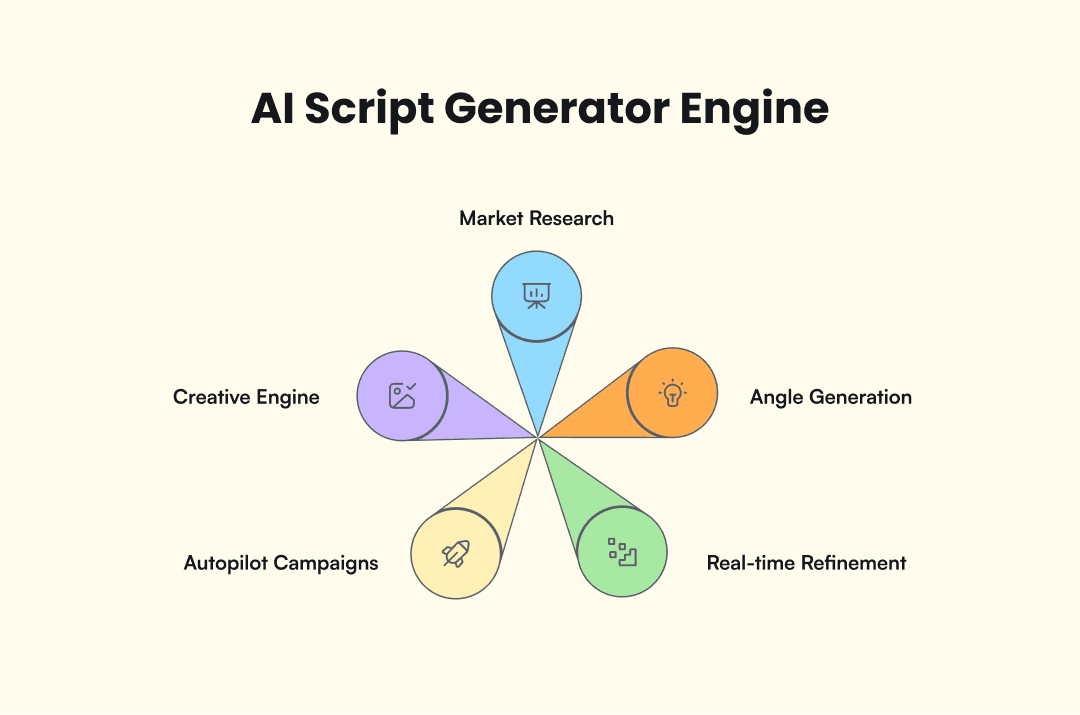
Most AI script generators treat script writing as an isolated task. Feed them a product description, get a generic copy back. AdMove takes a different approach by integrating market research directly into script generation.
Feature | What It Does | Why It Matters |
|---|---|---|
Market Research Integration | Analyzes product URL/catalog, competitive landscape, audience pain points | Scripts address real market positions instead of generic benefits |
Angle Generation | Creates multiple positioning strategies per product for different personas | Test different value propositions without manual ideation |
Real-Time Refinement | Adjust tone, hooks, or sections without rewriting entire script | Iterate based on performance data quickly |
Autopilot Campaigns | Turns scripts into video ads and launches campaigns automatically | Eliminates production and deployment bottlenecks |
Creative Engine | Learns from brand assets and performance data | Generates on-brand creative variations automatically |
Market research that informs every line
AdMove analyzes your product URL or catalog to understand what you’re selling, who’s buying, and how competitors position similar offers. It extracts positioning angles from product pages, identifies pain points from reviews and forums, and maps competitive messaging gaps.
The result? Instead of “save time and money” (every ad’s claim), you get hooks like “eliminate the three hours you spend every morning optimizing bids manually,” leaving the tool to identify specific pain points through research.
Marketing angles tailored to personas and platforms
AdMove generates multiple marketing angles for different audience segments and platforms. Selling project management software? You might get an efficiency angle for operations managers, a collaboration angle for remote teams, and a visibility angle for executives. Each comes with platform-specific scripts: quick-hit for TikTok, educational for YouTube, and professional for LinkedIn.
And this is how the same product solves different problems for different people. Manual writing forces you to pick one angle and hope. AdMove enables you to test multiple positioning strategies at once.
Real-time script refinement
The refinement interface lets you adjust tone, rewrite hooks, or modify sections without having to start over. If your opening isn’t grabbing attention, regenerate just that part while keeping the rest. When you’re adapting based on early performance data, these granular controls are invaluable.
Autopilot campaigns
AdMove turns scripts into social media video ads and launches campaign automatically. The app handles creative production (matching scripts to visuals from your brand assets) and campaign setup across platforms, removing the gap between scripts approval and campaign launch, where most operations bog down.
Creative engine that learns your brand
The creative engine analyzes your existing brand assets and performance data to create ads that match your visual identity. As campaigns run, it learns which creative elements drive performance and weights future generations toward what’s working. If product demos outperform lifestyle footage for your brand, the system automatically generates more demo-focused variations.
Tips and Pitfalls
Start with specific hooks
Your first three seconds determine if anyone keeps watching. Avoid generic hooks like “Are you tired of wasting time?” Instead, use specific hooks such as “Spending two hours every morning adjusting Meta campaigns manually?” Specificity signals that you understand the viewer's exact problem.
Keep core message under 30 Seconds
Your full video might run 60-90 seconds, but the problem-solution-CTA loop needs to land in the first 30. If viewers can’t grasp what you’re offering and why should they care in half a minute, you’ve lost them.
Align tone with platform expectations
TikTok aspects casual language, fast-paced editing, and trendy hooks. LinkedIn expects professional framing, industry-specific terminology, and clear ROI discussions. Review AI-adjusted tone for authenticity.
Avoid generic openings and over-promising
“In today’s fast-paced world”, “What if I told you”. No, avoid that; it immediately screams low-quality content. Similarly, promising “10x ROI” or “overnight success” damages credibility. Stick to specific claims. “Reduce campaign setup time from 3 hours to 20 minutes” is both believable and consistent.
Test Multiple Variations Systematically
AI generators produce volume quickly. Use that for structured testing. Generate scripts with different hooks but identical body copy to isolate what opening works best. Test different CTAs while keeping the problem-solution consistent.
Don’t pick your favorite, test systematically and choose based on results.
Best Practice | Why It Matters | Common Mistakes to Avoid |
Specific hooks | Calls out precise pain point your audience recognizes | Generic questions like "Tired of wasting time?" |
Core message in the first 30 seconds | Captures attention before viewers scroll away | Burying the main point 45+ seconds into the video |
Platform-appropriate tone | Matches audience expectations for that context | Using LinkedIn language on TikTok or vice versa |
Specific, verifiable claims | Builds credibility through precision | Vague promises like "10x ROI overnight" |
Systematic A/B testing | Identifies what actually drives performance | Picking scripts based on personal preference |
Start Creating Better Scripts Today
Video ad scripts determine when your creative stops the scroll or gets ignored. The frameworks, AI tools, and processes outlined here give you a system for producing scripts that convert without heading into a dead end.
AdMove’s AI script generator goes beyond basic text generation; it integrates market research to address real competitive positioning instead of generic benefits, sprinkled with autopilot execution that eliminates the production bridge between script approval and campaign launch.
Ready to see the difference? Generate your first AI ad script and experience how market research integration and autopilot execution change what’s possible in ad operations.