
A UGC ad is a paid advertisement that uses content created by real people, or AI-generated content designed to look that way, rather than polished brand studio production. The format works because it triggers the same trust response as a personal recommendation, and the numbers back that up. UGC-driven conversions run 6.73x higher than non-UGC content based on Q1 2026 benchmarks. Also, UGC posts generate 6.9x more engagement than brand-created content.
Those numbers explain why every media buyer and brand owner is chasing UGC volume. But most guides cover either human creators or AI tools, not both, and almost none connect creative production to a testing and measurement system.
The approach that works treats UGC creation as a system: script, produce with human creators or AI tools or both, test variations at volume, measure what lands, and iterate. Each step feeds the next.
Key Takeaways
A UGC ad is a paid advertisement that uses content from real people, or AI-generated content designed to mimic that style, instead of polished brand studio production.
Every UGC ad script follows a four-part structure: hook (0–3 seconds), problem (3–8 seconds), solution/demo (8–20 seconds), and CTA (final 3–5 seconds).
Hooks are the highest-leverage testing variable in any UGC ad. Batch-testing hooks in isolation, with the script body held constant, produces cleaner performance data than testing complete ads.
Human-creator workflows produce 5 to 10 ads per production cycle. AI workflows generate 50-plus variations from a single script, which makes volume testing practical at lower per-unit cost.
The hybrid approach uses human creators for 2–3 hero ads that establish social proof, then AI tools to produce 20-plus hook and angle variations for testing.
Hook rate diagnoses the opening, hold rate diagnoses the script body, CTR diagnoses the CTA, and CPA measures creative-to-conversion efficiency. Each metric points to a different fix.
Each platform requires different UGC optimization: TikTok rewards fast pacing where the first frame earns the second, Meta feed ads assume silent viewing with captions carrying the full message, and Instagram Reels sits between the two in production polish.
The 90/10 production rule for AI-generated UGC puts 90% B-roll and product footage against 10% talking-head avatar to reduce the synthetic feel that triggers viewer skepticism.
What makes UGC ads effective
Consumers have a trust gap with brand content. UGC ads outperform traditional branded content because they trigger the same trust response as a personal recommendation: Nielsen’s Consumer Trust Index shows 88% of buyers trust people they know over any form of advertising, and that trust translates directly into ad metrics. Influee reports 28% higher engagement rates for UGC ads compared to brand-created ads, while early industry research established click-through rate lifts of up to 4x for UGC formats.
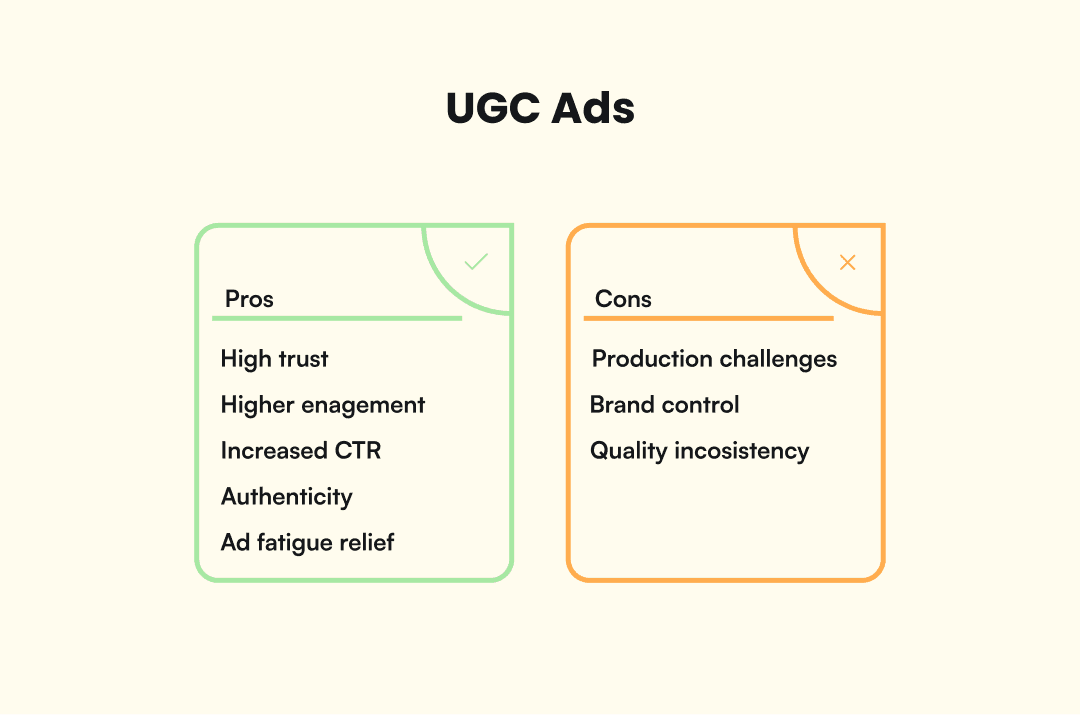
An EnTribe survey found 84% of consumers trust brands more when campaigns feature UGC, and 60% call it the most authentic form of marketing content.
The mechanism is deliberate imperfection. A UGC ad shot on an iPhone with natural window light and conversational delivery makes the viewer think, “this person is like me.” Studio-quality production works against this effect because it signals advertising rather than peer experience. The content should look like something a friend posted from their couch, shot on a phone with natural lighting.
Ad fatigue compounds the advantage. As audiences build resistance to polished creative, the raw feel of UGC resets attention. A viewer who skips a branded product video will stop for someone talking into their phone about the same product, because the format reads as personal content rather than advertising.
UGC ad formats and when to use each
Not every UGC format works for every goal. The format you choose should match your campaign objective, target platform, and funnel position. Tutorials and app reviews usually generate higher installs per mille than testimonials, which means format selection has a direct, measurable impact on cost efficiency.
Format | Best for | Platform fit | Funnel stage |
|---|---|---|---|
Testimonial | Trust and social proof | Meta, Instagram Reels | Mid-funnel, bottom-funnel |
Problem/solution | Pain point activation | TikTok, Meta | Top-funnel, mid-funnel |
Unboxing | Product reveal and excitement | TikTok, YouTube Shorts | Top-funnel |
Comparison/versus | Competitive positioning | Meta, YouTube Shorts | Mid-funnel |
Routine/day-in-my-life | Lifestyle integration | TikTok, Instagram Reels | Top-funnel |
POV/first-person | Viewer identification | TikTok, Instagram Reels | Top-funnel |
Tutorial/how-to | Education and product demo | YouTube Shorts, Meta | Mid-funnel, bottom-funnel |
Start with the format that maps to your primary campaign objective. If you’re running top-of-funnel awareness, problem/solution and POV formats on TikTok give you the widest reach. For retargeting warm audiences, testimonials and comparison ads on Meta tend to close better.
How to write a UGC ad script
The 4-part script structure (hook → problem → solution → CTA)
Every UGC ad, whether delivered by a human creator or an AI avatar, runs on the same four-part script structure.
Hook (0–3 seconds): the pattern interrupt that stops the scroll. A question, bold claim, or visual surprise.
Problem (3–8 seconds): name the viewer’s pain in their language. “I was spending $200 a month on skincare that wasn’t working” beats “Are you tired of bad skincare?” because it’s specific and personal.
Solution/demo (8–20 seconds): show the product solving the problem. Physical products in use, services or software as screen walkthroughs or before-and-after comparisons.
CTA (final 3–5 seconds): soft beats hard. “Check it out if you’re dealing with the same thing” keeps the peer-to-peer tone that makes UGC convert. Aggressive CTAs break the authenticity the rest of the ad worked to build.
Timing scales with ad length: 15 seconds compresses the middle, 30 seconds balances each part, and 60 seconds expands the demo.
Hook frameworks that stop the scroll
Hooks are the single most testable element in any UGC ad. Five frameworks cover most high-performing openers:
Question hook: “Did you know most people wash their face wrong?”
Bold claim/statistic: “This $12 serum outperformed my $90 one.”
Before-and-after: “Here’s my skin two weeks ago vs today.”
Social proof opener: “Over 50,000 people switched to this last month.”
Pattern interrupt: “Don’t buy this product.” Contradicting expectations forces the viewer to find out why.
The key principle is to batch-test hooks. Keep the script body constant and swap only the opening. Practitioners testing 20 to 50 hook variations per product consistently outperform those running fewer than 10 complete ads, because the hook determines whether anyone sees the rest of the script.
Social proof and CTA best practices
Social proof works best as a script ingredient woven into the narrative: user counts, specific results (“my sleep score went from 62 to 89”), or before-and-after visuals. It should sound like something the creator would say to a friend, not a marketing claim.
Match your CTA intensity to funnel position. Awareness: “check it out.” Consideration: “see if it’s right for you.” Retargeting: “grab yours before they sell out.” HubSpot data shows 79% of consumers say UGC influences their purchasing decisions, so the format does most of the persuading before the CTA lands.
Creating UGC ads with human creators
Building a data-driven UGC brief
A good UGC brief turns ad-hoc creator content into repeatable output. Include these components:
Product angle: the specific benefit or use case the creator should focus on.
Target audience: who the viewer is and what language they use.
Format and platform: which UGC format from the taxonomy above, sized for the target platform.
Dos and don’ts: brand guardrails without killing authenticity.
Reference examples: links to 2–3 ads with the tone and style you want.
The data-driven part: pull your top-performing hooks, winning angles, and highest-converting audience segments from your ad account before writing the brief. Most briefs fail because they’re based on gut instinct rather than account performance data.
Sourcing creators and managing production
Find creators through UGC platforms (Billo, Insense, Trend), creator agencies, or direct outreach on TikTok and Instagram. Micro-influencers with 1K to 100K followers deliver 60% higher engagement rates than macro-influencers, and their content often feels more genuine because it is.
Vet for audience alignment with your target demographic, content style that matches your brand’s aesthetic range, and engagement quality. Comments and shares matter more than follower count.
For production, order in batches. Request multiple hook variations per creator in a single production cycle. Give clear direction on the brief but leave room for the creator’s natural voice. Over-scripting kills the authenticity that makes UGC work. Review raw footage before final edits rather than micromanaging the shoot.
Creating UGC ads with AI tools
The AI UGC workflow (script to finished ad)
AI UGC creation follows a consistent pipeline regardless of which tool you use. Start with a script built on the four-part structure, then move through avatar selection, voice generation, B-roll and visual overlay assembly, caption layering, and final export.
The tool market is fragmented, and most platforms cover one or two pipeline stages: avatar generation, preset video formats, or voice synthesis. Practitioners typically combine several tools to get from script to finished ad. A few platforms, including AdMove, handle the full production sequence in one workflow: script, avatar, voice, generation, and batch export. The space changes fast, so evaluate by pipeline coverage rather than individual feature lists.
What matters more than the tool is the volume advantage. Where a human-creator workflow might produce 5 to 10 ads per production cycle, an AI workflow can generate 50-plus variations from a single script in the same timeframe. That speed makes batch testing practical at a scale that was not possible two years ago.
Avatar, voice, and post-production
Avatar selection sets the tone. Most tools have a catalog of stock avatars, but the stronger approach is using character reference images to match the demographics and style of your target audience. A skincare brand targeting women in their 30s needs a different face than a SaaS tool targeting engineering managers.
Voice quality is where AI UGC has improved most. Beyond basic text-to-speech, voice cloning and voice mirroring techniques allow you to match emotional nuance and pacing to the script’s intent. Clone a voice with the right energy, and the delivery sounds like a real person sharing personal experience rather than reading a prompt.
The 90/10 rule for production: use 90% B-roll and product footage with 10% talking-head avatar. CapCut handles the final assembly for most practitioners, covering captions, music layering, and pacing cuts.
Human creators vs AI tools: how to choose
The full comparison
Most teams end up using both human creators and AI tools in different ratios. Seeing the trade-offs laid out across key dimensions helps you decide where each method fits.
Dimension | Human creators | AI tools |
|---|---|---|
Cost per video | $150–$500 typical, up to $2,000 for premium talent (market average ~$198/deliverable per Billo, 2025–2026) | $2–$57 per video based on current tool pricing. A campaign of 5 variations runs $100–$285 compared to $1,100–$2,950 through human creators |
Speed | 1–4 weeks from brief to final asset | Minutes to hours |
Authenticity | High. Real people, real reactions | Improving but still detectable in close-ups and extended speech |
Legal burden | Creator contracts, usage rights negotiation, FTC disclosure | Platform terms of service, AI content labeling requirements |
Scalability | Limited by creator availability and budget | Near-unlimited variations from a single script |
Creative control | Lower. Dependent on creator interpretation | High. Every element is editable |
When to use each method (and the hybrid approach)
The right method depends on your situation, so here are some examples.
Launching a new product: use human creators for 2–3 hero ads that establish genuine social proof, then AI tools to generate 20-plus hook and angle variations for testing.
Scaling a proven winner: AI tools let you produce 50 variations of a successful script in hours instead of commissioning new creators.
Testing a new market: AI gives you the speed to test messaging across demographics before investing in creator partnerships.
Ongoing creative refresh: the hybrid approach works best for sustained campaigns. Human-created hero content builds the trust baseline while AI-generated variations keep the testing pipeline full without burning through creator budgets every week.
Platform-specific UGC optimization
A UGC ad that performs on TikTok will not necessarily work on Meta without adjustment. Each platform has different expectations around pacing, audio, and CTA placement.
Platform | Aspect ratio | Ideal length | Pacing | Audio approach | CTA placement |
|---|---|---|---|---|---|
TikTok | 9:16 | 15–30s | Fast cuts, frequent visual changes | Native sound or trending audio | In-video or pinned comment |
Instagram Reels | 9:16 | 15–30s | Slightly slower than TikTok | Original audio preferred | End card or caption |
Meta/Facebook (Feed) | 1:1 or 9:16 | 15–60s | Moderate, front-load value | Must work silent (captions required) | Text overlay + end card |
YouTube Shorts | 9:16 | 15–60s | Moderate | Voiceover or direct speech | End card + verbal CTA |
TikTok rewards fast-moving content where the first frame earns the second. Instagram Reels overlaps with TikTok but favors slightly more polished production. Meta feed ads must assume silent viewing, so captions need to tell the full story on their own. YouTube Shorts allow longer content but the pacing still needs to earn attention in the first two seconds.
Editing and post-production
Editing is where human-creator and AI-generated content both get polished for performance. Captions, pattern interrupts, and aspect ratio matter more than anything else in the edit.
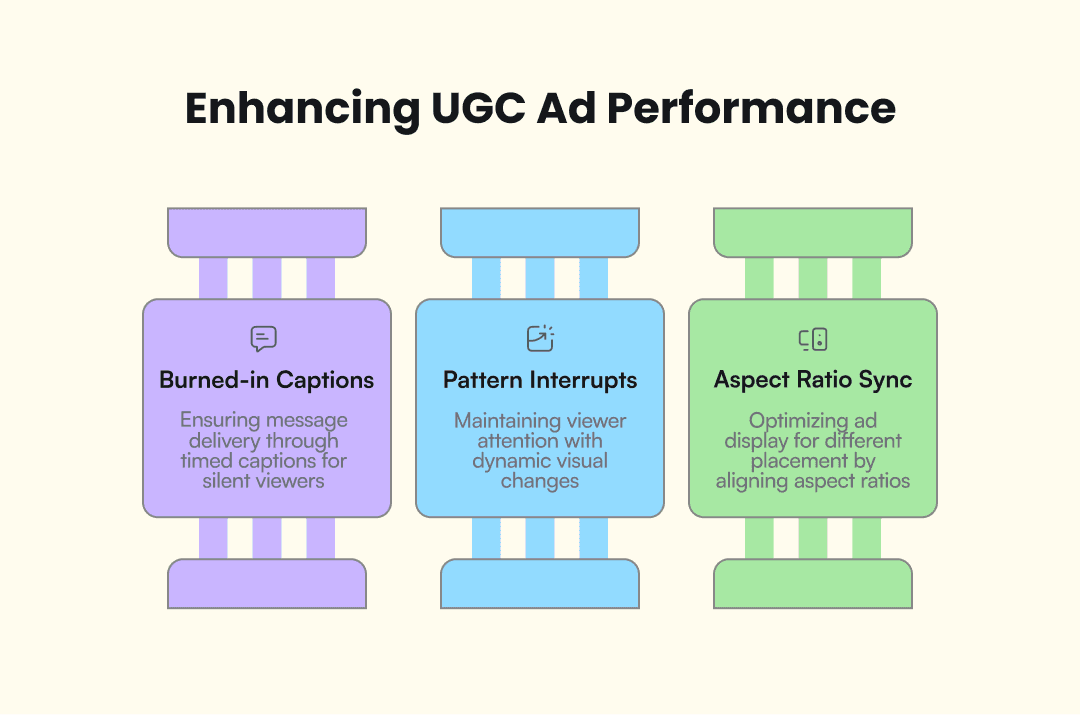
Every UGC ad needs burned-in captions timed to the delivery. Most social video is watched without sound, which means captions carry the entire message.
Pattern interrupts keep viewers watching through longer ads. A zoom cut, a B-roll insert, or a text overlay every 3 to 5 seconds prevents the visual monotony that triggers scroll-away. The goal is enough visual variety to hold attention through the full ad.
Aspect ratio needs to match placement as well as platform. A 9:16 vertical ad running in a 1:1 feed slot loses the top and bottom of the frame. Export multiple ratios from the same edit to avoid cropping critical content.
Batch testing and measuring performance
What to test and how
Hooks are the highest-leverage variable in any UGC ad. Test them in isolation: keep the script body, creator or avatar, and CTA constant, then swap only the opening 3 seconds. This gives you clean data on what stops the scroll versus what loses it.
Volume matters. Practitioners testing 20 to 50 hook variations per product find winners faster and at lower cost per insight than those testing 5 complete ads. For AI workflows, generating 50 hook versions from a single script takes minutes. For human-creator workflows, batch-order multiple hook variations in one production cycle to get the same coverage without multiplying costs.
Structure tests as controlled experiments: one variable changes per test, everything else holds. If you change the hook and the CTA at the same time, you will not know which drove the result.
Key metrics and iteration
Track these metrics and use each one to diagnose a specific problem:
Hook rate (percentage who watch past 3 seconds): a low hook rate means the opening failed. Test a new hook.
Hold rate (percentage who watch 50% or more): if the hook is landing but viewers drop off before the halfway mark, the script body is the problem. Rework the problem/solution section.
CTR (click-through rate): a strong hold rate paired with low CTR usually points to a weak or unclear CTA.
CPA and CPC (cost per acquisition and cost per click): your cost efficiency metrics. If CPC is high but CTR is strong, the problem is more likely in audience targeting than in the creative itself.
ROAS (return on ad spend): the metric that determines whether to scale or kill a creative. Factor in landing page conversion rate: a high-CTR ad sending traffic to a weak page produces poor ROAS regardless of creative quality.
The iteration loop: pull metrics after 48–72 hours of delivery, diagnose using the framework above, update the brief, produce new variations, and test again. Each cycle should produce a better-performing batch than the last.
Legal compliance and usage rights
FTC disclosure and AI content labeling
Any UGC ad involving a material connection between the brand and the creator requires disclosure under FTC guidelines. This covers paid partnerships, free products, affiliate relationships, and gifted items. The disclosure must be clear and conspicuous: visible in the ad itself. A hashtag stack or link description doesn't meet the standard. Violations carry penalties of up to $53,088 per occurrence under current FTC enforcement rules, with annual inflation adjustments.
For AI-generated UGC, content labeling requirements are tightening across platforms. Meta and TikTok both require AI disclosure on synthetic media. Beyond legal compliance, labeling AI content proactively builds audience trust rather than risking a credibility hit if viewers figure it out on their own.
Content permissions and usage rights
For human creators, contracts should cover four things: content ownership (who owns the raw footage and final edits), usage scope (which platforms, for how long), modification rights (can you re-edit or remix the content), and exclusivity terms (can the creator promote competitors during and after the campaign).
For user-submitted UGC like customer reviews and social posts, get explicit written permission before using any content in paid ads. A public social media post is not an ad license.
For AI-generated content, check each tool’s terms of service for commercial usage rights before publishing. They vary widely.
Common mistakes that kill UGC ad performance
Script mistakes: leading with the product instead of the viewer’s problem, writing formal ad copy instead of conversational language, and burying the hook after the first 3 seconds.
Production mistakes: the most common one is over-producing to the point the content looks like a traditional ad. Poor audio quality kills credibility faster than poor video quality, and shooting in landscape when the platform is vertical wastes the frame.
Testing mistakes: testing full ads instead of isolating hooks, running fewer than 10 variations and calling it a “test,” and killing creatives before they have enough data. Give paid delivery at least 48–72 hours before making a call.
Legal mistakes: FTC disclosure on sponsored content is not optional, and customer UGC needs written permission before going into paid ads.
AI-specific mistakes: too many teams treat AI generation as one-and-done instead of iterating on output. The other common gap is using stock avatars that don’t match target demographics and skipping voice customization in favor of default text-to-speech.
Building your UGC system
UGC ad creation works best as a loop. Script based on data, produce using whichever method fits your budget and timeline, test at volume by isolating hooks, measure with the right metrics, and feed results back into the next round of briefs.
Start where your constraints point you. If you have a limited budget and a fast timeline, AI tools give you volume testing without creator costs. If you have an established brand with creator relationships, lean on human-led hero content and use AI for variations. Agencies scaling multiple accounts tend to get the most out of a hybrid approach where AI handles volume and humans handle the flagship creative.