
The difference between a $2 click and an $8 click usually comes down to the copy. Same targeting, same budget, same audience, but one ad gets ignored and the other gets clicked. And on platforms like Meta and Google, that gap widens over time because the algorithms actively reward the better-performing ad with cheaper distribution.
Writing ad copy that converts means understanding what makes someone pause, read, and act. The hook earns the first second, the body gives the reader a benefit worth caring about, and the call to action tells them what happens next. This guide covers the full process for media buyers, agency teams, and DTC operators running live campaigns: audience research, choosing between AIDA, PAS, and FAB, platform tactics for Meta, Google, TikTok, and YouTube, and how to test and scale the copy that wins.
What is ad copy?
Ad copy is the persuasive text in a paid advertisement, written to get a specific person to take a specific action. It shows up in headlines, descriptions, primary text, calls to action, and the text overlaid on the creative itself; if a piece of paid media has words, those words are ad copy. Most ads follow a standard three-part anatomy: a headline that stops the scroll, a description or body that makes the case, and a call to action that tells the reader what happens next. This headline-description-CTA template is the default structure across Meta, Google, TikTok, and LinkedIn, even when each platform names the parts differently.
The principle that governs all three parts is benefits over features. "Waterproof to 30 meters" is a feature. "Swim with it, shower with it, forget it's on your wrist" is the benefit that sells the watch. Strong ad copy makes that translation for every claim: the spec matters less than the outcome the reader already wants.
Writing it well means knowing exactly who you're targeting, opening with a strong scroll-stop hook, including one clear call to action, keeping the tone conversational, and weaving in social proof or urgency where it earns its place. Keep it concise, and test variations to find what converts.
Ad copy is also a different job than content writing. A blog post has minutes to build an argument and earn trust over repeat visits. An ad has a second or two, a character limit, and one shot at a click. And unlike organic content, every impression an ad earns is paid for, which is why each word has to pull weight.
How ad copy quality affects what you pay
Even with perfect targeting and unlimited budget, weak copy wastes spend. Your creative determines whether someone stops scrolling; your copy determines whether they act. Most advertisers underestimate the third effect: copy quality changes what you pay per click, per impression, and per acquisition.
Meta and Google both run auction-based systems, and neither is purely about who bids the most. Both factor in ad quality and expected engagement when deciding which ads to show and what to charge. Think of it as an ad tax: brands running weak, low-engagement copy pay more for the same results, while copy that earns clicks and conversions buys cheaper distribution.
How it works on Google: Google assigns every keyword a Quality Score from 1 to 10 based on expected click-through rate, ad relevance, and landing page experience. Practitioner research (2026) puts the weighting at roughly 39% expected CTR, 39% landing page experience, and 22% ad relevance; the split is reverse-engineered from auction data, so treat it as directional. The cost effect is concrete: an advertiser with a Quality Score of 10 pays roughly half the CPC of one with an average score on the same keyword, and below-average scores carry a surcharge. Expected CTR is the largest factor, and your headlines and descriptions drive it, which makes copy the most direct lever on the score.
How it works on Meta: Meta's auction weighs three things: your bid, estimated action rates, and ad quality. Ads that earn clicks, shares, saves, and reactions signal relevance, so Meta shows them to more people at a lower cost per result. Low-engagement ads get reduced delivery and higher costs, and the ad relevance diagnostics (quality ranking, engagement rate ranking, conversion rate ranking) show you where your copy stands. Meta's Andromeda update raised the stakes. Creative became the targeting input the algorithm optimizes against; the system evaluates a larger pool of ad candidates per impression and filters weak ones out earlier.
The practical effect: strong copy can earn a $1.80 CPC while generic messaging pays $7.50 for the same click in front of the same audience. Better copy raises your conversion rate and cuts the cost of every impression and click.
AIDA vs. PAS vs. FAB: which framework, and when
Three frameworks do most of the heavy lifting in professional ad copywriting: AIDA, PAS, and FAB. Each fits a different situation and a different stage of buyer awareness, and matching the framework to the audience is the difference between copy that converts and copy that gets scrolled past.
Framework | Structure | Best for | Awareness stage | Example opening |
AIDA | Attention, Interest, Desire, Action | Colder readers you can walk through a full case | Unaware to solution-aware | "Your ad account is leaking budget. Here's where." |
PAS | Problem, Agitate, Solution | Audiences who feel a pain but don't know the fix | Unaware, problem-aware | "Spending $5,000/month on ads that don't convert?" |
FAB | Features, Advantages, Benefits | Buyers comparing options who need concrete reasons | Solution-aware, product-aware | "Next-day shipping, so it arrives before your event." |
The AIDA framework
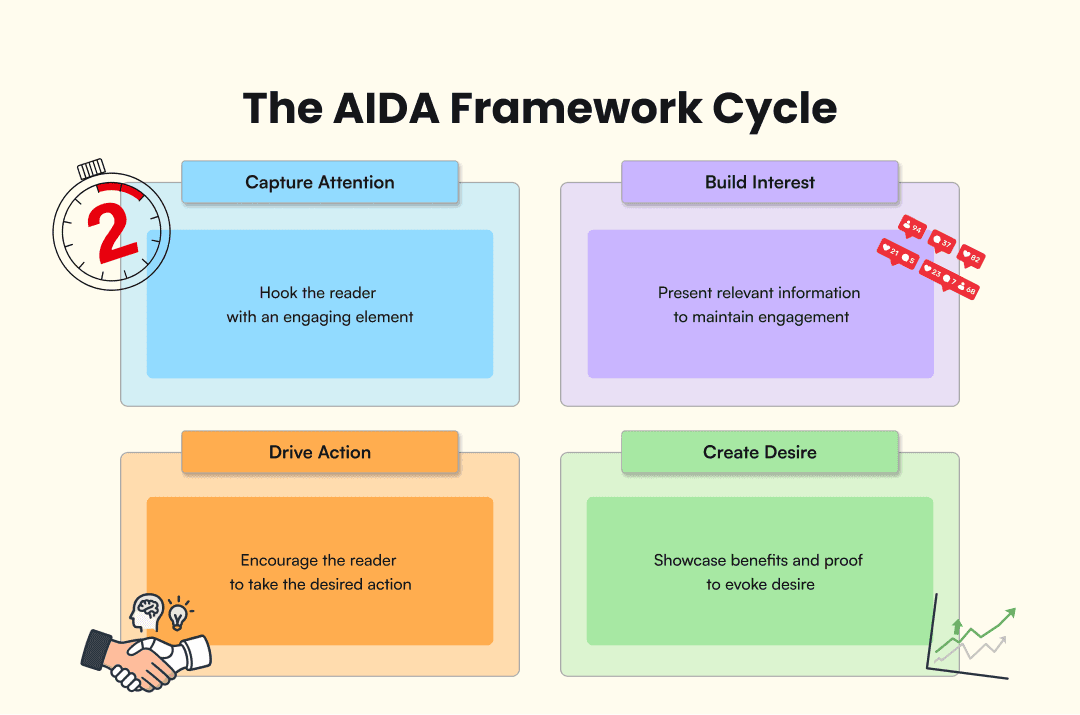
AIDA stands for Attention, Interest, Desire, Action. The hook earns attention, a claim relevant to the reader builds interest, proof or a vivid benefit creates desire, and the CTA converts it into a click. AIDA is the oldest of the three and the one most copywriting guides teach first. It needs room to run the full sequence, which makes it a fit for longer Meta primary text, YouTube scripts, and any ad where a colder reader has to travel from curiosity to click in one piece of copy.
The FAB framework
FAB stands for Features, Advantages, Benefits. It translates what your product does into what your customer gains.
Feature: What the product has or does.
Advantage: Why that feature matters compared to alternatives.
Benefit: The real-world outcome for the buyer.
Feature | Advantage | Benefit |
Next-day shipping | Get it faster than competitors | Wear it to your event this weekend |
Organic ingredients | No harsh chemicals | Safe for sensitive skin, no reactions |
AI-driven research | Automated analysis of buyer intent | Spend 4 fewer hours per week on manual research |
FAB works best for solution-aware and product-aware audiences, people who already know they need something and are comparing options. They want to know what makes your offer different, and FAB gives them concrete reasons.
The PAS framework
PAS stands for Problem, Agitate, Solution. It starts with the reader's pain, intensifies it, then presents your product as the way out.
Problem: Name the frustration your audience feels.
Agitate: Make the cost of inaction clear and specific.
Solution: Introduce your product as the resolution.
PAS works best for unaware and problem-aware audiences. These people may not know your product category exists, or they know they have a problem but haven't started looking for solutions. PAS hooks them by naming what they're already frustrated about.
Matching frameworks to buyer awareness
The awareness spectrum (based on Eugene Schwartz's five levels) determines which framework and messaging angle your copy should use:
Awareness level | What they know | Best framework | Copy approach |
Unaware | Don't know they have a problem | PAS | Lead with a surprising problem statement |
Problem-aware | Know the problem, not the solution | PAS | Agitate the pain, introduce your category |
Solution-aware | Know solutions exist, comparing options | FAB | Differentiate your offer with specific advantages |
Product-aware | Know your product, haven't bought | FAB | Overcome final objections, add social proof |
Most aware | Ready to buy, need a push | Direct CTA | Offer, discount, or urgency to close |
The short version: use PAS when the audience feels a problem but doesn't know your solution, use FAB when they're comparing options and need specific reasons to pick you, and use AIDA when you have the space to walk a colder reader from attention to action inside a single ad.
Whichever framework you pick, hold the awareness level steady from ad to landing page. A problem-aware hook that clicks through to a pricing page creates a disconnect that kills conversions; message match gets a full treatment in the platform and mistakes sections below.
How to write ad copy, step by step
The frameworks give you the skeleton. This process fills it in, from research through a finished ad.
Step 1. Research your audience and product
Effective ad copy starts with the audience. Mine reviews, comments, and support tickets for the exact words people use to describe their problem, then write to one person instead of a demographic. You also need deep product knowledge: features, use cases, and the objections that stop people from buying, so you can resolve them in the copy before they become reasons to scroll past.
Before writing, answer four questions:
What frustrates your audience about their current situation?
What outcome do they want?
What words and phrases do they use to describe the problem?
Which awareness stage are they at, and what makes your offer different?
Step 2. Write a scroll-stop hook
The scroll-stop hook is your first line, and the first five to seven words do the stopping. On Meta it appears before the "see more" truncation, on Google it's your 30-character headline, on TikTok it plays in the first second. It can be a bold claim, a question, a problem statement, or a surprising fact.
Question hook: "Still struggling with ads that don't convert?"
Problem statement hook: "Your ads aren't working because you're selling features."
Bold claim hook: "We grew revenue 40% without increasing ad spend."
Curiosity hook: "Most brands get this completely wrong."
Step 3. Build the body on benefits
Translate every feature into an outcome using the feature-advantage-benefit chain from the FAB framework above. Readers care about the after state: "Wake up to fresh ads in your inbox every Monday" beats "automated ad generation tool." Specific numbers make the after state believable. "Saved 4 hours a week" reads like it came from real data; "saves time" reads like it came from a brainstorm. Use emotional triggers such as empathy or FOMO deliberately, one per ad, instead of stacking them.
Step 4. Close with one clear CTA
Every ad needs one clear CTA telling the reader exactly what to do next. Use action verbs: "Shop now," "Get your free audit," "Start today." Quimby Digital's 2026 analysis puts the CTR lift from action verbs at 20% or more, a directional figure, but the direction matches what split tests keep showing. Match the CTA to the funnel stage and to the platform's button so the copy and the click destination agree. Weak or missing CTAs kill conversions more often than you'd expect.
Step 5. Add urgency and social proof deliberately
Testimonials, reviews, user counts, and trust signals reduce skepticism. Specific proof beats vague claims: "Helped 2,847 brands scale their ad spend" lands harder than "trusted by thousands." Urgency works the same way when it's real. A deadline that exists ("Early-bird pricing ends Friday") moves people; a countdown timer that resets on refresh teaches them to ignore you. One proof element and one urgency element, well placed, beat a stack of both.
How to write ad copy for different platforms
Each platform has its own constraints, audience behavior, and creative norms. The table gives you the quick reference; the guidance below goes deeper on each one.
Things to consider | Meta (FB/IG) | Google Search | TikTok | YouTube |
Character limits | No hard cap; truncates after ~125 characters | Headlines: 30 chars. Descriptions: 90 chars | Short captions + text overlays | Script-based, no character limit |
Where the hook lives | First line before "see more" | Headline is the hook | First 1 second of video | First 5 seconds before skip |
Tone that performs | Conversational, relatable | Direct, intent-matched | Creator-style, native-feeling | Conversational, value-first |
Key copy consideration | Storytelling works for warm audiences; short punchy copy for cold | Keyword relevance directly affects Quality Score and CPC | Brand-voice copy underperforms vs. creator-voice | Deliver value before the skip button appears |
Message match priority | Ad copy to landing page | Search query to headline to landing page | Hook to content payoff | Hook to video content to CTA |
Facebook and Instagram ad copy
The hook appears in the first line before the ~125-character truncation, so make it count. Longer body copy can work for storytelling, especially with warm audiences who already know your brand. A conversational, relatable tone outperforms corporate speak here more than anywhere else, and Meta's algorithm weighs post engagement (comments, shares, saves), so copy that sparks a reaction gets cheaper distribution over time. For calibration: TheEEDigital's 2026 benchmarks put average Facebook CTR around 1.71% for traffic campaigns and 2.59% for lead gen, vendor figures, but a usable baseline for judging your own numbers.
Google search ad copy
Google's character constraints are tight: search ad headlines max out at 30 characters, descriptions at 90. Keyword relevance feeds your Quality Score directly, and the same relevance signals set what you pay per click, as covered in the economics section. Message match is critical here because the user typed a specific query and expects the ad to answer it; WordStream's May 2026 data puts average search CTR at 6.64%, and ads that mirror the query's exact language are what beat that number. Include a clear CTA in the description, and make sure the landing page delivers what the headline promises.
TikTok ad copy
TikTok favors native-feeling content. Copy that sounds like a creator rather than a brand performs better. Hooks work best within the first second of video, and text overlays often matter as much as captions. The platform's users are quick to skip anything that feels like a traditional advertisement, so the copy needs to blend into the feed.
YouTube ad copy
The first five seconds determine whether viewers skip. Script the hook to earn attention before the skip button appears. Longer-form storytelling works here (you have the time for it), but you still have to deliver value fast. The hook should make a specific promise or raise a specific question that the viewer wants answered.
Writing ad copy for mobile
Around 70% of ad impressions happen on mobile (2026 industry consensus), which means the desktop preview you write in is the minority experience. Write to the truncation point: front-load the value into the first line, keep sentences short enough to scan on a 6-inch screen, and check how the copy breaks on a phone before launch. A hook that lands on desktop but truncates mid-sentence on mobile is losing most of its audience.
Ad copy examples that convert
These examples show the frameworks applied to real ad formats, with the working parts called out on each.
Example 1: E-commerce product ad (Facebook/Instagram)
Uses PAS for a problem-aware audience.
Hook: "Your skincare routine is missing this one step." Creates curiosity and names the problem.
Body: "Most serums sit on top of your skin. Ours absorbs in 30 seconds and works while you sleep. 4,200+ five-star reviews." Agitates (your current serum isn't absorbing), then presents the solution with specific social proof.
CTA: "Shop the bestseller." Clear, action-oriented, specific.
Example 2: Local service ad (Google Search)
Uses FAB for a solution-aware audience (they searched for a plumber).
Headline: "Same-Day Plumber in Austin | Licensed & Insured"
Description: "Emergency repairs in 2 hours or less. No call-out fee. Book online now." Feature (same-day), advantage (faster than scheduling days out), benefit (your emergency is handled today). Removes the cost objection and holds message match with the search query.
Example 3: SaaS ad (YouTube pre-roll)
Uses PAS for a problem-aware audience.
Hook (first 5 seconds): "What if your ads wrote themselves while you slept?" A bold claim that earns attention before the skip button.
Body: "Admove's AI agent researches your products, writes your copy, and delivers fresh ads every week."
CTA: "Start your free trial." Low-friction next step.
How to test and improve your ad copy
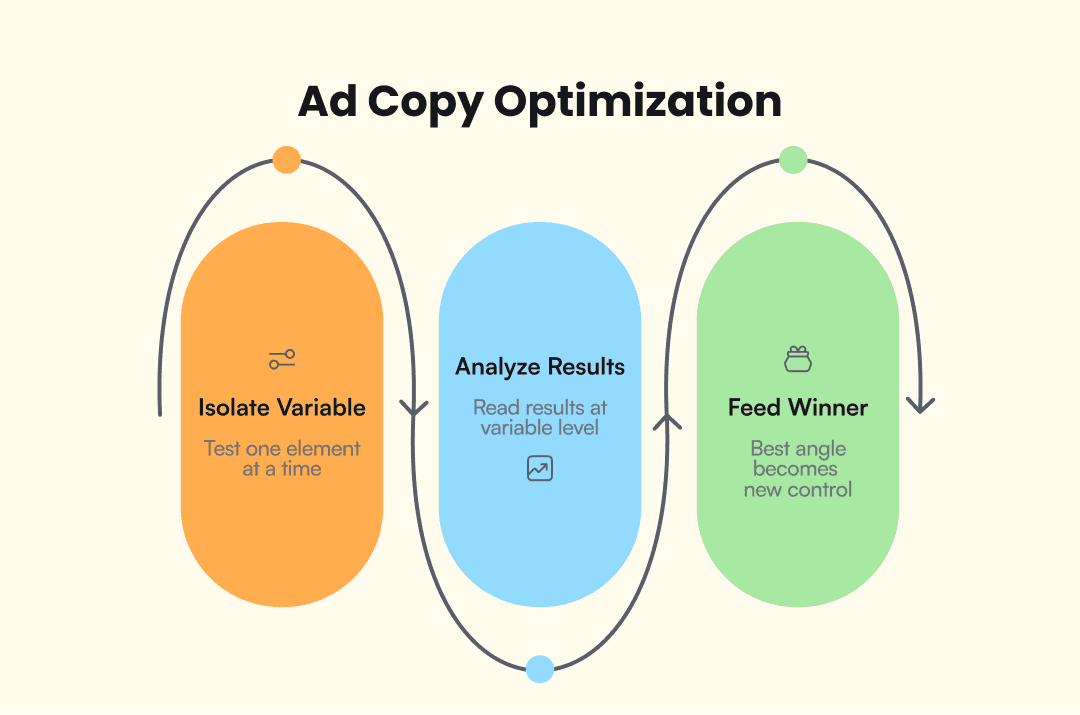
The best copy you have is just the current control, and with enough testing something usually beats it. With creative driving 70 to 80% of Meta ad performance, a systematic testing loop earns more than any single writing technique in this guide.
A copy-testing loop has three parts. First, isolate one variable: test hooks against hooks, CTAs against CTAs, never everything at once, or you won't know what moved the numbers. Second, read the results at the variable level rather than the ad level; a losing ad can contain a winning hook that deserves another body. Third, feed the winner forward: the best-performing angle becomes the control the next batch has to beat.
What to test first: hook, angle, CTA, in that order of impact.
What to watch: CTR for hook strength, CPA for angle quality, and frequency alongside declining CTR for creative fatigue.
Creative fatigue is the signal most teams miss. When the same audience has seen an ad too many times, CTR slides and costs climb even though the copy hasn't changed. Active campaigns typically need a refresh every one to three weeks; an angle library of documented winning hooks and structures is what makes that cadence sustainable.
Alternatives to writing every ad from scratch
Manual, single-format copywriting is one way to produce ads, and for most teams it's no longer the only one in play. IAB research puts AI adoption in the creative process at 83% of ad executives. With adoption that high, most teams have moved past the decision to use AI and are working out where it fits in their process.
AI-assisted copywriting handles the repetitive layers well: producing variations of a winning angle, adapting a Facebook ad to Google's 30-character headlines, reformatting one benefit for different audiences and awareness levels. What it can't do reliably is pick the winning angle in the first place, judge when an approach has been overused by competitors, or catch copy that follows the brief but reads wrong. Those calls still belong to a human, and teams that skip the review step get more ads and worse results.
Two adjacent paths are worth knowing. Multi-format adaptation takes one proven message across static, video, and carousel instead of rewriting per format. And video ad scripts reuse the same hook-body-CTA logic in spoken form, which matters as TikTok and YouTube take a bigger share of ad budgets.
How to scale ad copy production without losing quality
Most teams know what good ad copy looks like. The hard part is producing enough variations to test every week, across every client or product line, without burning out or drifting off-brand.
The fix is a repeatable workflow: research feeds briefs, briefs feed copy, winners feed the next round. Systematize the research phase so audience insights, product details, and proven angles live in a brief the whole team writes from instead of someone's head. When an ad performs, document its angle, hook, and structure; a brand that tracks its top 20 hooks can feed those patterns into new variations in minutes instead of hours. And put voice, tone, and positioning guidelines in writing, because more variations means more chances for drift, and brand consistency is the first casualty of volume.
The repetitive layers are where AI-native tooling earns its keep. Admove's Product Intelligence researches each product across audiences, use cases, and objections, then grounds ad scripts in real buyer intent. Creative Strategy produces the variations, and Brand Hub keeps every output aligned with your voice and positioning, so one strategist can run the creative volume that used to need a team of copywriters.
Common ad copy mistakes to avoid
These come up in ad accounts over and over, and each one burns budget in a way the dashboard won't explain on its own.
Writing features instead of benefits. "AI-driven research" describes the product; "spend 4 fewer hours a week on manual research" describes the reader's gain. Fix: run every claim through the FAB chain before it ships.
Burying the hook. If your strongest line sits in the third sentence, most people never see it. Fix: the hook goes first, always.
Weak or stacked CTAs. "Learn more" wastes the click, and two CTAs split it. Fix: one specific, benefit-driven CTA per ad.
Ignoring message match. An ad promising a specific fix that lands on a generic homepage kills conversions. Fix: the ad's promise is the first thing the landing page repeats.
Copy and creative telling different stories. If the image shows one thing and the headline says another, the disconnect costs clicks. Fix: write the copy and brief the visual together.
Overcomplicating the message. One ad carries one idea. Fix: cut every claim that doesn't serve the main one.
Neglecting mobile. Most impressions are mobile; desktop-perfect copy that truncates on a phone fails where it counts. Fix: check the truncation point before launch.
Write better ads in less time with Admove
Good copy is the cheapest lever in your ad account. It earns the click, then lowers what you pay for it. And the workflow holds at any scale: research the audience, match the framework to their awareness stage, write to the platform's constraints, test one variable at a time, and feed winners into the next round.
Producing enough of it every week, across every client, is where teams stall. Admove's AI agents handle the research, copywriting, and creative production, so a stretched team gets a steady flow of on-brand ads without the manual grind.