
Advantage+ Creative is Meta’s AI-driven personalization layer that automatically adjusts your ad creatives across placements, devices, and audience segments. Rather than showing one static version of an ad to everyone, the system generates multiple variations by changing visuals, text overlays, aspect ratios, and even layering in music or animation, then serves each user the version most likely to drive action.
Since Andromeda expanded Meta's ad ranking to process thousands of times more candidates in parallel, creative diversity replaced audience targeting as the primary performance lever. Advantage+ Creative enhancements now come pre-selected for Sales, Leads, and App Promotion campaigns, and industry research consistently puts creative quality above media buying as the largest single driver of campaign ROI.
Most guides on this topic either catalog features without strategic context or offer high-level advice with no tactical specifics. The gap sits at the practitioner level: knowing which enhancements to turn on, which to disable, and how to monitor what the AI does with your assets after launch.
Key Takeaways
Creative quality is the single largest performance variable on Meta's platforms, outweighing audience targeting, bidding, and placement decisions.
Since February 2026, all new Sales, Leads, and App Promotion campaigns launch with every Advantage+ Creative enhancement turned on by default.
Andromeda, Meta's updated ad ranking system, evaluates thousands of times more ad variants in parallel than its predecessor, shifting the primary performance lever from audience targeting to creative diversity.
9:16 vertical video is the priority format for 2026 because the vast majority of Meta's ad inventory runs vertical and nearly all users access the platform on mobile.
CPM-reach (CPMr), the cost to reach 1,000 unique users, is the primary fatigue signal. A sustained climb in CPMr means the algorithm is running out of responsive users for your current creatives and a refresh is due.
Since March 2026, Meta requires disclosure on ads containing AI-generated or AI-modified content. Skipping this step is now one of the most common reasons for ad rejections.
What Advantage+ Creative does in the Andromeda era
Advantage+ Creative is a personalization engine. When you upload a single creative asset, the system applies a set of enhancements (visual adjustments, text variations, aspect ratio changes, music, and more) to generate multiple versions of that ad. Each user sees a different combination based on their device, placement, and Meta’s prediction of what will drive a response. Meta uses up to 5% of impressions to test new enhancement combinations, and the winners scale automatically.
Enhancement | What it does | Best for |
Visual touch-ups | Adjusts brightness, contrast, and filters to match platform norms | All campaigns. Businesses already use this |
Text improvements | Adds or repositions text overlays, adjusts font styling | Direct response campaigns with clear CTAs |
Image expansion | Extends background to fit different aspect ratios (e.g., 1:1 to 9:16) | Multi-placement delivery across Reels, Stories, and Feed |
Music addition | Layers audio tracks onto static or video creatives | Video-first campaigns with manual track selection |
3D animation | Adds depth and motion effects to static images | Niche use cases only. Low adoption rate |
What changed with Andromeda is scale. Meta’s updated ranking system processes thousands of times more ad variants in parallel than its predecessor. Before Andromeda, advertisers competed primarily on audience selection. Now the algorithm evaluates so many creative permutations that the quality and variety of your inputs matter more than who you target.
Creative assets are oxygen for the system. The more diverse formats, hooks, and styles you feed it, the more combinations the AI can test. But diversity is not the same as volume. Uploading 50 minor variations of the same product photo gives the system redundant inputs. Five genuinely different approaches (a UGC clip, a product demo, a testimonial, a text-heavy explainer, a lifestyle shot) give it real room to find winners. By most practitioner estimates, roughly 80% of performance work in 2026 is creative operations, with media buying accounting for the remaining 20%. That ratio reflects how much the balance has shifted toward producing the right creative inputs.
Which enhancements to enable and which to disable
The default in 2026 is everything on. Since February, new campaigns in Sales, Leads, and App Promotion objectives launch with all Advantage+ Creative enhancements pre-selected. That default works for most direct-response advertisers, but not every enhancement suits every campaign.
Enhancement | Recommendation | When to disable | Notes |
Visual touch-ups | Enable for all campaigns | Strict brand color guidelines only | High adoption rate. Safe default. |
Text improvements | Enable for DR, review for brand | Brand campaigns with approved copy only | AI-generated text may not match your tone of voice |
Image expansion | Enable for multi-placement | Single-placement campaigns with controlled crops | Fills non-native aspect ratios automatically |
Music addition | Enable with manual selection only | Never use auto-generated music | Auto-generated tracks risk tonal mismatch. |
3D animation | Test selectively | Most campaigns | Low adoption rate. Can look unnatural. |
Enable enhancements that expand the system's testing surface without giving up control over brand-sensitive elements. Visual touch-ups and image expansion are safe defaults that give the algorithm more creative combinations to test across placements. Most advertisers use them; far fewer turn on 3D animation. Text improvements and music depend more on your source material and brand standards, so results vary. 3D animation is worth testing on specific product categories (footwear, accessories, tech hardware), but not as a blanket setting across your full account.
One risk worth addressing directly: over-enhancing. When every enhancement runs simultaneously on assets that were not designed for heavy modification, the output can feel unnatural. If your creative assets already carry a strong visual identity, overlapping AI adjustments on color, text, and motion can erode what made the original effective. Review enhanced variations before scaling spend. Override enhancements entirely for brand-sensitive campaigns, sequential storytelling, and regulated industries where unapproved copy or visuals carry compliance risk. The human-in-the-loop checkpoint is what separates intentional use from blind automation.
Advantage+ Creative vs. manual creative control
Advantage+ Creative wins in scale scenarios: broad audiences, multi-placement delivery, high asset volume, and campaigns targeting conversions or app installs. When the system has enough creative diversity and clean conversion signals, it finds winning combinations a human media buyer would never test manually.
Manual control wins where precision matters: brand campaigns with fixed messaging, sequential storytelling across ad sets, regulated industries with compliance requirements, and any campaign where exact visual or copy approval outweighs performance experimentation. The predecessor system, Dynamic Creative, offered a simpler version of this split, but Advantage+ Creative’s enhancement layer makes the automation side meaningfully stronger.
Factor | Advantage+ Creative | Manual control |
Best for | Performance campaigns, broad audiences, multi-placement | Brand campaigns, regulated industries, sequential narratives |
Creative volume | Handles 20-150 assets per ad set with automated testing | Limited by manual testing capacity |
Time investment | Lower. The system generates and tests variations. | Higher. Each variation needs manual setup. |
Brand control | Moderate. You set guardrails, AI fills the gaps. | Full. Every element approved before launch. |
Risk profile | Over-enhancement, tonal mismatch, unintended variations | Missed optimization opportunities, slower iteration |
Published benchmarks show Advantage+ campaigns cutting cost per result by up to 44% across large sample sizes, but that figure covers the full suite: audience expansion, placement distribution, and bidding adjustments alongside Creative enhancements. Creative contributes, though isolating its share from the rest of the stack is difficult with public data.
The recommended approach for most advertisers is running both in parallel. Use Advantage+ Creative on core performance campaigns while keeping manual control on brand and compliance work. Asset Reporting lets you compare enhanced variations against your original creatives directly. Let the performance data drive your allocation between automated and manual rather than accepting the default toggle.
Creative specs and production principles
Feed the algorithm what it needs. These specs determine whether Advantage+ Creative has workable material or burns impressions on assets that don’t fit the placements your audience uses.
Format and aspect ratio
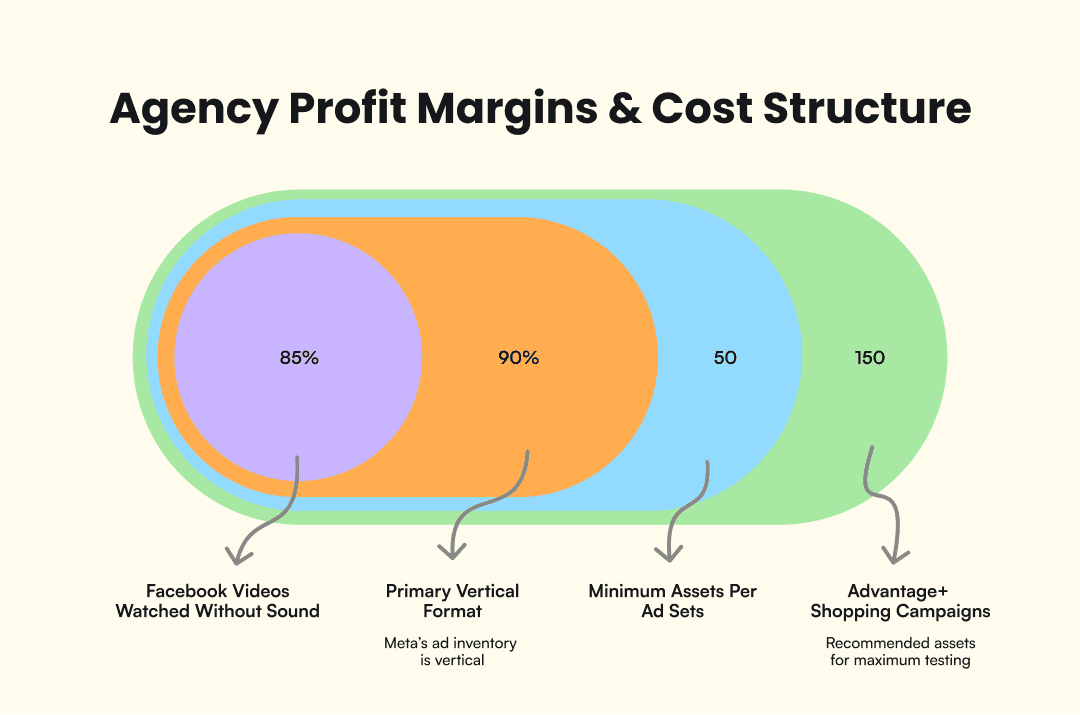
9:16 vertical is the primary format in 2026. Roughly 90% of Meta’s ad inventory is vertical, and 98% of users access Meta platforms on mobile. Build vertical-first and let the system adapt for other placements.
4:5 is the secondary format for Feed placements. Having both ratios ready gives Advantage+ Creative more flexibility across Reels, Stories, and Feed.
Design within safe zones. When the system expands images for different placements, text and key visual elements outside the safe area get cropped or obscured.
Hook and sound
The first 3 seconds determine scroll-stop rate. Front-load your strongest visual or claim before any branding or logos appear.
85% of Facebook video is watched without sound. Captions are mandatory. Burn them into the video or use Meta’s auto-captioning, but verify readability on mobile screens.
UGC and social-native content outperforms polished studio production for most DTC and e-commerce brands. Authentic footage shot on phones reads as peer content in the feed, not advertising, and the performance data consistently supports this approach for conversion-focused campaigns. Advantage+ Creative rewards visual variety and genuine creative differentiation between assets, not high production value.
Asset volume targets: plan for 20-50 assets minimum per ad set. For Advantage+ Shopping Campaigns (ASC), Meta recommends up to 150 assets for maximum testing coverage. Creative refresh cadence ties directly into the monitoring workflow covered in the next section.
Monitoring fatigue and staying compliant
Launching with the right enhancements and creative specs is half the work. The other half is knowing when to intervene after the campaign goes live.
Your primary fatigue signal is CPM-reach (CPMr), which measures the cost to reach 1,000 unique users. A healthy CPMr typically stays below $20 for most verticals. When CPMr starts climbing over a sustained period, the algorithm is working harder to find new users who respond to your existing creatives.
Metric | Healthy range | Action trigger |
CPMr | Below $20 | Rising CPMr over 7+ days signals creative fatigue |
CTR trend | Stable or improving | Declining CTR alongside rising CPMr confirms fatigue |
Frequency | Below 3-4 per week | Frequency above threshold means audience overlap and ad blindness |
CPA spike | Within target | CPA jumping 20%+ with stable spend indicates creative exhaustion |
Most campaigns benefit from new creative assets every 2-4 weeks. The ROAS gains from dynamic creative come from keeping the input pipeline fresh on an ongoing basis.
Conversions API (CAPI) paired with your pixel is the data foundation for everything Advantage+ Creative does. If your conversion signals are noisy or incomplete, the AI calibrates against bad data. Get event tracking right before scaling spend.
Since March 2026, Meta requires disclosure when ads contain AI-generated or AI-modified content. Undisclosed AI content is now one of the more common rejection reasons. If you run Advantage+ Creative enhancements on AI-generated base assets, verify your disclosure settings before launch.
After launching or making significant edits, Meta needs roughly 7 days to calibrate delivery. Every edit during that window resets the clock. Plan your creative calendar around this instead of chasing early performance numbers.
Putting it together
Advantage+ Creative works best when you treat it as a system that needs intentional inputs, not a toggle you switch on and forget. The workflow runs in stages: understand how the AI personalizes, select enhancements based on your campaign type and brand requirements, produce creative assets with the diversity and format specs the algorithm needs, then monitor performance and refresh before fatigue degrades your results.
The advertisers getting the most from Advantage+ Creative are the ones feeding it quality inputs on a regular schedule. That means vertical-first formats, genuine creative variation across concepts and styles, and clean conversion data so the AI has reliable optimization signals. Where the system falls short (brand-sensitive campaigns, regulated messaging, sequential storytelling), manual control remains the better choice.
For teams that need to produce creative at the volume and variety Advantage+ Creative demands, AdMove handles the production pipeline from product URL to finished ad variations across formats and hooks, keeping the content fresh so the algorithm always has new material to test.