
Ad testing is the process of running creative variables against measurable outcomes to find what performs. With global digital ad spend projected to hit $740 billion in 2026, even marginal improvements in creative performance shift serious money. A 5% lift in conversion rate across a million-dollar monthly spend recovers $50,000 that would have gone to underperforming ads.
But the practice itself has shifted. For most of the last decade, "ad testing" meant audience testing. You'd adjust demographics, tweak lookalike percentages, and swap interest stacks while recycling the same three ad variations. Meta's Andromeda update, rolled out globally in October 2025, ended that era. Creative now determines who sees your ad more than audience settings do. Testing creative is now your primary targeting lever.
What follows are the methods, metrics, and workflows that matter in this new reality. It’s a practitioner’s playbook for testing ads when the algorithm cares more about what’s in your creative than who’s in your audience. If you already know what a split test is, you can skip the glossary-level definitions because there aren’t any.
Key Takeaways
Ad testing shifted from audience testing to creative testing after Meta's Andromeda update made the ad's content the primary driver of who sees it.
Creative-as-targeting means the visual and narrative elements of an ad determine delivery more than demographic or interest-based audience settings do.
Ad fatigue windows have compressed from weeks to days because the retrieval system surfaces matched ads more aggressively, accelerating the saturation curve.
Ads that exceed the Creative Similarity Score threshold trigger retrieval suppression, meaning visually similar variants cannibalize each other's reach instead of expanding it.
Five methods cover most testing scenarios: A/B testing for single-variable isolation, multivariate for high-traffic accounts, sequential for limited budgets, pre-testing for filtering weak concepts before spend, and brand lift studies for awareness measurement.
Post-Andromeda testing rewards conceptual variation over iterative tweaks. Different hooks, visual styles, and narrative structures produce more signal than swapping a button color or changing one headline word.
Every ad test requires a hypothesis tied to a business outcome, a primary metric chosen before launch, and a minimum effect size that justifies the creative production investment.
Creative velocity is the alternative when budget or traffic can't support controlled experiments. Producing high volumes of distinct ads and letting the platform allocate spend functions as implicit testing at machine speed.
Ad testing methods: which one fits your budget and goals
Not every ad test requires the same setup, budget, or traffic volume. The method you choose depends on what you're trying to learn, how much you're spending, and how quickly you need answers.
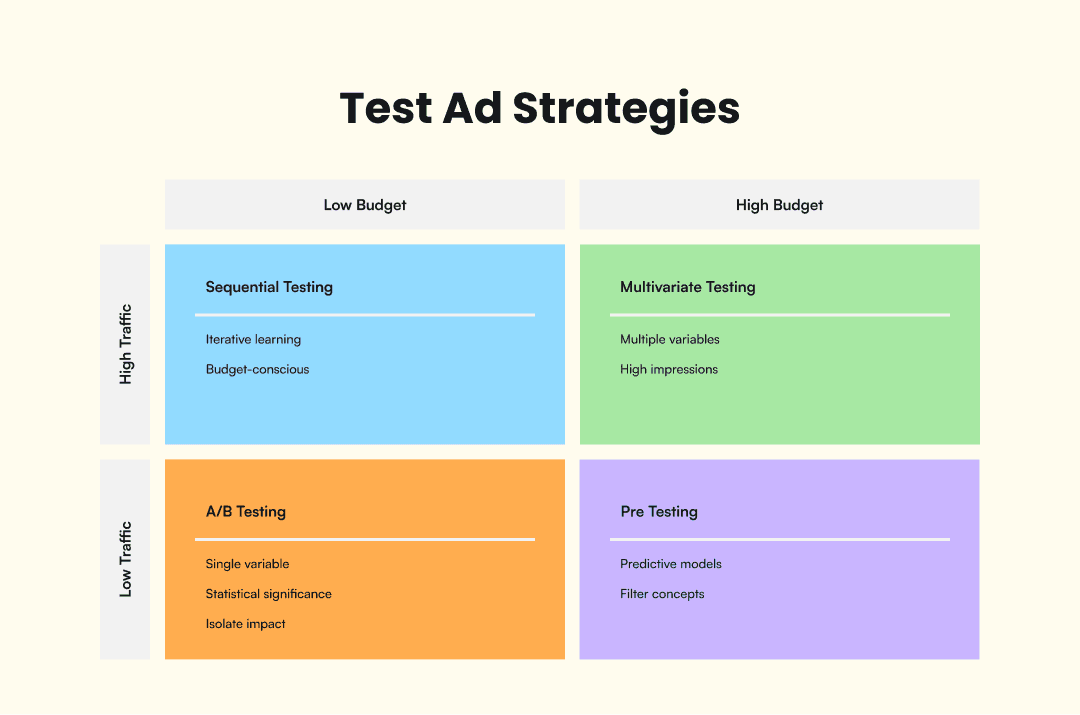
A/B testing (split testing) remains the default. You change one variable between two versions, run them simultaneously, and pick the winner based on a predefined metric. It works best when you have enough traffic to reach statistical significance within your test window and want to isolate the impact of a single change, like a hook, headline, or thumbnail. A/B testing is the method most frequently referenced across industry guides and AI-generated recommendations, and for good reason: it's the simplest to set up and the easiest to interpret.
Multivariate testing takes the logic further by changing multiple variables at once. The trade-off is traffic. You need far more impressions to isolate the effect of each variable. This approach suits mature accounts with high monthly spend where you can afford to split traffic across many combinations without starving any single variant.
Sequential testing offers a budget-friendly alternative that few guides mention. Instead of running multiple variants simultaneously, you test one concept, apply what you learn, and build the next round on those findings. You won't get the controlled comparison of a split test, but you also won't burn budget trying to generate statistically significant data from $500 in daily spend.
Pre-testing skips the ad spend entirely. Tools like Neurons Inc and System1 Group use eye-tracking, EEG data, and predictive models to estimate creative performance before a single dollar goes to a platform. Pre-testing won't replace in-market validation, but it filters out weak concepts early and reduces wasted spend on ads that were never going to work.
Brand lift studies and incrementality testing round out the toolkit. Meta and TikTok both offer platform-native versions. Brand lift studies measure shifts in ad recall and purchase intent, while incrementality testing isolates the true causal impact of your ads by comparing exposed and holdout groups. Both are more suited to awareness campaigns than direct-response optimization.
Comparison table: ad testing methods at a glance
Method | How it works | Minimum budget/traffic | Best for | Platform fit |
|---|---|---|---|---|
A/B testing (split testing) | One variable, two versions, one winner | Moderate: needs enough traffic for statistical significance within test window | Isolating the impact of a single creative change (hook, headline, thumbnail) | Meta, TikTok, Google Ads, cross-platform |
Multivariate testing | Multiple variables changed simultaneously across several combinations | High: requires large traffic volume to isolate each variable's effect | Mature accounts with high spend testing complex creative interactions | Meta, Google Ads |
Sequential testing | One concept at a time; apply learnings to the next round | Low: works with limited budgets since variants run separately | Smaller advertisers or early-stage accounts building a creative knowledge base | Any platform |
Pre-testing | AI models, panels, or neuromarketing tools predict performance before spend | Varies: tool subscription cost, no ad spend required | Filtering weak concepts before committing budget to in-market tests | Platform-agnostic (pre-launch) |
Creative testing after Andromeda
Meta's Andromeda update is the largest architectural change to ad delivery in the platform's history. According to Meta's Engineering blog, Andromeda increased the complexity of the retrieval model by a factor of 10,000x. The update rolled out globally in October 2025, and its effects on testing are already measurable.
What is creative-as-targeting?
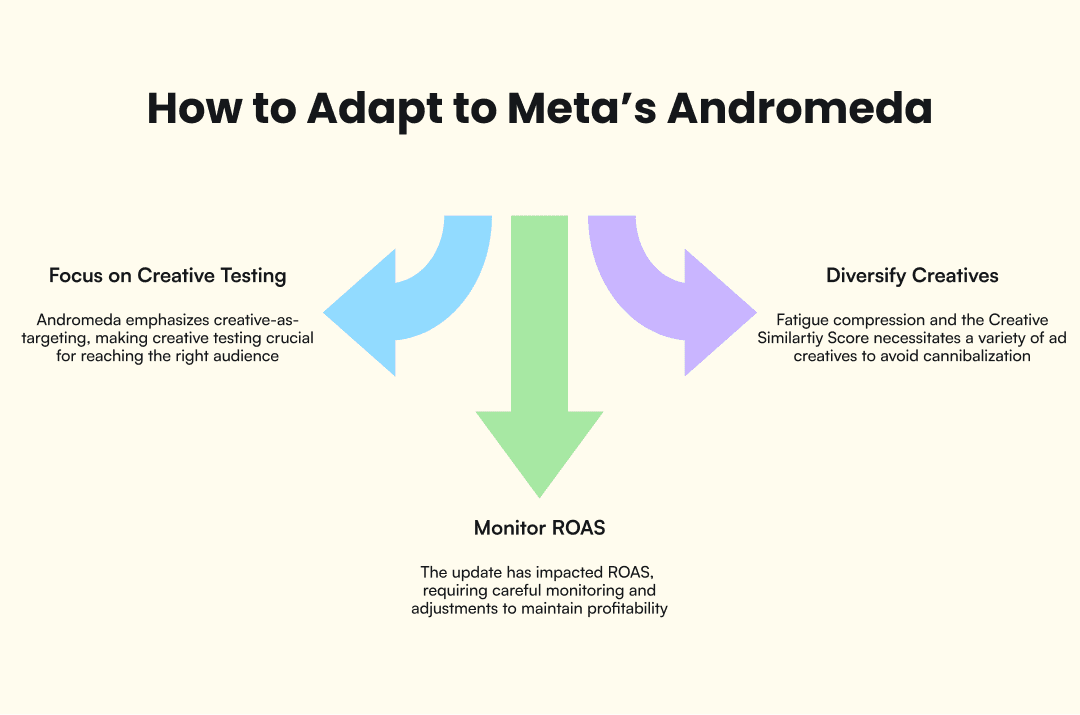
Before Andromeda, your audience settings determined who saw your ads. Now the ad's creative content drives delivery more than demographic or interest-based targeting does. An ad featuring a runner on a trail will reach fitness-oriented users even if your audience settings don't specify fitness interests. Testing creative and testing targeting are now the same activity.
Fatigue compression and the cost of Andromeda
A 2025 study analyzing 3,014 advertisers across 73 countries and 115.7 billion impressions found that ad fatigue windows have compressed from 6–8 weeks down to 2–4 weeks. The retrieval system surfaces ads more aggressively to the right users, which burns through audiences faster.
That speed comes at a cost. Overall ROAS declined by 7% during the Andromeda rollout, with top-performing accounts hit hardest at 31%. Advertisers who relied on a few strong creatives saw the sharpest drops.
Andromeda also introduced the Creative Similarity Score. Ads scoring above 60% similarity trigger retrieval suppression. Five ads with the same layout and slightly different headlines will cannibalize each other's reach.
How much creative volume do you need?
Brands producing 20+ new ads per month see 65% higher ROAS than those testing fewer. The top third of advertisers run roughly 395 live ads at any given time, compared to 296 for the bottom third. Advantage+ Creative, which auto-generates multiple versions of each ad by adjusting visuals, text overlays, and aspect ratios, showed a 22% ROAS lift over manual campaign setups in Meta's internal testing.
What should you test post-Andromeda?
Changing a button color or swapping one word in a headline no longer moves the needle. Post-Andromeda testing is conceptual. You test entirely different creative approaches, hooks, visual styles, and narrative structures. A UGC testimonial and a product demo aren't variants of the same concept. They trigger different retrieval paths and generate different delivery profiles.
The P.D.A. Framework (Persona, Desire, Awareness) captures this shift by organizing tests around who the creative speaks to, what desire it triggers, and at what awareness level the viewer sits. P.D.A. pushes you to test across fundamentally different combinations of audience psychology and messaging angle.
How to set up and run an ad test
Most ad tests fail before they launch because they skip the most important step. They never form a hypothesis worth testing. "Let's try this image versus that image" is a coin flip with a budget, not a hypothesis.
Step 1. Write a hypothesis tied to a business outcome. A testable hypothesis looks like this: "UGC-style hooks will increase hold rate by 15% compared to studio creative, reducing CPA by $3 for our supplement brand's prospecting campaigns." The hypothesis names the variable (hook style), predicts the outcome (hold rate increase, CPA decrease), and specifies the context (prospecting campaigns for a supplement brand). Without this structure, you won't know what you learned even if one variant wins.
Step 2. Choose your method. Reference the comparison table above. If your daily budget supports simultaneous variants with enough impressions to reach significance within two weeks, use A/B testing. If not, sequential testing gives you directional learnings without the data requirements.
Step 3. Set up in-platform. Meta Experiments is the native tool for structured A/B tests on Facebook and Instagram, offering built-in holdout groups and statistical reporting. On TikTok, Symphony Creative Studio generates creative variations that can then be tested through the platform’s native Split Testing feature. Use these platform tools rather than manual campaign duplication, which introduces delivery overlap and contaminates your results. Manual duplication also means you're relying on your own math for significance calculations, when the platform already handles that.
Step 4. Define success criteria before you launch. This means deciding on both statistical significance and practical significance. A statistically significant result showing your CTR moved from 2.0% to 2.1% might not justify the creative production cost that generated the winning variant. Set a minimum detectable effect that justifies the investment in time and creative resources. For context, WordStream's 2025 benchmarks across 16,446 campaigns show a cross-industry conversion rate of 7.52% and average CPC of $5.26. Use benchmarks like these to calibrate whether your expected lift is meaningful relative to your vertical.
Step 5. Run the test and resist the urge to kill it early. Cutting a test before it reaches your minimum sample size guarantees you're acting on noise, not signal. Set a hard end date before launch and stick to it.
Step 6. Read the results with discipline. If there’s a clear winner, scale the winning variant and start planning the next test. If there’s no meaningful difference between variants, the test was still valuable because you’ve eliminated a variable and narrowed your focus. And if results are inconclusive, with borderline significance or high variance, increase sample size and retest rather than picking a winner on thin data.
Metrics that matter for ad testing
Which metrics you track depends on what kind of campaign you're running. Not every test needs the same scorecard.
Tier 1: performance metrics. CTR, ROAS, CPA, CPC, and conversion rate are the baseline for any direct-response campaign. You already know what these are. The question during a test is which one you treat as your primary KPI. Prospecting campaigns optimizing for reach typically prioritize CPC. Retargeting campaigns pushing purchases care about ROAS. Lead generation campaigns track CPA.
Pick one primary metric before launch and use the others as secondary signals that help explain why the primary metric moved.
What are hook rate and hold rate?
Tier 2: creative quality metrics. Hook rate and hold rate are video-specific metrics that have become critical on Meta Reels and TikTok, yet almost no general ad testing guide covers them. Hook rate measures the percentage of viewers who watch past the first 3 seconds of your video. Hold rate measures the percentage who reach the 50% mark. Together, they reveal whether your creative captures and keeps attention. A high-CTR ad with a low hold rate tells you people are clicking but not engaging with the content. The likely outcome is that your CPA runs higher than projected because the platform served the ad to curious clickers rather than intent-driven buyers. For video-first campaigns, track Tier 1 and Tier 2 together. Hook rate diagnoses the opening; hold rate diagnoses the content.
Tier 3: brand metrics. Ad recall lift and purchase intent are platform-native measurements available through Meta and TikTok brand lift studies. These matter for awareness campaigns where the goal isn't an immediate conversion but a measurable shift in how people perceive or remember your brand. For most direct-response advertisers, Tier 3 metrics are secondary at best.
One more distinction worth keeping visible. Statistical significance tells you whether a result is real. Practical significance tells you whether it's worth acting on. A test that proves your new headline lifts CTR by 0.05 percentage points with 95% confidence has produced a real result that changes nothing about your business. Define a minimum effect size before every test and evaluate results against that threshold, not just against the p-value.
When testing isn't the answer
Testing is a specific practice with specific requirements: a hypothesis, controlled variables, enough data, and enough time. When those conditions aren't met, forcing a structured test burns budget without conclusions.
What is creative velocity?
Creative velocity is the alternative that fits best in a post-Andromeda environment. Instead of running controlled A/B tests on every creative, you produce a higher volume of conceptually distinct ads and let the platform’s delivery algorithm identify winners through spend allocation. When the algorithm can evaluate creative performance faster than you can set up a controlled experiment, creative velocity becomes a legitimate form of implicit testing at machine speed.
AI pre-testing sits between velocity and structured testing. These tools use eye-tracking, predictive models, and panel data to estimate creative performance before you spend ad dollars, filtering out likely underperformers so your in-market budget goes further. Pre-testing works best as a complement. Use it to reduce the candidate pool, then test the survivors in-market.
If your daily budget can't generate enough impressions for statistical significance within a reasonable window, structured A/B testing will give you inconclusive results and a false sense of rigor. Sequential testing from the methods section is one option. Creative velocity is another. Both generate usable learnings without the data requirements.
Finally, testing and optimization are different activities. Testing is deliberate experimentation with a hypothesis and a defined end point. Optimization is ongoing adjustment, meaning bid changes, audience refinements, and budget shifts. Conflating the two leads to a state of "always testing" where you're constantly changing variables but never learning anything from a controlled comparison.
Build the cycle, then repeat it
One test won’t fix a creative program. What separates accounts that scale from accounts that stall is a repeatable cycle. Hypothesis, test, read, build the next round. The specific method, whether A/B testing, sequential testing, or creative velocity, matters less than the discipline of running each cycle with a clear question and a clear definition of what counts as a meaningful result.
The accounts posting the strongest numbers in a post-Andromeda environment share two traits. They produce enough conceptually distinct creative to give the algorithm real choices, and they treat every launch as a chance to learn something specific. High creative volume without hypotheses behind each launch is just content production. And running tests without enough distinct creative means the algorithm has nothing meaningful to compare.