The way Facebook Ads produces ROI changed in late 2025, when Meta fully deployed Andromeda, its retrieval-augmented ad delivery system, across every ad account globally. The channel still delivers some of the strongest returns in paid social, but the levers behind those returns have moved.
The old model was audience-first: find the right people, show them a decent ad, optimize bids from there. Andromeda flipped that sequence. Creative quality now determines which audiences see an ad in the first place, and it has become the single largest variable in Facebook Ads ROI for 2026.
The formulas, benchmarks, and tracking infrastructure still matter as foundations. But the brands winning on ROAS this year are the ones who understood the creative-first shift early enough to build their measurement and production systems around it.
Key Takeaways
ROI measures net profitability after all costs including creative production, agency fees, tools, and labor. ROAS only measures revenue per ad dollar, which can look positive while the campaign loses money once full costs are counted.
MER (Marketing Efficiency Ratio) divides total revenue by total marketing spend across all channels, bridging the gap between platform-reported ROAS and what the business P&L actually shows.
Break-even ROAS equals 1 divided by contribution margin. Whether a given ROAS counts as "good" depends on unit economics, not industry benchmarks.
Creative quality is now the primary variable in Facebook Ads ROI because Meta's Andromeda system scores predicted engagement before deciding which users see an ad. The creative itself functions as targeting under this delivery model.
Andromeda compressed effective ad lifespans from weeks to days and raised the minimum creative volume per campaign. Advertisers need conceptually distinct assets (different value propositions, emotional angles, and formats) rather than minor variations of the same hook.
Accurate Facebook Ads tracking requires dual signal collection: the Meta Pixel for client-side events and the Conversions API (CAPI) for server-side events. Browser-level tracking alone underreports conversions because of restrictions introduced by iOS 14.5, Safari, and Firefox.
Facebook Ads won't produce positive ROI when contribution margins are too thin for realistic ROAS targets, when audiences are too small for Meta's learning phase to function, or when sales cycles are too long for any onsite conversion event to fire within the attribution window
What is Facebook Ads ROI (and how is it different from ROAS)?
Facebook Ads ROI is a profitability metric that measures the net return on total investment in Facebook advertising. ROAS (return on ad spend) is an efficiency metric that measures revenue generated per dollar of ad spend. The two get conflated constantly, but they answer different questions.
ROI uses the formula: (Revenue − Total Costs) / Total Costs × 100. Total costs include ad spend, creative production, agency fees, tools, and labor. A campaign generating $50,000 in revenue against $30,000 in total costs produces an ROI of 66.7%.
ROAS uses a narrower formula: Revenue / Ad Spend. That same campaign with $20,000 in ad spend shows a ROAS of 2.5x. But the $10,000 in production, labor, and tool costs that ROAS ignores is the gap where profitability hides or dies. A 2.5x ROAS looks healthy until the full cost picture turns the ROI negative. CPA (cost per acquisition) is one of those total-cost components that ROI captures but ROAS misses: a $20 CPA across 1,000 conversions adds $20,000 to total costs, a figure invisible in ROAS calculations.
A third metric fills a gap neither ROI nor ROAS covers alone. Marketing Efficiency Ratio (MER) divides total revenue by total marketing spend across all channels. MER matters most for multi-channel advertisers, where platform-specific attribution has grown unreliable since iOS 14.5. When Meta Ads Manager reports a 3x ROAS but the business P&L doesn’t reflect it, MER exposes the disconnect.
ROI vs ROAS vs MER: When to use each
Metric | Formula | What it measures | Best for | Blind spots |
ROI | (Revenue − Total Costs) / Total Costs × 100 | Overall campaign profitability | Evaluating whether a campaign made or lost money after all costs | Doesn’t isolate channel-level efficiency; slow to calculate if cost allocation is messy |
ROAS | Revenue / Ad Spend | Revenue efficiency per ad dollar | Platform-level optimization and comparing campaign performance within Meta | Ignores production, labor, agency, and tool costs; can look positive while ROI is negative |
MER | Total Revenue / Total Marketing Spend | Business-level marketing efficiency | Multi-channel advertisers and iOS-heavy audiences where platform attribution is unreliable | Hides which channels drive performance; not useful for campaign-level decisions |
What is a good Facebook Ads ROI in 2026?
A good Facebook Ads ROAS in 2026 falls in the 1.86x to 2.87x range depending on the dataset and methodology, though these benchmarks mean little without knowing a specific business’s break-even threshold.
The variance across sources reflects real differences in methodology. One dataset covering more than 35,000 ecommerce brands puts the median ROAS at 1.86x to 1.93x. Another benchmark lands at 2.24x. A broader read puts the overall Meta ROAS at 2.79x, and a higher-spend dataset tracking $48 million or more in ad spend reports 2.87x cross-industry. Each measures a different slice of the advertiser population using different attribution windows and methods, which is why the ranges diverge.
Metric | Range / Average |
ROAS | 1.86x to 2.87x |
CPA | $19.68 average |
CPC | $0.70 to $3.77 ($1.72 avg), up 11% YoY |
CPM | $12.47 to $14.19 |
CTR | 2.19% median |
CVR | ~9.21% cross-industry (high; verify context) |
Break-even ROAS: The number that matters
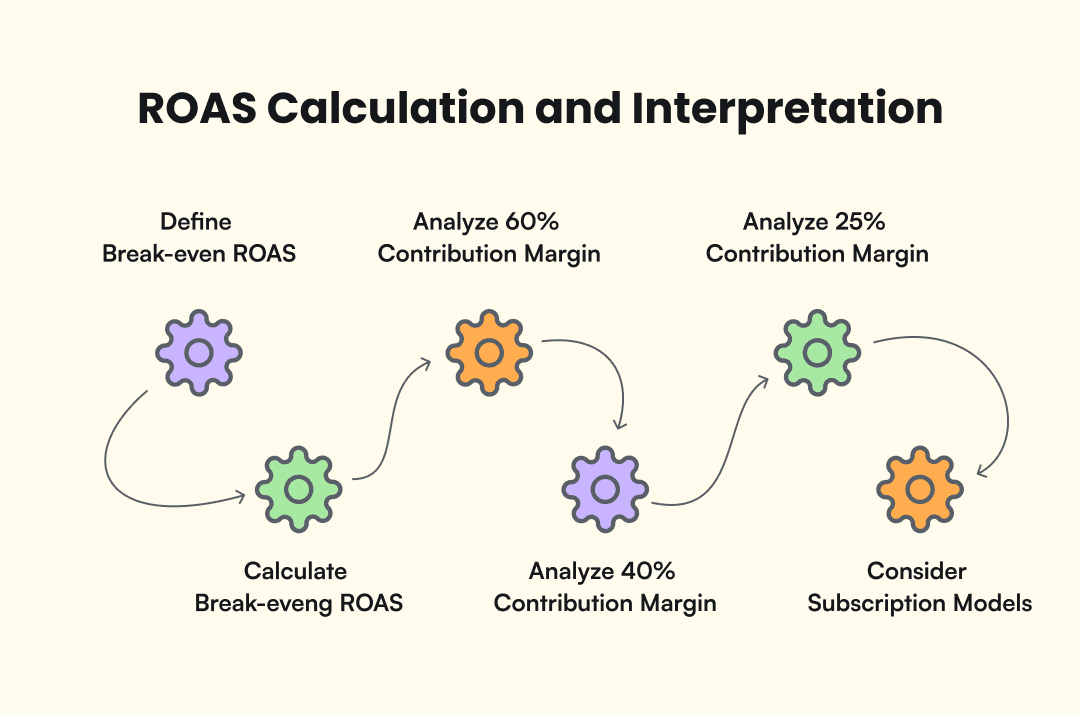
Break-even ROAS is the minimum return on ad spend required before a campaign generates any profit. The formula: break-even ROAS = 1 / contribution margin. Three margin levels produce three different answers.
At a 60% contribution margin, break-even ROAS is 1.67x. An ecommerce brand selling digital products or high-margin apparel hits profitability the moment ROAS clears that threshold.
At 40% contribution margin, break-even ROAS is 2.5x. Many DTC brands sit in this range. The median ROAS figures from the benchmarks above (1.86x to 2.24x) fall below 2.5x, meaning the average campaign at 40% margins loses money on first purchase.
At 25% contribution margin, break-even ROAS is 4x. Brands in CPG and low-margin retail need top-decile performance just to break even on ad spend.
Whether a 2x ROAS counts as "good" comes down to a business's unit economics, which industry averages can't capture. For subscription and repeat-purchase models, the calculation shifts further: a 2x ROAS on first purchase can be profitable if the customer’s lifetime value produces an LTV-to-CAC ratio above 3:1 over the full customer lifetime. The acquisition cost spreads across multiple purchases and a higher average order value.
Why creative quality drives 56% of your Facebook Ads ROI
Creative is usually treated as one improvement lever among many.
Meta cited this finding at its 2023 Performance Marketing Summit, and it remains the most widely referenced creative-impact statistic in the industry. Google published a complementary figure in 2022: 70% of campaign success is determined by the creative, according to internal research shared via Meta IQ.
Creative fatigue compounds the problem. Meta’s own data, presented at the same 2023 Summit, shows a 40% drop in CTR by the fourth repeated exposure to the same ad. Conversion rates fall by 60% at similar frequency levels. Refreshing creatives treats the symptom while the structural change underneath stays in place. When the delivery system itself evaluates creative quality before deciding who sees an ad, producing mediocre creative at higher volume still starves a campaign of reach. Frequency-based fatigue on the audience side used to be the whole problem. Now the bottleneck sits on the distribution side, where the system gates reach by creative quality.
How Meta’s Andromeda system changed the ROI equation
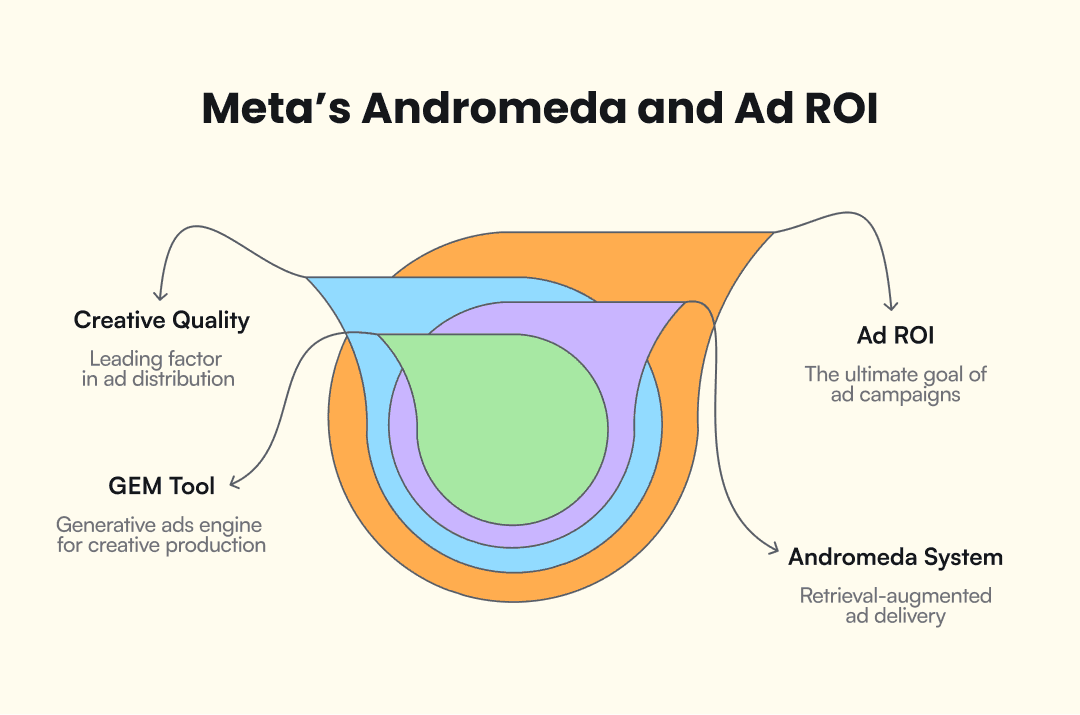
Meta’s Andromeda is a retrieval-augmented ad delivery system that Meta deployed globally across all ad inventory in October 2025. Before Andromeda, Meta’s auction matched ads to audiences primarily through targeting parameters and bid optimization. Andromeda shifted the primary signal: the system now evaluates creative quality as the leading factor in ad distribution, scoring each creative’s predicted engagement before deciding which users see it. Practitioners describe this model as “creative-as-targeting,” where the creative itself determines reach more than the audience settings do.
The performance impact is measurable. Advertisers using Advantage+ Creative saw a 22% increase in ROAS after Andromeda’s deployment, according to Meta’s Engineering blog. But the system also compressed effective ad lifespans.
That compression created a new creative volume requirement. Practitioner consensus from agencies including Logical Position, points to 10 to 15 conceptually distinct creative assets per Advantage+ campaign as the minimum for stable performance in 2026. Meta’s own response to this volume demand is GEM (Generative Ads Engine), a tool designed to help advertisers produce creative variations at the pace Andromeda consumes them.
How to track Facebook Ads ROI accurately
Accurate ROI tracking in 2026 requires dual signal collection: client-side through the Meta Pixel and server-side through the Conversions API (CAPI).
The Meta Pixel remains the tracking foundation, firing on page loads, add-to-cart events, and purchases within the browser. But browser-level tracking has weakened steadily since iOS 14.5 introduced App Tracking Transparency (ATT) in 2021. Safari and Firefox already blocked third-party cookies. Apple’s ATT prompt extended the gap to mobile app installs and cross-app tracking. The cumulative result: Facebook underreports conversions by approximately 42%. Your in-platform ROAS figures regularly understate what campaigns produce.
CAPI fills the gap by sending conversion events directly from your server to Meta’s servers, bypassing browser restrictions entirely. It runs alongside the Pixel rather than replacing it. Meta’s documentation recommends running both in what they call “redundant event matching,” which de-duplicates events while maximizing signal coverage. Setting up CAPI requires developer involvement or a partner integration, but the attribution improvement justifies the effort for any advertiser spending more than a few thousand dollars per month.
Beyond Meta’s tools, GA4 with properly configured UTM parameters gives you a second, independent view of which traffic and conversions Meta is driving. When the ROAS reported in Meta Ads Manager diverges from what GA4 shows, MER (total revenue divided by total marketing spend, covered in the metrics section above) helps reconcile the gap at the business level rather than the campaign level.
The practical tracking setup comes down to four items: Meta Pixel installed and firing on all conversion events, CAPI connected for server-side redundancy, GA4 with UTM parameters on all Meta traffic, and a monthly MER calculation that reconciles platform-reported returns against actual revenue. Without this dual-layer infrastructure, your ROI numbers are built on a reporting gap that iOS 14.5 opened and that platform reporting alone cannot close.
How to improve Facebook Ads ROI
Improving Facebook Ads ROI in 2026 starts with creative testing at concept-level volume, supported by audience strategy, landing page performance, and budget discipline. Each lever connects to the creative-first delivery model Andromeda introduced.
Creative testing at concept-level volume. Under Andromeda, testing one headline against another misses the point. The system rewards conceptual diversity: 10 to 15 distinct creative angles per Advantage+ campaign, each a separate idea rather than a reworked version of the last one. Each concept should represent a different value proposition, emotional angle, or format (static versus video versus UGC-style). The creative fatigue data (40% CTR drop, 60% conversion rate drop at fourth exposure) makes the case for spending production effort on new concepts instead of refining a single one.
Audience strategy across warm, lookalike, and retargeting layers. Custom audiences built from your CRM data, email lists, and site visitors form the warm traffic foundation. Lookalike audiences extend reach to similar prospects for scaled prospecting. Retargeting recovers visitors who left without converting, and at ad frequency levels below the fatigue threshold, it remains one of the highest-ROAS tactics available. Under Andromeda’s creative-first delivery, broad targeting combined with Advantage+ often outperforms narrow audience segmentation, because the system already selects recipients based on creative fit.
Landing page optimization. Your landing page sits outside Meta’s platform but directly multiplies or destroys your ROAS. Page speed, message match between ad and landing page, and CTA clarity are the primary levers. A 2-second delay in page load can cut conversion rates roughly in half, and no amount of ad tuning recovers a weak landing page.
Budget and bidding discipline. Meta’s algorithm needs 50 conversion events within seven days to exit the learning phase for any ad set. Premature budget changes, pausing and restarting campaigns, or splitting budget across too many ad sets resets the learning phase and wastes spend during re-learning. Set a budget that lets your ad sets reach 50 conversions within the learning window and resist the urge to intervene before the data arrives.
When Facebook Ads ROI won’t work
Facebook Ads won’t deliver positive ROI in every scenario, and you can identify the failure conditions before spending a dollar.
Ultra-low margins create the most common trap. If your contribution margin sits at 15%, your break-even ROAS is 6.67x, which exceeds realistic performance for most verticals and campaign types. The math doesn’t work regardless of creative quality or audience strategy.
Tiny niche audiences pose a structural problem. Meta’s algorithm needs volume to learn, and audiences below roughly 50,000 in a single geography may not generate enough conversion signal for the learning phase to function. Your campaigns stay permanently in exploration mode with unstable results.
Long B2B sales cycles break Meta’s delivery model. When there is no onsite conversion event within a reasonable attribution window (7 or 28 days), Meta has nothing to learn from. If you sell six-figure contracts over six-month sales cycles, Google Search, LinkedIn, or direct outbound will likely produce stronger ROI.
Heavy regulatory constraints in industries like pharmaceuticals, alcohol, and financial services in certain markets limit both creative options and targeting capabilities. Even strong execution hits a ceiling when the rules restrict what you can show and to whom.
What to prioritize for ROI in 2026
Andromeda changed the equation structurally. The brands producing 10 to 15 conceptually distinct creative assets per campaign, fast enough to replace winners before fatigue sets in, have an advantage the old targeting-first playbook cannot match. For teams running multiple brands and struggling to keep creative volume at the pace the algorithm demands, Admove helps generate on-brand ad creatives at the pace Andromeda rewards.