
Meta’s ad platform is moving from manual campaign management toward autonomous AI agent systems, software that perceives campaign data, reasons about what to change, and acts with decreasing human involvement. Over 4 million advertisers already use Meta’s generative AI tools, producing more than 15 million AI-enhanced ads per month, and Q1 2026 ad revenue hit $55.02 billion.
The AI-for-ads space is fragmented across multiple layers, and no single resource connects them. This article maps the full space: Meta’s internal infrastructure models (Andromeda, GEM, REA), the native tools inside Ads Manager (Advantage+, AI Business Assistant), the newly launched MCP Connectors that bridge Meta to external LLMs, and the third-party platforms building fully autonomous agents on the Meta Marketing API. Each is positioned within a three-tier framework (advisory, semi-autonomous, fully autonomous) that ties infrastructure to practical campaign decisions.
Key Takeaways
A Meta ads AI agent perceives campaign performance data, reasons about the best response, and acts toward a defined objective. Rule-based automation fires on triggers without evaluating whether the action is the right one.
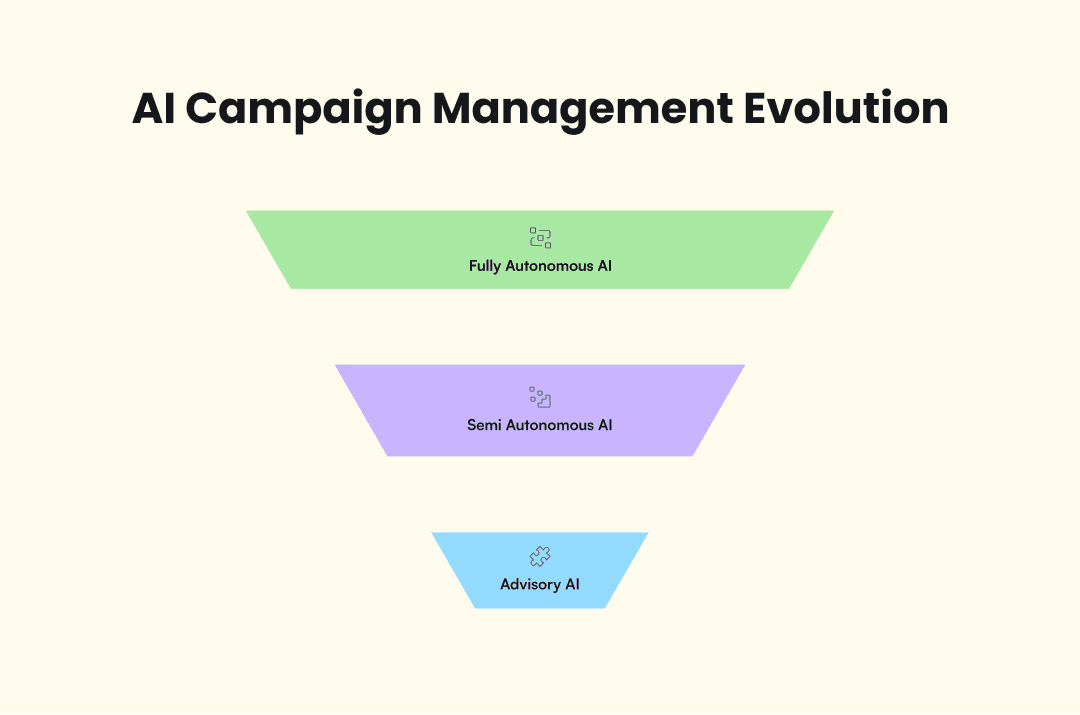
The AI agent space maps to three tiers: advisory tools recommend actions without executing them, semi-autonomous tools adjust within human-set boundaries, and fully autonomous agents manage campaigns end to end with minimal oversight.
Andromeda, Meta's ads retrieval engine, treats creative content as a primary targeting signal. High-relevance creative reaches more users regardless of audience parameters, which is why broad targeting increasingly outperforms narrow definitions in Advantage+ campaigns.
REA, disclosed in March 2026, doubled the accuracy of six ranking models while reducing the engineering team needed to maintain them. Meta's own delivery system is becoming an autonomous agent that improves itself without human input.
Advantage+ operates as Meta's semi-autonomous campaign layer. Performance gains depend heavily on creative volume, creative quality, and server-side signal quality through the Conversions API.
MCP Connectors, launched April 29, 2026, give any Model Context Protocol-compatible LLM read and write access to Meta ad accounts without developer credentials, custom code, or app review.
Third-party platforms fill the creative production gap that Meta's native tools leave open. Andromeda rewards creative diversity and quality, but nothing inside Ads Manager produces the ads themselves.
Autonomous budget allocation without guardrails can burn through spend before anyone catches the mistake. Starting with read-only access and adding write permissions after demonstrated accuracy is the safest adoption path.
Manual campaign management still outperforms AI agents for budgets under $3,000/month, niche B2B audiences, brand-sensitive campaigns, and new ad accounts with fewer than 30 days of conversion data.
What is a Meta ads AI agent?
A Meta ads AI agent is a goal-based system that perceives campaign performance data, reasons about the most effective response, and takes action toward a defined objective like lowering cost per acquisition or scaling spend on top-performing creatives.
Automation vs. agents: where the line falls
Rule-based automation tools like Revealbot execute predefined triggers: if CPA exceeds $15, pause the ad set. The tool doesn’t consider whether pausing is the right response, whether the ad set is still learning, or whether reallocating budget elsewhere would produce a better outcome. It follows the rule.
AI agents operate differently. They take in data across multiple campaign signals, weigh competing paths, and act toward an outcome rather than firing on a trigger. The three-layer architecture (perception, reasoning, action) separates them from even sophisticated rule chains.
Advantage+ sits in the semi-autonomous zone. It automates targeting, bidding, and placement allocation within the parameters an advertiser sets, but doesn’t explain its reasoning or adjust its approach based on cross-campaign learning. Knowing where a tool falls on this spectrum prevents two common mistakes: paying for full autonomy when rule-based triggers would suffice, or trusting a rule-based tool with multi-variable campaign decisions it was never designed to handle.
The three tiers: advisory, semi-autonomous, fully autonomous
Advisory. Tools recommend actions but don’t execute them. Meta’s AI Business Assistant analyzes campaign data and suggests adjustments through a conversational interface. LLMs like Claude and ChatGPT serve a similar function when connected to ad account data. Nothing happens without the advertiser’s explicit approval.
Semi-autonomous. Tools adjust within human-defined boundaries. Advantage+ campaigns are the primary example: the advertiser sets budget, creative assets, and conversion objectives; the system handles targeting, bidding, and placements within those guardrails. Most Meta advertisers today operate at this tier.
Fully autonomous. Agents manage campaigns end to end with minimal oversight. Third-party platforms like Admove have to write access to campaign settings through the Meta Marketing API and can create, modify, pause, and scale campaigns based on their own analysis. Highest leverage, highest trust required.
Each tier maps to a different risk tolerance. A solo media buyer managing five client accounts needs different safeguards than an enterprise agency running 200 campaigns across 30 brands.
How Meta’s AI infrastructure powers ad delivery
Meta is building autonomous AI agents that sit inside its own ad delivery system. Three infrastructure models control which ads reach which users, and each one responds to different creative inputs. That distinction matters for how you set up campaigns.
Andromeda: the creative-as-targeting engine
Andromeda is Meta’s ads retrieval engine. A December 2024 overhaul increased the model’s complexity by 10,000x and improved ads quality by 8%.
The practical consequence is a shift Meta calls creative-as-targeting. Andromeda evaluates ad creative content and quality as a primary signal for determining who sees it, independent of audience parameters. High-relevance creative reaches more of the right users; low-quality creative gets suppressed regardless of targeting settings. This is why broad targeting increasingly outperforms narrow audience definitions in Advantage+ campaigns, because the creative itself is doing the targeting work.
GEM and REA: the models behind the curtain
GEM (Generative Recommendation Model) operates 4x more efficiently than its predecessor and delivers up to a 5% conversion lift on Reels placements. REA (Recommendation Engine Agent), disclosed in March 2026, doubled the accuracy of six ranking models while increasing engineering productivity by 5x: three engineers now maintain eight models that previously required dedicated teams.
Meta Lattice, the unified ranking architecture underneath, feeds signals into both systems, while the Adaptive Ranking Model adds +3% conversions and +5% CTR on Instagram. The takeaway is that Meta’s own ad delivery system is becoming an agent. REA autonomously improves the ranking models that determine ad placement and pricing.
System | Function | Key metric | Advertiser impact |
Andromeda | Ad retrieval and creative evaluation | 10,000x complexity, +8% ads quality | Creative quality directly affects distribution; broad targeting works because creative is the targeting signal |
GEM | Generative recommendation | 4x efficiency, up to 5% conversion lift on Reels | Better ad-to-user matching, especially in video and Reels placements |
REA | Autonomous ML ranking | 2x accuracy across 6 models, 5x engineering productivity | More accurate pricing and placement; system self-improves without manual engineering |
Meta’s native AI tools for advertisers
Advantage+ suite
Advantage+ is Meta’s semi-autonomous campaign system: Advantage+ Shopping Campaigns (ASC), Advantage+ Creative, Advantage+ Audience, and Advantage+ Placements. Each component automates a specific layer of campaign management within advertiser-defined parameters while handling targeting, bidding, and placement decisions autonomously.
Adoption has scaled rapidly. Over 4 million advertisers used Meta’s AI tools as of January 2026, up from 1 million six months earlier. Meta reported an Advantage+ annualized revenue run rate exceeding $60 billion, and the average ad price rose 12% YoY in Q1 2026.
Performance claims require context. Meta for Business reports that Advantage+ campaigns deliver 22% higher ROAS compared to manual campaigns. That 22% figure reflects Meta’s own measurement across its full advertiser base, though, and results vary significantly by vertical, budget level, and creative quality. Advertisers running smaller budgets or weaker creative consistently report results closer to parity with manual campaigns.
The suite performs best when paired with high-volume creative testing and the Conversions API (CAPI) for server-side event tracking. Signal quality directly affects how well Advantage+ performs.
Meta AI Business Assistant
Meta’s AI Business Assistant is an advisory-tier agent inside Ads Manager. Through a conversational interface, it diagnoses campaign issues, surfaces improvement opportunities, and recommends actions. The advertiser executes every change manually.
In beta, it achieved a 20% higher issue resolution rate and 12% lower cost per result for SMBs who followed its recommendations. The conversational interface is the key differentiator from Advantage+. Where Advantage+ adjusts silently, the AI Business Assistant explains what it sees and why it recommends specific changes.
URL-to-campaign automation: Meta’s fully automated vision
Meta has signaled a future where advertisers paste a URL and receive a complete campaign with creative, targeting, and bidding generated automatically. Not yet live, but the building blocks are in place: Meta’s video generation tools reached a $10 billion annualized revenue run rate, growing at 3x the pace of overall ad revenue. Combined with Andromeda’s creative-as-targeting model and the Advantage+ stack, full URL-to-campaign automation is a question of when, not whether.
Meta ads AI connectors: the MCP bridge
On April 29, 2026, Meta launched MCP Connectors in open beta: a no-code connection between Meta’s ad platform and any LLM that supports the Model Context Protocol standard. The MCP server at mcp.facebook.com/ads gives LLMs like Claude and ChatGPT direct read and write access to campaign data and management functions.
What MCP Connectors do
MCP Connectors eliminate the developer-credentials barrier that restricted programmatic access to the Meta Marketing API. Before MCP, pulling campaign data into an external tool required API keys, developer review, and custom code. MCP replaces that with a no-code authorization flow through Meta Business accounts.
What advertisers get:
Read access. Campaign performance metrics, audience breakdowns, creative performance data, account-level diagnostics.
Write access. Campaign creation, budget adjustments, bid changes, ad set modifications.
Permission control. Advertisers choose the scope they grant and can start read-only before enabling write capabilities.
The technical distinction from the Marketing API is that MCP requires no developer credentials, no app review, and no code. Any Model Context Protocol-compatible LLM handles the connection natively.
How MCP changes the agent space
Before MCP, Meta-native tools operated on one side and third-party platforms with custom API integrations operated on the other. Bridging the two required engineering resources most advertisers couldn’t justify.
MCP dissolves that divide. Any MCP-compatible LLM becomes a potential ad management interface. Claude connected through MCP can pull real-time metrics, diagnose underperformance, and execute changes through natural language. Third-party connectors like Admove extend the space further.
What matters more is that MCP gives advertisers something Meta’s native tools don’t provide. A transparent, conversational interface to campaign data. Where Advantage+ adjusts silently, an LLM connected through MCP shows its reasoning: what the data says, what it recommends, and why. For teams that have resisted automated management because they couldn’t see what was happening underneath, MCP Connectors are the first platform-level response to that concern.
Third-party AI agent platforms
Meta's native tools handle delivery, targeting, and bidding, but nothing on the platform produces the actual ads. Andromeda's creative-as-targeting model made that a bigger problem than it used to be: the quality and volume of creative assets now directly influence who sees them and at what cost. Advantage+ and the AI Business Assistant have no opinion about whether your hook lands or your script matches your buyer's actual pain points. A different category of AI agent has started filling that gap on the creative production side.
Admove: an AI agent for creative operations
Admove is an AI agent that covers the creative side of ad operations: strategy, production, and early-stage campaign management. It works through a chat interface where the agent researches products, builds buyer personas, generates ad angles, writes scripts, and produces static and video ads from a single conversation.
What separates Admove from general-purpose AI tools is grounding. Every output pulls from brand-specific data stored in isolated workspaces, so an agency running 15 client accounts never bleeds tone or product claims between brands.
Capability | What the agent does | How it works |
|---|---|---|
Brand grounding | Enforces voice, product accuracy, and persona targeting across every output | Each client gets an isolated workspace with its own voice guidelines, product specs, uploaded media, buyer personas, and custom skills installed through a Knowledge Hub |
Creative production | Generates UGC-style videos with AI avatars, b-roll compositions, static image ads, ad copy, scripts, and voiceovers in multiple languages | Teams can reverse-engineer a competitor ad into a reusable framework, cut long-form video into short-form variants for Reels and Stories, and iterate on any output from the same conversation |
Campaign management (early) | Pushes generated ads to a Meta Ads account as drafts and answers ad-hoc performance questions from connected Meta data | Human review before publish is built in; persistent dashboards and team approval flows are on the roadmap but not yet live |
How this connects to the Meta ecosystem
The practical value becomes clearer when you map Admove against the infrastructure covered earlier. Andromeda rewards creative diversity and quality with better delivery. Advantage+ handles the bidding and placement logic. The missing piece for most agencies is producing enough high-quality, on-brand creative to feed those systems at the pace they demand. Admove sits in that gap: the agent that turns strategy into ready-to-test ads, while Meta's own systems decide where and how to deliver them.
Limitations and risks of AI agents for ads
The black box problem
Advantage+ doesn’t explain its decisions. When it shifts your budget from Ad Set A to Ad Set B, the reasoning is invisible. If campaigns underperform, you can’t diagnose what changed because the system doesn’t surface what it did.
Third-party agents that operate through the Marketing API inherit some of this opacity. They can read performance data and make changes, but the underlying delivery decisions (which users see your ads, at what price) stay inside Meta’s infrastructure, controlled by Andromeda and REA.
The visibility spectrum:
Full visibility. Rule-based tools where every trigger and action is documented.
Partial visibility. Agents that show their reasoning but rely on Meta’s opaque delivery layer.
Minimal visibility. Advantage+ where the system adjusts silently.
Budget and overspending risk
Autonomous budget allocation without guardrails can burn through spend fast. An agent that reads a CPA spike as a signal to scale, when the spike actually reflects a data lag, can commit significant budget to the wrong decision before anyone catches it.
LLM-based agents connected through MCP add another layer of risk: language models can misinterpret ambiguous data or take unintended actions. Start with read-only access. Add write permissions after demonstrated accuracy. Keep mechanical safeguards (budget caps, daily spend limits, anomaly alerts) in place regardless of which tool manages the campaign.
Creative quality and brand safety
AI-generated creative has improved enough that Meta's video generation tools alone hit a $10 billion revenue run rate. The gaps that remain are specific: tone consistency breaks down when automated systems produce dozens of variants, and visual quality still falls short of professional production for brands with strict aesthetic standards.
The fix is keeping creative approval as a human-controlled gate while letting AI handle targeting, bidding, and budget allocation.
How to start: a phased adoption plan
The three phases below map directly to the advisory, semi-autonomous, and fully autonomous tiers. Start with low-risk diagnostics and expand autonomy as the tools earn trust.
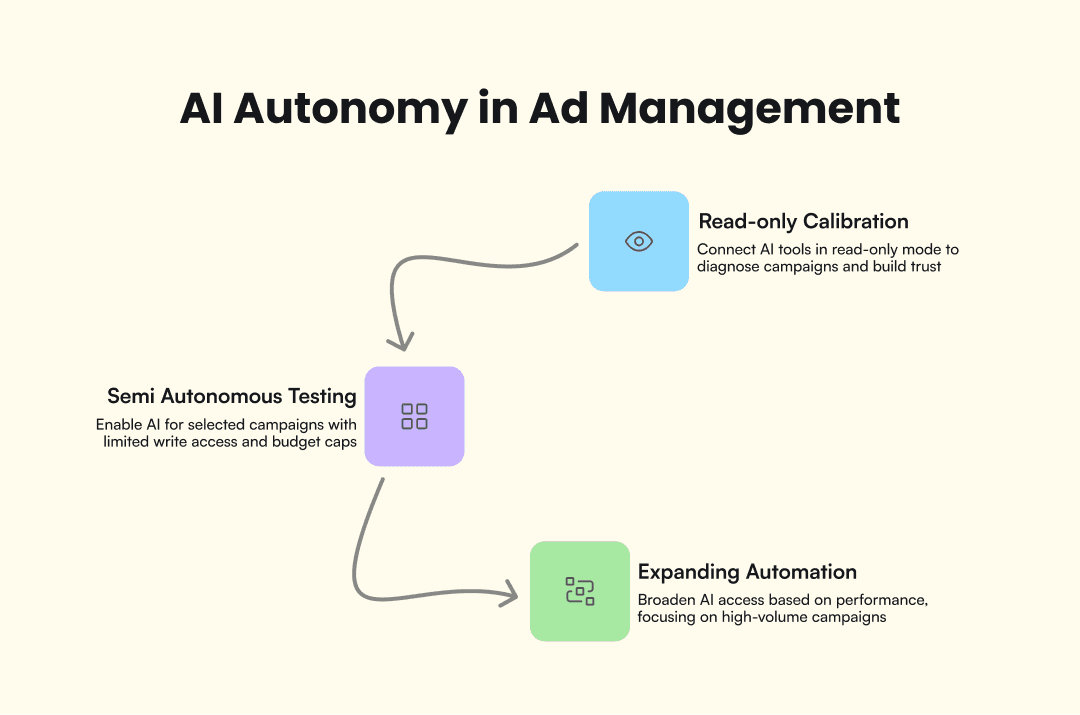
Phase 1: read-only (weeks 1-2)
Connect Claude or ChatGPT to your Meta ad account through MCP Connectors in read-only mode.
Use the AI Business Assistant inside Ads Manager as a parallel diagnostic tool.
If evaluating a third-party platform like AdAmigo, use its free or trial tier with read-only permissions.
You're testing whether the AI's judgment is worth trusting before anything touches budget. Ask it to diagnose your top underperforming campaigns and compare those recommendations against your own analysis. When the output lines up with what you'd already do, or catches angles you missed, you have a trust baseline to build on. Bad reads are just as informative, and the only cost was time.
Phase 2: semi-autonomous (weeks 3-6)
Enable Advantage+ for one or two campaigns alongside manually managed campaigns.
If testing a third-party agent, grant limited write access with strict budget caps.
Track CPA, ROAS, spend efficiency, and creative performance across agent-managed vs. manual campaigns.
Set specific thresholds that trigger manual override (e.g., CPA spikes 30% above your 7-day average).
Four weeks gives most campaigns enough data to show whether the AI is improving or degrading performance.
Phase 3: expanding autonomy
Broaden agent access based on what Phase 2 actually showed you. Prospecting and top-of-funnel campaigns are the safest place to start expanding because a wrong call there costs a few hundred dollars in wasted spend rather than a lost customer.
Retargeting and brand campaigns are a different story. The audiences are smaller and more valuable, and a wrong creative can burn through a high-intent segment before anyone catches it. Most advertisers who get this right don't hand over everything. They let AI agents run the high-volume operational work and keep human hands on strategy, creative approval, and the audiences that drive the most revenue.
When AI agents aren’t the right fit
Scenarios where manual management wins
Small budgets under $3,000/month don’t generate enough data for AI to outperform thoughtful manual management. The learning phase alone can consume a disproportionate share of the budget.
Niche audiences (B2B targeting specific job titles, hyperlocal campaigns) depend on contextual judgment that current AI agents can’t replicate.
Brand-sensitive campaigns where a single off-brand creative can cause reputational damage aren’t candidates for automated placement or creative decisions.
New ad accounts with fewer than 30 days of conversion data don’t give AI systems enough signal to work with.
The hybrid model
Most advertisers land between full manual control and full agent autonomy. The practical model:
Automate the repetitive, high-frequency tasks: bid adjustments, audience expansion, placement allocation.
Keep manual control over strategic decisions: overall budget allocation, creative approval, audience strategy, campaign architecture.
Agencies running multiple client accounts increasingly structure workflows this way. Agents handle monitoring, bid management, and budget pacing. Strategists focus on the creative and strategic work that AI still can’t match.
What this means for your ad account
Meta's own ad delivery system is already an autonomous agent. Andromeda, GEM, and REA make targeting, ranking, and pricing decisions that advertisers never see. Advantage+, MCP-connected LLMs, and third-party platforms like AdAmigo all add advertiser-controlled autonomy on top of a system that was running on its own before any of them existed.