We get asked this a lot. By agencies managing dozens of accounts for brands where one off-brand creative can damage a relationship that took years to build.
The skepticism is warranted. Most AI-generated ad creative is not good enough. Generic visuals, disconnected messaging, output that ignores brand guidelines. If that's what "AI ads" means, no agency working with serious brands would try it.
One of our agency partners was curious enough to find out for themselves. They tried Admove on some of their client accounts to see what would happen.
Key Takeaways
Monolith KLH, a 40-person Paris media buying agency managing clients like Orange and BNP Paribas, tested Admove across several client accounts to evaluate whether AI-generated ad creative could meet strict brand compliance standards.
Creative output per client jumped from 8-12 variations per month to 40-60, including an increase in video ad production that previously required external editors or studio time.
Brief-to-creative turnaround dropped from 5-7 business days to under 24 hours. The team recovered 25-30 hours per week, shifting that time from production coordination into media strategy and client work.
Strategists identified the generated brief layer as the biggest time saver. AI-produced creative directions replaced building every brief from scratch, while the team kept full editorial control over which directions moved forward.
Admove's Brand System applied each client's visual identity, voice, and vocabulary rules automatically across every generated creative. For an agency managing dozens of separate brand identities, this reduced manual compliance checks.
High-compliance clients still required human review of every creative before launch, and AI-generated briefs lacked awareness of recent campaign shifts or past performance data.
Who ran the test
Monolith KLH is a Paris-based media buying agency, around 40 people. The group formed when Monolith Partners (an omnichannel branding agency founded in 2015) acquired KLH Media (a digital performance agency) in late 2025. Together they cover brand awareness through conversion, on and offline.
Their portfolio include brands where every creative passes through compliance checks and detailed identity systems. 90% right doesn't cut it when the client expects 100%.
That's why AI creative tools made them nervous. Their daily work is protecting the visual and verbal identity of brands with millions of customers. An AI generating ad creatives sounds useful in theory. In practice, it's a risk until proven otherwise.
They're not new to AI either. They built L.U.K.E., a proprietary tool that measures brand visibility inside AI-generated search responses. They understand what AI can do. They needed to see it hold up under their working conditions.
"Monolith KLH reached out because they were curious whether AI creatives could meet the standards their clients expect. It started as a trial on a few accounts. We got honest feedback, and we're still learning from each other. They help us understand what agencies need day to day, and that shapes how we build the product. It's a relationship that keeps developing."
— Daniel Demian, co-founder and CEO of Admove

What they were trying to solve
Monolith KLH works with brands that provide detailed branded materials, footage, visual assets, and guidelines for how their identity should appear in advertising. The agency takes those materials and turns them into enough ad variations to keep campaigns fresh, test angles, and stay ahead of creative fatigue across every client.
Their strategists and media buyers know what they're doing. The constraint was how many variations they could produce and how fast.
Every client needed the same cycle: research the product and audience, develop creative direction, produce variations within brand guidelines, review, revise, get approval. Across a growing portfolio, the team was spending more time coordinating production than doing the media buying and strategy work they're built for.
Meta's Advantage+ and creative-first optimization made this more urgent. The algorithm rewards creative diversity and freshness. A handful of variations per client per month leaves performance on the table no matter how good each individual ad is.
They wanted to see if Admove could help them produce more, faster, without compromising how their clients' brands show up in market.
How Admove fit into their workflow
Admove didn't replace anything. It handled specific parts of the workflow where speed and volume were the constraint.
Monolith KLH tried it on several client accounts. Here's what it looked like:
Product Intelligence took over the research. When they connected a client's product catalog, Admove generated Product Intelligence for each product:
Competitive positioning and market context
Buyer personas with demographic and behavioral detail
Key selling points from actual product data
Work that normally takes hours per product arrived as a generated starting point the team reviewed, edited, and built on. They could also create custom personas or refine AI-generated ones with their own client knowledge.
Every ad started with a generated brief. In Admove, every ad (video or static) begins as a brief: a creative direction card with the angle, the hook, the target persona, and the messaging approach, informed by product research and the client's Brand System.
The strategists' workflow:
Review generated briefs
Select directions that fit the campaign
Drop the rest
Trigger ad generation only from approved briefs
Instead of building every brief from scratch, they picked from a set of generated directions and layered their own judgment on top.
Multi-format creatives from approved briefs. Once briefs were selected, Admove generated:
Video ads with AI avatars and voiceovers
Static image ads with ad copy ready for Meta
Scripts and hooks
Multiple formats for different placements
Every creative came out with the client's Brand System applied: visual identity, voice, and vocabulary consistent across every asset without anyone manually checking each one.
Iteration inside the system.
Static image ads: refined through a chat interface. Describe the change, get a new version, compare to previous versions, revert if needed.
Video ads: scene-by-scene editing through the script timeline. Adjust copy, swap between avatar and footage scenes, replace media, change voiceovers and music.
Back-and-forth that used to take days can happen immediately.
What worked, and what didn't
What worked:
Volume. Creative output per client went from 8-12 variations per month to 40-60, including a jump in video ad production. More angles in market, underperformers identified faster.
The brief layer. Strategists said this saved the most time. Generated creative directions as a starting point meant less time building briefs from scratch and more time on media strategy and client work.
Brand System enforcement. Every generated creative automatically followed each client's identity rules. For an agency managing dozens of separate brand identities, this built trust in the output over time.
Video remixing. Generating video variations with different hooks, scripts, and scene compositions without waiting on editors or external production.
What didn't:
High-compliance clients still needed human review. Brands with very specific visual standards needed someone looking at every creative before it went live. Admove got close, but close wasn't enough for certain accounts.
Briefs missed recent campaign context. AI-generated directions don't know that a client pivoted their messaging last week or that a specific angle failed two quarters ago. The strategists' editorial judgment stayed necessary.
Some formats needed manual work. Ad variations that had to sit alongside branded materials the client provided sometimes needed adjustment to feel cohesive with the broader campaign.
What they were spending before Admove
Before Admove, creative production costs were spread across studio rentals ($500–2,000+ per day), hours of strategist time on product research and persona development, manual creative briefing per campaign, and revision cycles that took days per round, per client. Ad variation output was capped by how many hours the team had.
With Admove, most of these either shrank or were absorbed into the system. Credits are spent only on generating the ads themselves. The research, personas, and briefs come built in as part of the workflow described above.
What changed
Brief-to-creative turnaround dropped from 5 to 7 business days to under 24 hours. 25 to 30 hours per week went back to the team, out of production coordination and into media strategy and client work.
This also changed how the agency operates. The traditional model ties creative output to headcount. More clients, more people, more overhead. Admove made it possible for the same team to serve more accounts and test more across all of them.
"What moved this test to something ongoing wasn't one number. It was when their team saw they could bring on new accounts without the usual pressure on creative capacity. That shift, from needing to hire before growing to growing while the creative keeps pace, is what we built Admove for."
— Daniel Demian, co-founder and CEO of Admove
So, is AI-generated ad creative good enough?
Based on what a 40-person media buying agency managing clients like Orange and BNP Paribas found after trying Admove on their accounts: yes. With a caveat that matters.
AI creative doesn't replace strategic thinking. It won't write your positioning. It won't understand the politics of a client relationship or know that the CMO changed direction mid-quarter.
What it does is remove the production bottleneck that stops agencies from testing enough creative to learn what works. It gives strategists better starting points through generated research and briefs. It gives media buyers more variations to work with. And it gives the team time back for the work that humans are better at.
"Finding a partner that adapts to how we work wasn't something we expected from an AI company. A lot of tools are built for generic use. What made the difference with Admove was Daniel and Gery's willingness to listen and build around what agencies like ours need. We're involved in what comes next, and for a team where brand standards are everything, that kind of collaboration matters more than any list with features."
— Laurent Foisset, CEO of Monolith KLH

Why Monolith KLH is staying
This is the part we weren’t expecting to write yet.
Monolith KLH didn’t just decide to keep using Admove after the test. They asked to stay close to the product roadmap. The reason: what’s coming next.
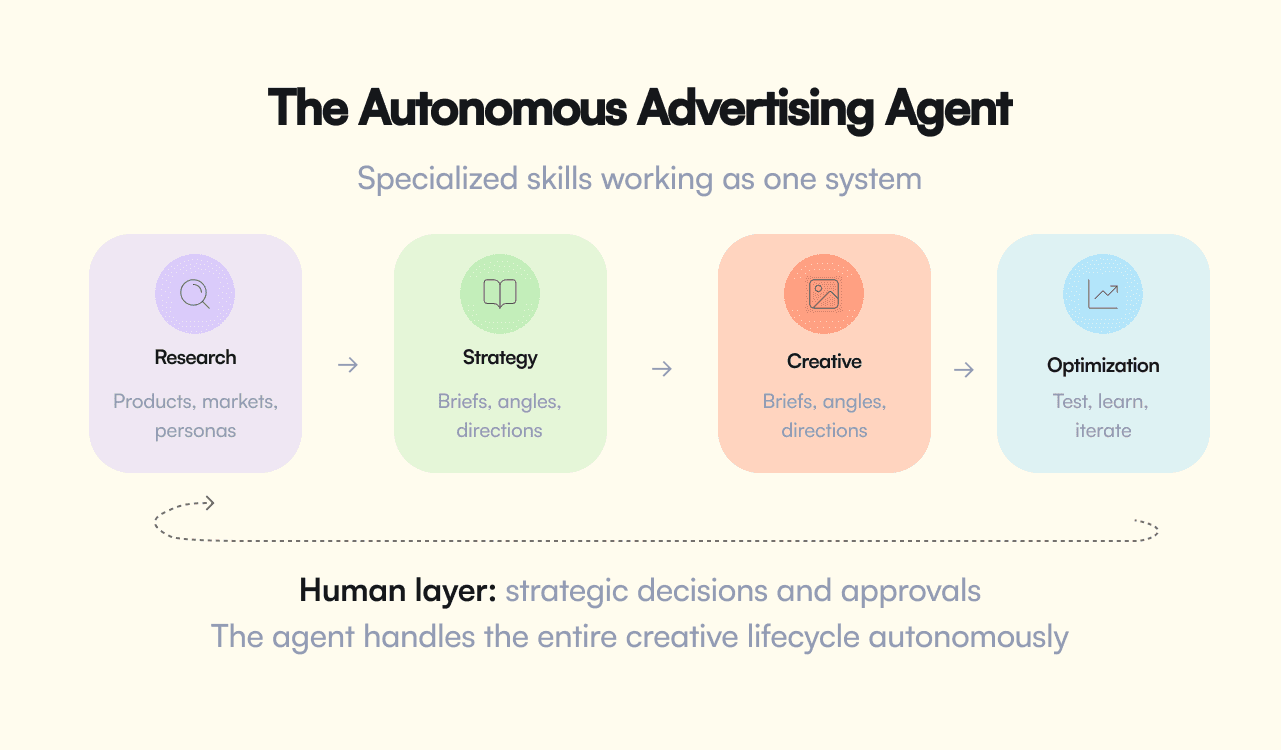
Admove is evolving into something bigger than a creative generation system. We’re building a fully autonomous advertising agent, one with specialized skills across research, strategy, creative production, and optimization, all working together as a single system. The direction is an agent that doesn’t wait for a brief but proactively manages the entire creative lifecycle for every account: researching products, generating briefs, producing creatives, and surfacing what to test next, with the human layer focused on strategic decisions and approvals.
If your agency’s creative pipeline can’t keep up with the accounts you want to win, that’s the bottleneck worth solving.