
Meta’s advertising infrastructure underwent its biggest architectural change in October 2025. Andromeda, a retrieval system 10,000x more complex than its predecessor, fully replaced the legacy audience-matching engine. The shift moved ad delivery from audience-based targeting to creative-based retrieval: the algorithm now reads your creative to find your audience instead of matching your targeting inputs to users. Every optimization tactic downstream, from tracking to creative testing to campaign structure, depends on this change.
Meta commands 68.31% of total ecommerce ad budget. Facebook alone reaches over 3 billion monthly active users, with Instagram matching that figure as of September 2025. Most optimization advice still treats it like it worked two years ago: pick audiences in Meta Ads Manager, write ad copy, check your ROAS. That approach misses the architectural layer that now controls delivery.
This guide works through the optimization chain in the order Andromeda’s architecture demands: how the delivery system decides which ads to show, why your tracking stack (Meta Pixel plus Conversions API) feeds the algorithm’s learning, how creative testing drives reach under the new system, when Advantage+ campaigns outperform manual structure, and where the whole framework breaks down.
Key Takeaways
Andromeda is Meta's retrieval system that replaced legacy audience matching in October 2025, shifting ad delivery from audience-based targeting to creative-based retrieval where the algorithm reads your creative to find your audience.
Entity ID fingerprints every ad through three signal channels (computer vision, NLP, and audio analysis), and those fingerprints determine which user profiles your ad qualifies to appear for.
GEM (Generative Ads Recommendation Model) handles the second delivery stage by ranking Andromeda's candidate ads using conversion signals to make final placement decisions.
Conversions API sends conversion events server-side to Meta, bypassing browser restrictions and ad blockers that cause Pixel-only tracking to miss the majority of conversions in a post-iOS 14.5 environment.
Event Match Quality (EMQ) scores how well server-sent events match Meta's user records on a 0-10 scale, with 7.0 as the threshold where CAPI's performance benefits fully activate.
Andromeda's preferred campaign structure concentrates conversion data into fewer ad sets (one campaign, one to two ad sets, 10-20 active creatives) rather than fragmenting budget across multiple ad sets with fewer creatives each.
Broad targeting outperforms interest stacking because Andromeda handles audience discovery natively when it receives high-quality creative signals across all three Entity ID channels.
How Andromeda and GEM decide which ads get shown
Andromeda is the retrieval system that controls Stage 1 of Meta’s ad delivery pipeline. When a user opens Facebook or Instagram, Andromeda narrows the full ad inventory down to a candidate set of ads that user might engage with. It does this by reading creative signals, not by matching audience targeting inputs. The system’s model complexity increased by a factor of 10,000x compared to the prior ranking infrastructure, according to Meta’s December 2024 announcement, which coincided with deployment on NVIDIA GH200 Grace Hopper Superchips. Meta’s own data shows Andromeda achieved a 6% recall improvement and 8% ads quality improvement on selected segments.
GEM (Generative Ads Recommendation Model), introduced in November 2025, handles Stage 2. After Andromeda narrows the candidate set, GEM ranks those candidates using conversion signals to make final delivery decisions. GEM is the layer that determines which ad, among the qualified candidates, gets shown to a specific user at a specific moment. According to Meta’s own reporting, GEM is 4x more efficient at driving ad performance gains compared to the original recommendation ranking models.
The two-stage delivery pipeline:
Stage | System | What it does |
Stage 1: Retrieval | Andromeda | Narrows the full ad inventory to a candidate set based on creative signals (Entity ID fingerprints). Runs in milliseconds. |
Stage 2: Ranking | GEM | Ranks the candidate set using conversion signals and makes the final delivery decision for each impression. |
The bridge between your creative and Andromeda’s retrieval decisions is Entity ID, a fingerprinting system that extracts targeting signals directly from your ad assets.
How Entity ID reads your creative
Entity ID analyzes every ad through three signal channels:
Computer vision processes imagery, composition, color palettes, and product placement within the frame.
Natural language processing reads text overlays, captions, and the ad copy attached to the creative.
Audio analysis evaluates voiceovers, music selection, and sound design in video ads.
Each of these channels feeds Andromeda’s understanding of who should see the ad. A video featuring a close-up product demonstration with a female voiceover, upbeat music, and text overlay mentioning “sensitive skin” tells Andromeda something very different than a flat-lay lifestyle image with no text and ambient sound. The fingerprint determines retrieval eligibility: which user profiles your ad qualifies to appear for.
Entity ID’s fingerprinting is the architectural foundation of what practitioners now call creative-as-targeting. Your creative quality directly determines your audience reach because Andromeda reads creative to find audiences. Traditional interest-based targeting still exists as an input, but Andromeda’s retrieval layer can override narrow targeting when the creative signals suggest a broader match. Andromeda’s override capability is why broad targeting outperforms interest stacking in most current campaigns: Andromeda handles audience discovery natively when it receives high-quality creative signals across all three Entity ID channels.
Every creative element is now a targeting signal: the thumbnail image, the background music, the text overlay font size. Production quality across visual, text, and audio channels affects delivery reach as well as engagement rates.
Set up your tracking stack: Meta Pixel + Conversions API
Running Meta Pixel as your only tracking layer means losing the majority of your conversion data. Browser-based tracking in a post-iOS 14.5 environment drops attribution accuracy to roughly 40%. More than half of your conversions stay invisible to the algorithm. Ad-blocker usage now exceeds 30% of internet users worldwide according to industry estimates, which widens the gap further. First-party data sent server-side is the only reliable attribution path left.
Conversions API (CAPI) fixes this by sending conversion events directly from your server to Meta, bypassing browser restrictions and ad blockers entirely. The performance impact is well-documented:
Metric | Finding | Source |
Cost per result | 17.8% lower with CAPI vs. Pixel-only | Meta, April 2026 |
Campaign performance | 15-20% increase for CAPI adopters | Calibrate Analytics, Nov 2025 |
ROAS improvement | Two-thirds of advertisers reported improved ROAS | IAB guide, Oct 2025 |
Attribution gap | Pixel-only drops to ~40% accuracy | wetracked.io, 2026 |
Implementation used to require developer resources. That changed in April 2026 when Meta launched a one-click CAPI setup option inside Events Manager. The technical barrier is gone for most advertisers. Custom server-side implementations through partners or through Google Tag Manager server containers remain available for advertisers who need more control over event parameters and data flow.
When both Pixel and CAPI run simultaneously, event deduplication prevents double-counting. Meta matches events by event ID and timestamp, so you won’t inflate your conversion counts. The dual-tracking setup gives you browser-side coverage for users who aren’t blocking scripts, plus server-side coverage for the significant share who are.
The deeper reason CAPI changes your optimization ceiling is signal quality. Every conversion event that reaches Meta feeds Andromeda’s learning. More complete conversion data means Andromeda builds a more accurate model of which users convert, which improves delivery targeting across all your campaigns.
What Event Match Quality score to target
Event Match Quality (EMQ) scores how well your server-sent events match Meta’s user records, on a scale from 0 to 10. An EMQ of 7.0 or above indicates strong matching and is the threshold where CAPI’s performance benefits fully kick in.
The key parameters that drive EMQ higher:
Email address (strongest single match parameter)
Phone number
fbclid (the Facebook click ID that travels with the URL)
fbp (Facebook’s browser ID cookie)
Sending more of these parameters with each event gives Meta more data points to match the conversion to a specific user profile. EMQ turns CAPI from a binary checkbox into a quality scale. Two advertisers can both “have CAPI implemented” but see vastly different results depending on their EMQ score. An EMQ of 4.0 means Meta can match roughly half your events; a score above 8.0 means nearly all of them reach the right user record, which directly improves Andromeda’s conversion signal quality for your account.
Creative testing at scale
Brands testing 20 or more new ads per month see 65% higher ROAS compared to those testing fewer than 10, according to agency portfolio data cited across multiple industry benchmarks in early 2026. The figure isn’t independently verified as an industry-wide benchmark, but the mechanism behind it aligns with how Andromeda works: more creative variants give Entity ID more fingerprints to test across audience segments, which expands the pool of users Andromeda can match your ads to.
Three testing approaches serve different needs:
A/B testing isolates a single variable (headline, image, hook) to identify which version performs better in a head-to-head comparison.
Dynamic Creative Optimization (DCO) automates multi-element variations, letting Meta assemble combinations of images, headlines, and descriptions to find winning pairings.
Iterative creative runs systematic improvement cycles where learnings from one round of tests inform the next round’s creative briefs.
Choosing the right ad format
Format | Best for | Entity ID signal strength |
Short-form vertical video (Reels, Stories) | Engagement-driven placements, broad prospecting | Strongest (visual + text + audio) |
Carousel ads | Product catalogs, multi-feature storytelling | Moderate (visual + text per card) |
Static images | Retargeting, simple offers, familiar audiences | Lowest (visual + text only) |
The first 2-3 seconds of any video ad are the highest-leverage creative variable you can test. Scroll-stop rate, the percentage of users who pause instead of scrolling, is determined almost entirely by the opening hook. Testing multiple hooks against the same body content is one of the fastest ways to increase creative output without producing entirely new ads. A single 30-second video can generate three to five testable variants by swapping only the opening frames. The Meta Ads Library is a useful starting point for researching competitor hooks in your category.
Andromeda now predicts creative fatigue proactively rather than waiting for performance to decline. The system monitors engagement velocity and shifts delivery away from fatiguing ads before cost per result spikes. Proactive fatigue detection changes refresh cadence from a fixed schedule (replace creatives every 2-3 weeks) to a performance-signal-driven replacement model. Your job shifts from watching frequency metrics to maintaining a pipeline of fresh creatives that Andromeda can rotate in when it detects fatigue on current assets.
User-generated content (UGC) belongs in the testing mix alongside produced creative. UGC often generates different Entity ID fingerprints than polished brand content, which means Andromeda may surface it to different audience segments.
Advantage+ campaigns vs. manual campaign structure
Advantage+ Shopping Campaigns (ASC) deliver 32% lower CPA compared to manual campaign structures, according to. ASC works by handing most targeting and placement decisions to Meta’s automation layer, which lets Andromeda optimize delivery across a broader audience pool without the constraints of manually defined ad sets.
Factor | Advantage+ Shopping (ASC) | Manual campaigns |
CPA performance | 32% lower CPA (2026 benchmark) | Baseline |
Budget threshold | $1,000+/day recommended | Any budget |
Targeting control | Meta controls targeting and placements | Full control over audiences and exclusions |
Best for | Broad catalog promotion, scaling winners | Niche targeting, controlled A/B tests, small budgets |
Creative input | Feed 10-20 creatives, system selects | You assign creatives to specific ad sets |
Learning speed | Faster (consolidated data) | Slower (fragmented across ad sets) |
Advantage Campaign Budget (formerly Campaign Budget Optimization, or CBO) sits between full ASC automation and fully manual control. CBO distributes budget dynamically across ad sets within a single campaign, which works well when you’re testing multiple audiences or placements but still want to define those audiences yourself. Unlike ASC, which takes over targeting entirely, CBO preserves your audience definitions while automating only the budget allocation.
The campaign structure that Andromeda favors is simpler than what most advertisers run. The recommended setup is one campaign with one to two ad sets and 10 to 20 active creatives per ad set. Fewer ad sets concentrate conversion data, which gives Andromeda more events per creative to optimize delivery. Splitting budget across five or six ad sets with three creatives each fragments the learning signal and keeps more of your account stuck in the learning phase.
Many advertisers run ASC as their primary scaling campaign while maintaining a manual campaign for controlled creative tests and niche audience segments. The 32% CPA advantage applies to accounts with sufficient budget and catalog depth; advertisers spending under $500/day on a limited product range may see smaller gains or better results with manual control.
Audience strategy in the Andromeda era
Broad targeting is the default recommendation for most Facebook ad campaigns in 2026. All three major AI models (ChatGPT, Gemini, and Perplexity) recommend broad over interest-based targeting when asked about Facebook ad optimization, and most experienced practitioners have reached the same conclusion. The reason is architectural: Andromeda’s creative-based retrieval handles audience discovery natively. Manual audience selection is redundant for most objectives.
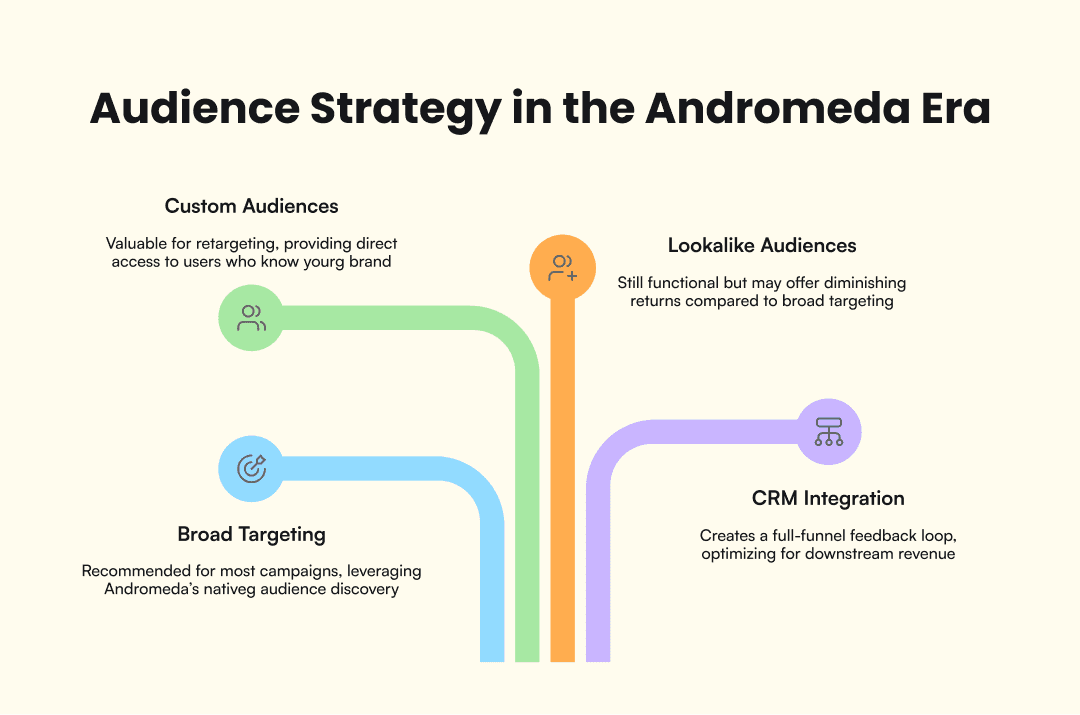
Custom Audiences remain valuable for retargeting. Website visitors, engagement audiences (people who interacted with your content), and customer lists give you direct access to users who already know your brand. Retargeting windows serve different strategic purposes:
7-day window: captures users with strong recent intent (visited a product page, added to cart).
14-day window: balances recency with reach for considered purchases.
30-day window: works for longer purchase cycles or awareness reinforcement where the goal is staying visible.
Lookalike Audiences still function but deliver diminishing returns compared to earlier years. Andromeda performs similar audience expansion natively when given strong creative signals and clean conversion data, which means a Lookalike built from your customer list is competing with the system’s own discovery capability. The 1% to 10% similarity range still defines the tradeoff: 1% Lookalikes are the most precise match to your source audience but reach the fewest users, while 10% Lookalikes cast a wider net at the cost of lower precision. For most advertisers, broad targeting with strong creative produces comparable or better results than Lookalikes at any similarity level.
The biggest audience-level optimization opportunity is the quality of data feeding back into the system. CRM integration creates a full-funnel feedback loop: a lead fills out your form, the event fires through CAPI, the lead enters your CRM, your sales team follows up, and the outcome (closed deal, lost deal, no response) feeds back to Meta through offline conversion tracking. This first-party data loop gives Andromeda conversion signals beyond the initial form submission, which means the system learns to target downstream revenue instead of stopping at the cheapest leads.
Without this feedback loop, Andromeda targets the proxy event you’re tracking (form submission, purchase) without knowing whether those conversions represent real business value. Building this pipeline takes coordination between your marketing and sales teams, but the payoff is an algorithm that improves its model of your actual customer profile with every closed deal.
Key metrics and 2026 benchmarks
The 2026 benchmark data for Facebook ads comes from multiple sources with different methodologies, so the context behind each number is as important as the number itself.
Metric | 2026 benchmark | YoY trend |
CTR | 2.19% median (all industries) | Stable |
CPC | $1.72 average / $1.11 global median | +11% YoY |
CPM | $13.48 median | ~20% YoY |
ROAS | 1.93x median | 12/15 industries improved |
A CTR well below the 2.19% median usually points to a creative problem: the ad isn’t generating enough interest to stop the scroll. If your ROAS falls below 1.93x, the diagnostic path starts with creative performance and tracking completeness before adjusting budget or audience settings.
The CPC gap between $1.72 (U.S.-weighted data) and $1.11 (global median) reflects geographic methodology more than platform changes. U.S.-focused benchmarks run higher because domestic auction competition is steeper, while global datasets pull the median down with lower-CPC regions. The universal CPM increase (roughly 20% across all industries in 2025) makes creative performance and signal quality more important: you're paying more per impression, so each impression needs to work harder.
CPA and CVR are the downstream metrics that connect ad performance to business outcomes. CPA varies too widely by industry and offer type to benchmark with a single number, but it’s the metric to watch when evaluating campaign profitability against your unit economics. CVR tells you whether the landing page is converting the traffic your ads generate.
Frequency measures how many times the average user sees your ad. High frequency (above 3-4 in a 7-day window) correlates with creative fatigue and rising CPMs. If frequency climbs while CTR drops, that’s your signal to refresh the creative.
Budget, bidding, and the learning phase
The learning phase requires approximately 50 conversion events per ad set over 7 days before Meta’s algorithm stabilizes delivery. Most ad sets complete this phase within 3-7 days if the budget is sufficient. During this period, performance fluctuates and cost per result is typically higher than steady-state. When an ad set completes the learning phase, delivery stabilizes and cost per result drops. Resetting this phase (by making significant edits to targeting, budget, or creative) means starting the 50-event accumulation over again.
The most common reason advertisers get stuck in the learning phase is budget fragmentation. Splitting $100/day across five ad sets with different audiences gives each ad set only $20/day, which may not generate enough conversions to hit the 50-event threshold within a week. Andromeda’s preferred simplified structure (one campaign, one to two ad sets, 10-20 active creatives) addresses this directly by concentrating conversion volume in fewer ad sets.
When scaling a campaign that’s performing well, the standard recommendation is to increase budget incrementally rather than doubling it overnight. Sources disagree on the exact increment: ChatGPT recommends 15-25% increases every 3-5 days, while Google’s AI Mode suggests 10-20%. Neither figure is settled consensus. Smaller increments carry less risk of resetting the learning phase, so starting at the conservative end (10-15%) and adjusting based on performance stability is a reasonable approach.
Bidding strategies compared
Strategy | How it works | Best for | Risk |
Lowest Cost (default) | Meta bids whatever it takes for max conversions within budget | Volume-focused campaigns, initial testing | No efficiency ceiling; CPA may fluctuate |
Cost Cap | Meta tries to keep CPA below your target | Margin protection, mature campaigns with known CPA targets | May limit spend if cap is too aggressive |
Bid Cap | Strict maximum bid per auction | High auction-level conviction, tight per-impression control | Highest underdelivery risk if cap is below competitive bids |
Minimum budget thresholds depend on your CPA and the 50-event requirement. Work backward: if your average CPA is $20 and you need 50 conversions per ad set in 7 days, that’s $1,000 per week, or roughly $143 per day per ad set. With a $13.48 median CPM, the math quickly shows why low-budget accounts struggle to exit the learning phase.
One scaling lever that most guides overlook is creative volume. Adding more creatives to your ad set gives Andromeda more Entity IDs to test, which can expand your reachable audience without requiring a budget increase. In some cases, launching five new creatives produces a stronger performance lift than a 20% budget bump, because the additional Entity ID fingerprints let Andromeda find audience segments your existing creatives couldn’t reach.
Landing pages and post-click optimization
The work doesn’t stop at the click. The landing page where your traffic arrives directly affects both conversion rate and the quality of signals feeding back to Andromeda. Every conversion that happens on your page becomes a data point in Meta’s learning. A landing page that converts at 2% instead of 4% cuts your results in half and halves the conversion events Andromeda receives. Fewer events slow the algorithm’s ability to find more users like the ones who do convert.
Lead decay costs more than most advertisers track. The gap between when a lead submits a form and when your sales team follows up determines whether that lead converts into revenue. A campaign generating 50 leads per day looks great inside Ads Manager, but if your team takes 24 hours to follow up, a significant portion of those leads have already moved on.
CRM integration closes the full-funnel feedback loop that makes post-click optimization measurable. When a lead submits a form, the event fires through CAPI. The lead enters your CRM. Your sales team qualifies and follows up. The outcome (closed, lost, unresponsive) feeds back to Meta through offline conversion tracking. The feedback loop creates the data pipeline that moves Andromeda’s targeting from form fills to actual revenue.
Landing page fundamentals still apply:
Fast load times (under 3 seconds).
Mobile-first design, given that the majority of Facebook traffic is mobile.
Message match between your ad creative and the landing page content so users see continuity from click to conversion.
When optimization isn’t the answer
If your daily budget can’t generate 50 conversion events per ad set within 7 days given your current CPA, optimization tactics won’t solve the problem. The system needs enough data to exit the learning phase, and no amount of creative testing or audience refinement changes that math. For the persistent question “is $10 a day enough for Facebook ads?”, the honest answer is: it depends entirely on your CPA. If your conversions cost $5 each, $10/day generates roughly 14 events per week, well short of the 50-event threshold. You’ll be perpetually stuck in the learning phase.
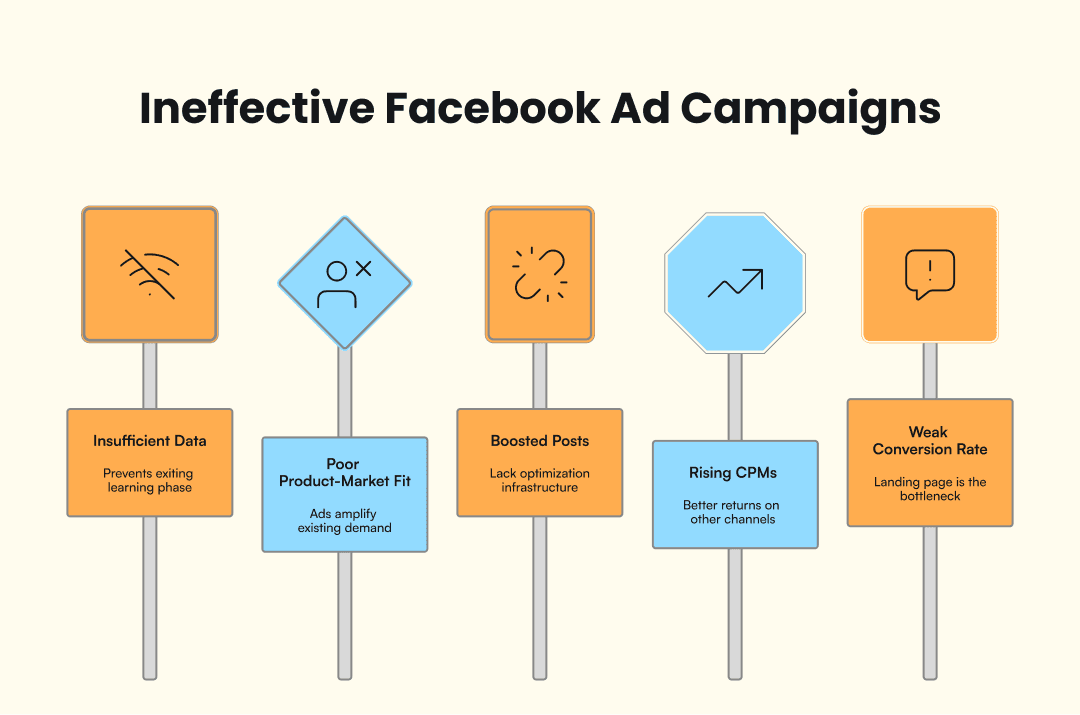
Product-market fit sits upstream of ad optimization entirely. Facebook ads amplify existing demand, and if your offer doesn’t convert when people land on it, no algorithm update or tracking improvement will fix that.
When your CTR is strong but your conversion rate is weak, the problem is the landing page, not the ad. Diagnosing this correctly saves you from wasting time rewriting ad copy when the problem lives on the page itself.
Rising CPMs, up roughly 20% in 2025 according to Triple Whale, mean some advertisers will find better returns on other channels depending on their target audience and conversion economics. Facebook remains the dominant paid social platform, but the cost increase is real and worth modeling against alternatives.
Ads run through Meta Ads Manager are not the same as boosted posts. Boosted posts lack the objective alignment, placement control, creative testing capability, and detailed targeting options available in Ads Manager campaigns. If you’re “running Facebook ads” through the boost button, you’re not accessing the optimization infrastructure this guide covers.
What to do first
The sequence Andromeda’s architecture rewards is clear: understand the delivery system, fix your signal quality through CAPI with a 7.0+ EMQ score, test creative at volume to feed Entity ID with diverse fingerprints, and let the system handle audience discovery.
If you take one action from this guide, implement CAPI and push your EMQ above 7.0. Meta’s own data shows 17.8% lower cost per result, and two-thirds of advertisers report improved ROAS after implementation. That’s the highest-return lever available to most accounts right now.
Andromeda and GEM will keep changing. The advertisers who understand the delivery architecture will read those changes faster than the ones reacting to surface-level metrics.