
Meta’s ad delivery system changed in late 2024. Andromeda, the retrieval engine that replaced legacy audience matching, increased the complexity of ad selection by 10,000x. Instead of matching your ad to audiences you define, Andromeda reads your creative (visual elements, copy, audio) to decide which users should see it. That shift turned every optimization lever upside down. Campaign structure, bidding, targeting, even your Meta Pixel and CAPI setup all feed different signals into a system that works nothing like the one most advertisers learned on.
Every recommendation below connects back to how Andromeda retrieves ads and how GEM, Meta’s ranking model, scores them for final placement. The audience is anyone making daily optimization decisions: media buyers managing accounts, agency owners advising clients on strategy, and DTC brand owners running their own campaigns. If you’re spending on Facebook Ads and the results don’t match what they used to, the delivery system is the reason, and understanding it is the first step toward fixing performance.
Key Takeaways
Andromeda replaced Meta's legacy audience-matching engine with a creative-based retrieval system that reads creative signals to find audiences rather than matching targeting inputs to users.
GEM ranks the candidate ads that Andromeda retrieves, using conversion signals to make final placement decisions for each impression.
Andromeda groups ads with similar creative fingerprints together, so minor variations like swapping a thumbnail on the same script get treated as duplicates and receive higher CPMs.
Running Meta Pixel as the only tracking layer misses the majority of conversion data in a post-iOS 14 environment. Conversions API sends events server-side to Meta, bypassing browser restrictions and ad blockers.
Event Match Quality scores server-sent events on a 0-10 scale. The 7.0 threshold is where CAPI's performance benefits fully activate, so implementation quality matters as much as having it at all.
Advantage+ Sales Campaigns deliver lower CPA and higher ROAS than manual structures for accounts with sufficient budget and catalog depth. Manual campaigns remain better for niche targeting, controlled testing, and smaller budgets.
Testing one variable at a time in a specific sequence (hooks first, then offers, then formats, then brand narrative) with minimum evaluation windows per variable type produces more reliable results than testing multiple variables at once.
Broad targeting outperforms interest stacking in most campaigns because Andromeda handles audience discovery on its own when it receives strong creative signals. Manual audience selection is redundant for most objectives.
Rising CPM paired with falling CTR and stable CPC indicates creative fatigue. ROAS drops paired with stable CTR point to audience saturation or a conversion path problem rather than a creative issue.
Optimization tactics stop working when the daily budget can't generate enough conversion events to exit the learning phase, or when the constraint is the offer or product rather than the ad platform.
How Facebook’s ad algorithm works now
Facebook’s delivery system operates in two stages. Andromeda handles retrieval, deciding which users might respond to your ad. GEM handles ranking and predicts which of those users will convert. Understanding both stages explains why creative quality, signal quality, and account structure all matter in ways that didn’t apply to the older system.
Andromeda and the creative-as-targeting shift
Andromeda is Meta’s retrieval system, introduced in late 2024 to replace the legacy audience matching model. It processes a candidate pool 10,000x larger than its predecessor and uses a mechanism called Entity ID to extract targeting signals directly from your creative. Entity ID fingerprints each ad across three channels: computer vision analyzes imagery and composition, NLP processes headlines, captions, and overlaid text, and audio analysis captures voiceover tone and music. Together, these signals create a unique profile that determines which audiences the ad gets shown to.
This retrieval-before-ranking architecture is why broad targeting now outperforms interest stacking for most advertisers. When Andromeda can read your creative to identify the right audience, manually narrowing targeting limits the system’s retrieval pool. Early results showed a 6% improvement in recall and 8% improvement in ads quality over the prior system. For media buyers, the practical implication is direct: your creative is your targeting. A fitness ad showing a home workout reaches a different audience segment than the same product shown in a gym, because Entity ID reads different signals from each version, independent of your interest settings.
GEM: how Meta predicts conversions
GEM is the ranking layer that sits behind Andromeda. After Andromeda surfaces a pool of candidate users likely to engage with your ad, GEM ranks those candidates by conversion probability. It decides who sees the ad and at what price. GEM operates at 4x the efficiency of Meta’s prior ranking models and processes more signals per auction with less computational overhead.
The direct consequence for advertisers is that conversion tracking quality feeds GEM’s predictions. The model pulls signals from your Meta Pixel and CAPI implementation to estimate which users will take your target action. Weak or incomplete tracking data means GEM ranks with partial information, which produces less accurate conversion predictions and drives up your cost per result.
The Creative Similarity metric
Andromeda groups ads that share similar Entity ID fingerprints together and treats them as near-duplicates in the retrieval stage. When the fingerprints overlap, you pay higher CPMs because the system isn’t extracting new audience signals from what it considers the same ad.
Change type | Entity ID result | Algorithm treatment |
Same script, different thumbnail | Overlapping fingerprint | Near-duplicate, higher CPMs |
Same image, swapped headline | Overlapping fingerprint | Near-duplicate, higher CPMs |
Talking-head UGC vs. product demo | Distinct fingerprints | Separate ads, broader retrieval |
Different message + different visual approach | Distinct fingerprints | Separate ads, broader retrieval |
The distinction matters because Advantage+ Creative and other automation features rely on genuine variety to test against. A headline swap on an identical image does not give Andromeda new signals. A UGC testimonial and a studio product demo for the same item do, because they reach distinct audience pools through different fingerprints.
Creative volume requirements reflect this dynamic. Industry recommendations vary: 10 to 20 distinct concepts per account, 15 to 50+ active creatives, and 3 to 5 genuinely new concepts every one to two weeks. The range reflects different spending levels and account maturity, but the underlying principle is consistent. More distinct creative gives Andromeda more unique fingerprints to work with, which broadens retrieval across its candidate pool.
Tracking infrastructure and signal quality
Everything downstream of your tracking setup depends on the quality of the data it sends to Meta’s algorithm. Andromeda retrieves based on creative signals, but GEM ranks based on conversion signals. If your tracking misses events or sends low-quality data, GEM’s predictions degrade and your costs rise.
Meta Pixel + CAPI dual tracking
In a post-iOS 14 environment, the Meta Pixel alone misses a large share of actual conversion events. Three categories of signal loss stack up against browser-based tracking:
1. Browser restrictions: privacy updates limit tracking scripts and block third-party cookies
2. Ad blockers: prevent the Pixel from firing on a share of desktop and mobile traffic
3. App Tracking Transparency (ATT): Apple’s opt-in framework, where most iOS users deny tracking permission
The Conversions API (CAPI) bypasses all three by sending event data server-side, directly from your server to Meta’s, without touching the browser. CAPI recovers an estimated 15 to 30% of conversion data that browser-based tracking misses. Running both Pixel and CAPI together with deduplication gives Meta the most complete signal set for GEM to work with. The technical barrier dropped in April 2026 when Meta introduced a one-click CAPI setup that removed the need for custom server configuration.
Event Match Quality (EMQ) optimization
Event Match Quality is Meta’s 0-to-10 scale that measures how accurately your server-sent events match Meta user records. Two advertisers can both run CAPI and see very different results, because the tracking quality benefits only activate at EMQ scores of 7.0 or higher.
The score depends on the matching parameters you pass with each event:
1. Hashed email address: the strongest single matching signal
2. Phone number: hashed, complements email for higher match rates
3. Facebook click identifier (fbclid): captured from the ad click URL
4. Facebook browser identifier (fbp): the first-party cookie set by the Pixel
Passing more of these parameters at higher quality raises your match rate. If your EMQ sits below 7.0, the priority fix is improving these parameters in your event payloads rather than increasing ad spend.
Campaign structure and Advantage+ setup
Andromeda learns faster when it can concentrate data into fewer ad sets instead of splitting signals across fragmented campaign structures. The preferred account structure in 2026:
Component | Recommended setup |
Campaigns | 1 per objective |
Ad sets | 1 to 2 per campaign |
Active creatives | 10 to 20 feeding Andromeda’s Entity ID system |
Targeting | Broad (creative signals handle audience discovery) |
Consolidated vs. segmented accounts
Consolidation works because Andromeda needs volume to learn. Splitting budget across multiple ad sets fragments the learning signal and extends the time each ad set spends in the learning phase. But segmented structures still win in specific situations:
Consolidated | Segmented | |
Structure | 1 CBO campaign, broad targeting, creative variety | Multiple campaigns with separate targeting per ad set |
Learning speed | Faster (data concentrated in fewer ad sets) | Slower (data fragmented, longer learning phases) |
Audience discovery | Andromeda handles it through creative signals | Manual control via interests or Lookalikes |
Best for | Ecommerce, DTC, most advertisers at scale | B2B with narrow ICPs, regulated/medical industries, early-stage brands |
Key advantage | Higher conversion volume, lower cost | Precise audience control, compliance isolation |
For most ecommerce and DTC advertisers, the consolidated approach produces better results. The segmented path is a deliberate choice for accounts where compliance, audience precision, or product-market fit testing requires manual control.
Advantage+ Sales Campaigns vs. manual
Advantage+ Sales Campaigns (ASC) is Meta’s fully automated campaign type, and adoption among ecommerce advertisers hit 67% in early 2026. Performance data from multiple sources shows consistent gains over manual setups:
Dimension | Advantage+ Sales (ASC) | Manual campaigns |
ROAS impact | +22% lift; +32% increase | Baseline performance |
CPA impact | 17% lower; 10 to 20% lower | Baseline performance |
Budget threshold | Above ~$1,000/day for best results | Works at any budget level |
Audience control | Algorithm handles targeting through creative signals | Full control over interests, Lookalikes, exclusions |
A/B testing | Limited variable isolation | Clean test-and-control setups possible |
Learning phase | Faster exits with consolidated data | Risk of fragmented learning across ad sets |
Best for | Ecommerce, DTC, high-volume accounts | B2B, regulated industries, niche targeting, early-stage brands |
Key risk | Under-delivers if conversion volume is too low | Higher manual overhead, slower optimization |
ASC works best when the system has enough conversion data to learn from. Manual campaigns retain their edge wherever you need specific audience controls, clean variable isolation for A/B tests, or operate at budgets where ASC can’t accumulate enough conversions.
Learning phase management
Every new ad set or significant edit triggers a learning phase where Meta tests delivery options until performance stabilizes. The learning phase typically takes 3 to 7 days and requires approximately 50 conversion events per week to complete.
What resets it: major budget changes, targeting adjustments, creative swaps, and bid strategy shifts. The most common reason accounts stay stuck in learning is budget fragmentation.
Splitting $5,000 per day across ten ad sets means each one gets $500, which may not generate enough conversions to exit the learning phase. Consolidation solves this structurally.
The connection between learning phase stability and budget strategy runs both ways, and higher-funnel optimization events (covered in the Budget section) offer a workaround for accounts that can’t hit the 50-conversion threshold on purchase events alone.
Creative testing and ad fatigue
Creative is the primary input to Andromeda’s retrieval system, which makes testing the most operationally important activity in a Facebook Ads account. Each genuinely different creative generates a distinct Entity ID fingerprint that reaches different audience segments. The more distinct creatives you test and validate, the broader your potential reach.
Building a creative testing pipeline
Test one variable at a time with equal budget splits across variants. The sequence that produces the fastest learnings:
• Hooks first: the first 3 seconds of video or the primary visual element. Highest impact on stop-rate, which determines whether anyone sees the rest of your ad.
• Offers second: pricing, discount structures, or bundle variations.
• Formats third: static vs. video, square vs. vertical, UGC vs. produced.
• Narrative last: full brand messaging angles. Slowest to test but highest long-term impact.
Adapt the process to your team size. A solo DTC founder can test 2 to 3 hook variants per week. An agency team managing multiple accounts needs a production pipeline that outputs 3 to 5 new concepts per account every one to two weeks. The methodology stays the same regardless of scale: isolate one variable, split budget evenly, and wait for enough data before declaring a winner.
Testing timelines by variable type
Each creative variable requires a different evaluation window because they affect different stages of the funnel:
• Hooks: 3 to 5 days of stop-rate and CTR data
• Offers: 5 to 7 days, since conversion events take longer to surface
• Formats: 5 to 7 days (static vs. video, UGC vs. produced, square vs. vertical)
• Brand narrative: 1 to 2 weeks when comparing entirely different messaging angles
• Minimum across all types: 7 days for statistical significance
Recognizing and fighting ad fatigue
Ad fatigue sets in when the same audience has seen your creative too many times. The threshold sits around a frequency of 3 to 4 across most account types. The average creative lifespan in a well-managed account is approximately 21 days, though high-spending accounts burn through creative faster.
The diagnostic pattern for fatigue is specific: rising CPM paired with falling CTR while CPC stays relatively stable. Engagement drops while reach holds, and auction costs rise. Andromeda now includes proactive fatigue detection that can flag creative decay before performance collapses entirely.
UGC and short-form video performance
UGC content generates different Entity ID fingerprints than polished brand creative. A real customer talking about your product in their living room sends different visual, tonal, and textual signals than a studio-produced ad. UGC is an audience reach variable as much as a creative quality one. It reaches different people because Andromeda reads it as a different ad entirely.
Short-form video (under 15 seconds) delivers 2.1x the ROAS of static images in recent benchmarks, and Reels placements run 34% lower CPMs than feed placements. The combination of vertical, mobile-first, short-form UGC is currently the highest-performing format class across ecommerce accounts.
Audience targeting in the Andromeda era
Andromeda changed the targeting calculus for Facebook advertisers. When the algorithm handles audience discovery through creative signals, the value of manual targeting inputs decreases for most campaign types. The question that matters now is “how good is my creative at signaling who should see it,” because Andromeda handles interest-level discovery on its own.
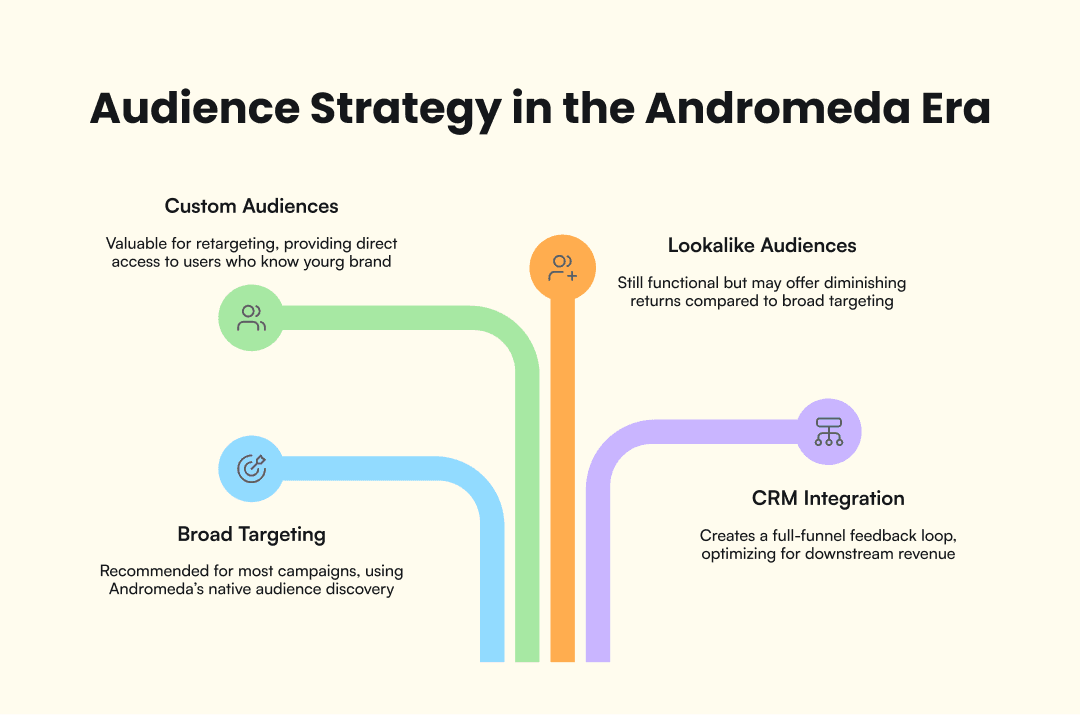
1. Broad vs. interest vs. Lookalike: what still works
Broad targeting (no interest or behavioral restrictions) outperforms detailed interest stacking in most scenarios because it gives Andromeda the largest possible retrieval pool. The algorithm’s creative-reading capability means it can identify high-intent users that manual interest categories would miss entirely.
Lookalike Audiences come in three types:
Standard Lookalikes: use behavioral similarity to your seed audience
Value-based Lookalikes: weight for revenue or LTV from your customer data
Modeled CRM Lookalikes: use your CRM data as the seed and let Meta’s models find patterns your segmentation rules wouldn’t catch
Value-based and modeled variants outperform standard Lookalikes, but all three show diminishing returns compared to broad targeting plus strong creative for mature accounts.
Interest targeting still wins in specific cases:
B2B with niche ICPs: targeting specific professional roles or job titles that creative signals alone can’t isolate
Regulated industries: where broad reach creates compliance risk and audience restrictions are mandatory
Early-stage accounts: where creative volume isn’t yet high enough for Andromeda to work with
2. First-party data and custom audiences
First-party data is the highest-quality signal you can feed to Meta’s system after iOS 14. Custom audiences built from three main sources provide direct behavioral signals rather than inferred ones:
Email lists: CRM exports and subscriber data, matched against Meta user records
Website visitors: tracked via Pixel and CAPI, segmented by behavior (viewed product, added to cart, purchased)
App activity: in-app events sent through the Meta SDK
Among these, CRM-to-CAPI integration creates the strongest feedback loop. Your CRM identifies which customers produce the highest downstream revenue, CAPI sends that signal back to Meta, and the algorithm optimizes for customers who resemble your best ones rather than your most recent ones.
The privacy-first direction of digital advertising means first-party data sources will only grow in importance as third-party cookies and tracking capabilities continue to shrink.
3. Retargeting across the funnel
Retargeting segments by intent level, from lowest to highest:
Viewed content: broadest retargeting pool, lowest purchase intent
Add to cart: product interest confirmed, higher conversion probability
Checkout abandon: strongest purchase intent, highest-value retargeting segment
Purchaser exclusions: remove existing buyers to avoid wasting spend on already-converted users
A standard budget allocation across funnel stages dedicates 60 to 70% of spend to prospecting, 20 to 30% to retargeting, and 10 to 15% to retention and upsell (Shopify).
Dynamic product ads work well for ecommerce retargeting because they show users the specific products they viewed rather than generic brand creative. For accounts running Advantage+ campaigns, retargeting audiences can be layered into the existing audience signal by specifying “existing customers” within ASC settings rather than building separate retargeting campaigns.
Budget strategy and scaling
Budget decisions sit downstream of creative and audience strategy for a reason: scaling spend before you have strong creative and clean tracking just amplifies inefficiency. Once those foundations are solid, the budget question becomes about allocation and scaling velocity.
Funnel-based budget allocation
A standard starting framework allocates 60 to 70% of budget to prospecting (cold audiences via broad or Lookalike targeting), 20 to 30% to retargeting (website visitors, cart abandoners), and 10 to 15% to retention and repeat purchase campaigns (Shopify). These ratios shift as accounts mature. New brands lean heavier on prospecting. Established DTC brands with large customer bases may shift more toward retention as their CRM audience grows.
CBO (Campaign Budget Optimization) distributes spend automatically across ad sets within a campaign, letting Meta allocate more to whichever ad set performs best. In a consolidated account structure, CBO handles most allocation decisions without manual budget splits.
Scaling without breaking the algorithm
Scaling advice from industry sources conflicts. Some recommend increases of 20 to 50% every 2 to 3 days. Others cap increases at 20% every 3 to 4 days to avoid resetting the learning phase.
The resolution: start conservative. Increase budget by 10 to 20% every 3 to 5 days and monitor whether the ad set stays out of the learning phase. If performance holds, you can accelerate. If the ad set drops back into learning, scale back and wait.
Vertical scaling (increasing budget on winning campaigns) is the default approach. Horizontal scaling (duplicating a campaign to target new audiences or regions) makes sense when vertical scaling hits diminishing returns, typically visible as rising CPA with each budget increment despite stable creative performance.
Higher-funnel events for low-volume accounts
Accounts generating fewer than 50 purchase events per week don’t give the algorithm enough data to optimize for purchases. The workaround is to optimize for events higher in the funnel: Add to Cart or Initiate Checkout events fire 3 to 5 times more frequently than purchases and can maintain the learning phase while the account builds volume.
This is an event ladder. Start at the highest-volume event where you still see quality signals (Add to Cart for most ecommerce accounts), and step up to Purchase optimization once you consistently hit 50+ purchase events per week. If volume drops, step back down rather than letting the campaign stall in learning.
Bidding strategies
Your bid strategy tells Meta how much you’re willing to pay and how to compete in the ad auction. The right choice depends on whether you’re optimizing for volume, efficiency, or margin protection.
Choosing between Lowest Cost, Cost Cap, Bid Cap, and ROAS Goal
Strategy | How it works | Best for | Benchmark CPC | Key risk |
Lowest Cost (default) | Maximizes conversions within budget, no cost guardrails | Volume campaigns where total conversions matter more than per-unit cost | $0.70 traffic, $1.92 lead gen | Cost spikes during competitive periods |
Cost Cap | Sets a target cost per result; Meta stays at or below your cap while spending full budget | Margin protection when you know your breakeven CPA | Varies by cap setting | Under-delivers if cap is too aggressive |
Bid Cap | Controls the maximum you pay in any single auction | Tightest per-auction cost control | Varies by cap setting | Severely limits delivery if set below market rates |
ROAS Goal | Targets a specific return on ad spend (formerly Minimum ROAS) | Ecommerce with clean conversion tracking and accurate revenue data | Varies by target | Requires accurate purchase value data to work |
When to override automated bidding
Automated bidding handles most situations well, but manual intervention helps when you see consistent overspending relative to your CPA target, when CPMs spike seasonally and you need to cap exposure, or when you’re running controlled tests where auction dynamics need to remain stable. The general rule: let automated bidding run for at least 7 days before overriding.
Landing pages and post-click experience
The best-optimized ad campaign still fails if the post-click experience doesn’t convert. Landing page performance is where many advertisers lose money they attribute incorrectly to ad performance problems.
Message match and mobile-first design
Every ad sets an expectation. The landing page needs to fulfill it immediately. If your ad shows a specific product at a specific price, the landing page should open with that product at that price, not a homepage or a category page. Mismatched messaging between ad and page increases bounce rates and wastes the click your campaign paid for. Over 90% of Facebook users access the platform on mobile devices.
Landing pages need to load in under 3 seconds on mobile connections, display properly without horizontal scrolling, and place the primary call-to-action above the fold.
Desktop-first design is still common among advertisers, and fixing it is one of the cheapest performance improvements available.
The connection between ad creative and page content also affects how Meta’s algorithm learns. When users bounce immediately after clicking, that negative signal feeds back into GEM’s conversion predictions and can degrade delivery over time.
Backend offer optimization
When an ad produces strong CTR but weak conversion rates, the problem usually isn’t the creative. Strong CTR means people are interested. Weak conversion means the offer, the price, or the landing page experience loses them after the click.
This diagnostic distinction matters: a creative problem shows up as low CTR, while an offer problem shows up as high CTR paired with low conversion rate. No amount of ad optimization fixes a weak offer or poor product-market fit. Before iterating on more ad creative, test the offer itself. Try different price points, bundle structures, or guarantee language. Evaluate campaigns on lifetime value rather than first-purchase ROAS, since a campaign that acquires customers at a loss on the first purchase can still be profitable if retention economics support it.
Measuring results and diagnosing problems
The value of metrics comes from reading them together and matching patterns to causes, because a single number rarely tells you what to fix.
Key metrics and 2026 benchmarks
Metric | Definition | 2025/2026 benchmark |
CTR | % of users who click after seeing your ad | 2.19% ecommerce median |
CPC | Cost per click | $0.70 traffic, $1.92 lead gen |
CPM | Cost per 1,000 impressions | $13.48 ecommerce median |
CVR | Conversion rate | 1.57% ecommerce, 7.72% lead gen (down 12% YoY) |
CPL | Cost per lead | $27.66 lead gen (up 26% YoY) |
ROAS | Revenue per dollar of ad spend | Account-specific |
These are medians across thousands of advertisers (2025 data). Evaluate your numbers against your own historical performance first, then use industry benchmarks as context.
Diagnostic decision trees
Read metric combinations to identify root causes:
• CTR dropping + CPM flat: creative fatigue. The audience is still reached but engaging less.
• ROAS dropping + CTR stable: audience saturation or conversion path issue. Clicks happen but fewer convert.
• CPM spiking + all else stable: auction competition or seasonal cost increases from outside your account.
Change one element at a time when troubleshooting. Adjusting targeting and creative simultaneously makes it impossible to isolate which change drove the result.
Optimization checklists
Daily:
• Spend pacing: review against daily budgets
• Delivery: check for issues or ad rejections
• Budget distribution: verify allocation across ad sets
• Frequency: flag any ad set above 3
Weekly:
• Creative performance: compare variants and pause underperformers
• Audience performance: review and adjust allocation
• Funnel drop-offs: check rates from impression through conversion
• Scaling decisions: evaluate whether to scale up or pull back
When to stop optimizing and what to do instead
There’s a point where further optimization within Facebook Ads produces diminishing returns. Recognizing that point saves you from burning budget on marginal gains when the constraint lies outside the ad platform.
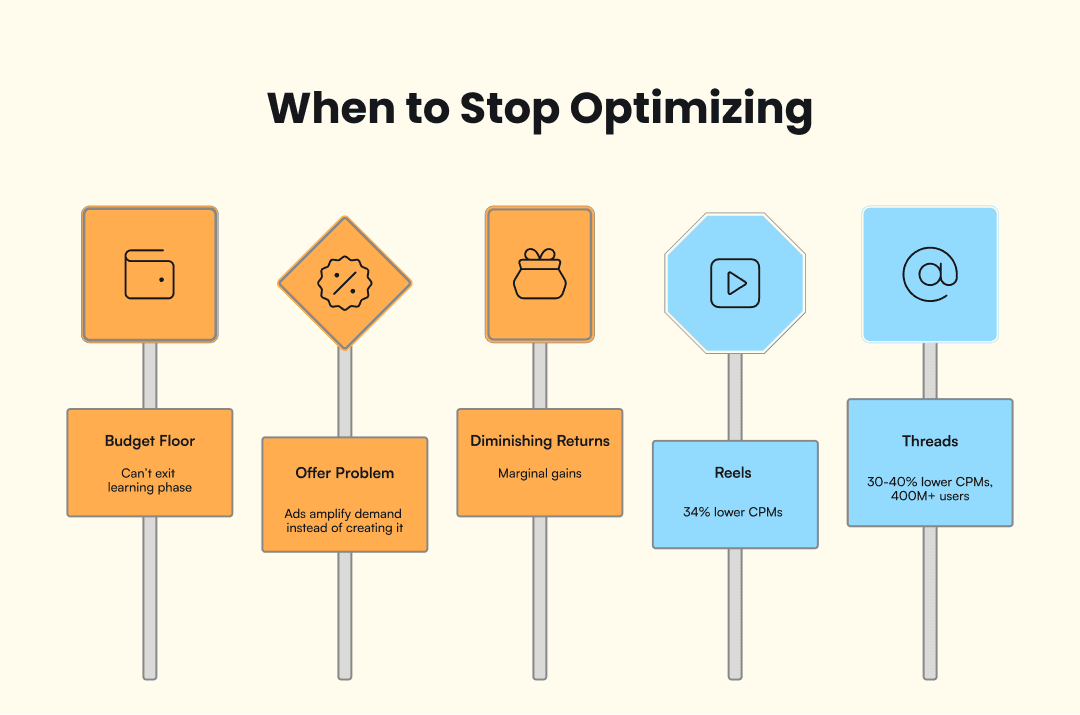
Recognizing diminishing returns
Three signals indicate you’ve hit the optimization ceiling. Your account can’t consistently generate 50 conversion events per week even after moving to higher-funnel events. Your creative produces strong CTR but conversion rates won’t budge regardless of landing page or offer changes. Or CPMs keep rising relative to your unit economics and compress margins past the point of profitability. When these patterns emerge, the constraint lives in the business model, the offer, or the market itself.
Reels and Threads as alternative placements
Within Meta’s ecosystem, Reels and Threads represent underpriced placement opportunities. Reels reached a $50 billion advertising run rate with 30% year-over-year watch time growth and CPMs running 34% lower than feed placements. Threads, which opened ads globally in January 2026, has over 400 million monthly active users and CPMs running 30 to 40% lower than Instagram feed.
Before adding more budget to feed campaigns with rising costs, test shifting some of that spend to these placements where competition is lower.
Shifting budget away from Facebook
Facebook CPMs rose approximately 20% year-over-year in 2025, making cross-channel evaluation a necessary part of budget planning. Compare your Facebook CPA and ROAS against equivalent metrics on other paid channels. If TikTok or Google Shopping delivers comparable results at lower costs, shifting some budget there is a standard portfolio management decision.
Facebook Ads optimization in 2026 follows a specific priority sequence once you understand how Andromeda and GEM work together.
Fix your signal quality first: implement CAPI and push your EMQ above 7.0.
Then build creative volume with genuinely different concepts that give Andromeda unique fingerprints to work with.
Consolidate your account structure so the algorithm has enough data to learn, and let broad targeting do what it’s designed to do.
After that, the tactical layers (bidding, budget scaling, retargeting tiers) have the foundation they need to perform.
If you take one action from this guide, implement CAPI. It’s the single highest-ROI change for most accounts, and Meta’s one-click setup has removed the technical barrier. The delivery system will keep evolving, but the underlying architecture, where creative quality drives audience discovery and signal quality drives conversion prediction, is the operating model for the foreseeable future.